|
 |
 |
 |
 |
 |
|
Although castle ar chitecture developed over the centuries in line
with weapons technology the principles remained much the same. A
good castle provided a secore base that could be easily defended.
It had defenses against frontal attack (thick, high walls and secure
entry gates) and from undermining ( rock foundations or a moat).
It also furnished means of repelling attackers while minimising
exposure of the defenders (arrow loops, crenellation, machicolations,
murder holes). It also provided means of escape and of making sorties
against attackers (postern gates and secret tunnels).
Also it needed facilities to withstand a siege - a fresh water supply or large cistern and vast supplies of food. Furthermore a good castle had no dead-spaces - ie external areas that defenders could not fire on, but did provide multiple locations from which vulnerable points could be defended. The best castles provided rings of defence so that defenders could hold out from a citadel even if the outer defences failed. Not least, a good castle was strategically placed, for example to monitor and control access to an important route through a valley.
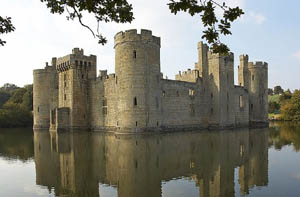
Castles also needed facilities for a garison and living quarters.
- External & Natural defenses: Cliffs and Mountain Tops, Rivers & Lakes, Moats and Ditches (douves), Ravelins
- Towers: The Keep (Donjon), Citadels, Watch Towers, Wall Towers (Towers and Curtain walls), Bartizans (Echaugettes)
- Walls: Curtain Walls, Battlements & Crenellations, Bossing, Taluses, Chemins de Rondes, Hourdes, Machicolations (Machicoulis), Brattices (Breteches), Meutrieres, Murder holes, Arrow Loops, Canoniers, Slighting a Castle
- Gateways: Gates, Elevated Doorways, Flanking Towers, The Portcullis, The Drawbridge, Barbicans, Postern Gates
- Prisons: dungeonss,cachets, oubliettes and torture chambers
- Domestic Elements: Stairways, Doors & Door Locks, Fireplaces, Windows, Roofs, Kitchens, Wells & Cisterns, Latrines & Garderobes
- Lists & Butts
- The Practicalities of Castle Building
 |
| Bodiam Castle |
 |
| |
 |
|
|
|
Natural & External Defenses:
Cliffs, Rivers, Moats, Ditches and Ravelines
Castles were often built on sites that were naturally defensible, for example on cliff tops or mountain tops. If no mountain top or cliff was available then at least a hill could be constructed. Many Mottes in Motte & Bailey castleswere man made. Hard living stone such as granite could render attempts at unermining nugatory.
In flat areas, rivers oftem provided a good defense for at least part of the castle perimeter. If no river existed then sometimes one could be diverted, or a an artificial lake could be constructed. On a smaller scale a moat could be built, again frustrating attempts at undermining. some of the most spectacular castles where built on islands or spits of land extending into seas or rivers.
Where it was impractical to supply water a dry ditch was better than nothing, making it difficult for attackers to get their siege engines up against the walls. In later times, after the introduction of gunpoweder, military engineers srted landscaping the whole surrounding area and building outposts called ravelins.
|
| Castle at Sidon |
 |
| |
| |
| |
|
|
Cliffs and Mountain Tops
 The classic story book castle always has a moat, but moats are only practicable on relatively flat land with a good water supply.
In the Languedoc most castles - and especially the so-called Cathar Castles are built on hill tops, and are protected by sheer cliff faces.
These sheer cligff faces serve the same purpose as moats - namely to keep attackers at a distance and frustrate attempts at undermining. The castle shown on the left is Montségur III, built on the site of Montségur II, the castle built as the Cathars' final defensive position in 1244.
|
| Puilaurens - another Cathar Castle |
 |
| |
|
|
Rivers & Lakes
Rivers provide a natural moat, for one, two or three sides of a
castle. By siting a castle in the meander of a river a castle builder
could get three quarters of a full moat for free, plus a guaranteed
water supply.
Similarly, lakes provide a great natural defence against enemy approach in general and undermining in particular.
The picture below is the Lake Palace at Udaipur, now an Hotel. 
|
| Rio Tejo, Portugal |
 |
| |
|
|
Moats and Ditches (douves)
A moat is a deep, broad ditch, generally filled with water, that
surrounds a castle, or town. To provide a preliminary line of defense.
sharpened stakes were sometimes sunk into the moat to make approach
even more difficult.
In some places moats evolved into more extensive water defenses, including natural or artificial lakes, dams and sluices. In later castles the moat or water defences may be largely ornamental. Moats could also double as fish ponds, if kept sufficiently clean.
In Medieval times moats were excavated around castles and fortifications as part of the defensive system of obstacles immediately outside the walls. A moat made access to the walls difficult for siege weapons, such as siege towers and battering rams, which needed to be brought up against a wall to be effective. A water-filled moat made very difficult the practice of undermining, digging tunnels under the fortifications in order to effect a collapse of the defences.
The word was adapted in Middle English from the French motte "mound, hillock" and was first applied to the central mound on which a fortification was erected (see Motte and Bailey), and then came to be applied to the excavated ring, a "dry moat".
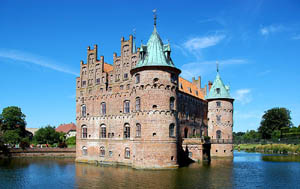
 Other forms of water defences developed by filling the moat with water and broadening it, to the extent that it resembles a lake, giving birth to the terms Water Palace and Water Castle.
See the aerial view f Kenilworth Castle on the left.
In some cases a water-filled moat was formed by taking advantage of a natural island or peninsula site, or by creating one or more artificial lakes behind a dam. Berkhamsted Castle illustrates a fairly early stage in this development, while Caerphilly Castle shows an advanced one. Kenilworth Castle had extensive water defences controlled by fortified dams and sluices.
A crannog is essentially a natural or artificial lake with the castle built on an island or peninsula, rising more or less sheer from the water. Among the more impressive examples is Castle Cornet, in Guernsey, where the function of the moat is performed by the sea.
Castles with moats or surrounded by artificial lakes are common in France, England, Scotland, Ireland and Wales, found in the Low Countries, and in Germany, Austria, and Denmark. They are also found further into the interior of the Continent. On occasion the moat was mixed with stool, urine and or old rotting food as well as the rotting corpses of dead animals to deter the enemy from even thinking of crossing.
In the post-medieval period, fortresses designed to resist firearm artillery often had a dry moat or ditch, and occasionally incorporated water in their defences as protection against storming: for example the bastion fortress at Olomouc. The polygonal forts developed during the 19th Century, relied heavily on dry moats for close protection.
Over the course of time, many fortified castles were converted into
palaces, or other grand residences, no longer primarily fortifications
but intended to receive guests, or as living quarters. Surrounding
moats or lakes became ornamental. As late as the seventeenth century,
French châteaux that were not remotely fortified nor built
on traditionally fortified and moated sites, pleasure houses such
as Vaux-le-Vicomte, were surrounded by traditional formal moats
that isolated the main corps de logis and were bridged by an axial
approach.
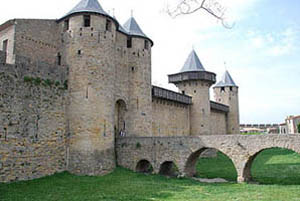
Moats are not common in the Languedoc, and even where they did exist
they were not always filled with water. Good examples of dry moats
can be seen outside the cite of Carcassonne, and also inside the
city just outside the Chateau Comptal.
dry moat outside the Chateau Comptal at Carcassonne |
dry moat outside the Narbonne gate at Carcassonne |
 |
 |
| Carcassonne |
 |
| |
| |
 |
| |
| |
|
| Muiderslot |castle in the Netherlands |
 |
| |
Caerlaverock Castle, a 13th century castle
on the border of England & Scotland |
 |
| |
| The moated manor house of Baddesley Clinton in Warwickshire,
England |
 |
| |
Matsumoto Castle
a Japanese Castle in Nagano Prefecture |
 |
| |
| carphilly |
 |
| |
 |
| |
| |
 |
| |
| |
|
|
|
|
Ravelins
A ravelin is a triangular fortification or detached outwork in front of the bastions of a fortress. Originally it was called a demi-lune.
 The ravelin is placed outside a castle opposite a fortification curtain. The edges of the ravelin are sited so that the guns there can sweep fire upon the troops that have to run along the fortification curtain. Ravelins are part of the extensive architecture of star forts developed after the introduction of gunpowder.
The wall facing the castle or fort is low and the angles of the others such that the ravelin provides no shelter to attacking forces if taken or abandoned by defenders.
Ravelines were introduced after the introduction of gunpowder and are typical of the seventeenth and eighteenth centuries. |
|
|
|
Towers:
Towers come in numerous varieties and serve several purposes. Here we will look at the following:
The Keep or Donjon
An old and simple system is the Motte and Bailey, familiar to many from school history lessons. A defensive tower built on top of a mound is surrounded by a fence and an outer ditch. The tower may be made of wood or stone and the mound may be natural or man-made. The motte is the mound, and the Bailey is the fence. A baileywick - "fenced-town" - was originally the area circumscribed by the bailey and controled by a Bailiff.
 This Motte and Bailey model is recognisable at the forerunner of any catle or fortified town. The keep remains as a citadel and the baily becomes a surrounding wall or encient. The French name for a Kepp is donjon.
Incidentally, when castles fell out of use in Tudor times, they were often used as gaols (US jails). The donjon in particular became associated with prisons, and the name became attached to places of imprisonment. This, combined with memories of seigneural and ecclesiastical torture chanbers, seems to be resonsible for the word donjon developing into the English word dungeon - no longer a tower, but a place of underground imprisonment.
|
|
The Donjon at Arques in the Aude, France
|
 |
| |
| |
The Keep (donjon) at Puivert
|
 |
| |
|
Defensive structures tend to follow the same
design principles around the world - this castle is in Saudi
Arabia
|
 |
| |
|
|
Citadels
The citadel was the final line of defence. It could stand alone - as at Beaucaire - even after the castle and its town had fallen.
The illustration on the right is Krak les Chevaliers - a castle build on the lands of the Counts of Tripoli - the family of St-Gilles, also Counts of Toulouse.
Krak most clearly shows the design of concentric rings of defense, the defenders falling back if necessary to the citadel shown on the top left of the illustration.
Krak can still be seen today. It was never taken by force, but its great weakness was its lack of water. |

|
|
Watch Towers (Guettes)
A watchtower is a type of fortification used in many parts of the world. Its main purpose is to provide a high, safe place from which a sentinel or guard may observe the surrounding area. It differs from a turret in that it is usually a freestanding structure.
The Romans built numerous towers as part of a system of communications, one example being the towers along Hadrian's Wall in Britain. Each tower was in sight of the next in the line, and a simple system of semaphore signalling was used between them.
 The Romans also built many lighthouses,
such as the Tower of Hercules in northern Spain, which survives
as a working building, and the equally famous lighthouse at Dover
Castle, which survives to about half its original height as a ruin.
In medieval Europe, many castles and manor houses, or similar fortified buildings, were equipped with watchtowers. In some of the manor houses of western France, the watchtower equipped with arrow or gun loopholes was one of the principal means of defense.
Scotland saw the construction of Peel towers that combined the function of watchtower with that of a keep or tower house that served as the residence for a local notable family.
Mediterranean countries, and Italy in particular, saw the construction of numerous coastal watchtowers since the early Middle Ages, connected to the threat of Saracen attacks from the various Muslim states existing at the time (such as the Balearic Islands, Ifriqiya or Sicily). From the 16th century many were restored against the Barbary pirates.
Notable examples of military Mediterranean watchtowers include the towers that the Knights of Malta had constructed on the coasts of Malta. These towers ranged in size from small watchtowers to large structures armed with numerous cannon. They include the Wignacourt, and de Redin.
 The Martello Towers that the British built in the UK and elsewhere in the British Empire were defensive fortifications that were armed with cannon and that were often within line of sight of each other. One of the last Martello Towers to be built was Fort Denison in Sydney harbour. The most recent descendants of the Martello Towers are the flak towers that the various combatants erected in World War II as mounts for anti-aircraft artillery.
In modern warfare the relevance of watchtowers has decreased due to the availability of alternative forms of military intelligence, such as reconnaissance by spy satellites and unmanned aerial vehicles.
|
|
Reconstructed Roman Watchtower in Germany
|
 |
| |
|
watchtower on Malta
|
 |
| |
|
A modern Watchtower
(in the camp of the French artillery detachment of the IFOR,
Sarajevo, 1995)
|
 |
| |
| |
| |
| |
|
|
|
|
Wall Towers and Curtain Walls
The Romans discovered that walled fortresses were more easily defended if towers were built into the defensive walls. These towers made it easy to give covering fire for the walls.
Although the upper parts are later, the the Roman pattern is preserved in the inner wall or enceint at Carcassonne.
|
|
Carcassonne
- an external view of a Roman tower
|
 |
| |
|
Walls were sometimes built in patterned stone
(see above). More often the walls were crepied - covered in
a coating such as lime to protect them. This is a castle wall
in Saudi Arabia
|
 |
| |
| |
| |
|
|
Bartizans (Echaugettes)
Not all towers reach down to the ground. some are built into walls, emerging from the curtain wall or from a corner.
A bartizan (or Echaugette) is an overhanging, wall-mounted turret projecting from the walls of medieval fortifications from the early 14th century up to the 16th century. They protect a warder and enable him to see around him.
Bartizansgenerally are furnished withoyletsorarrow slits.
Here are a couple of examples.
|
|
Echaugette on the corner of a building |
|
|
|
|
A typical bartizan
|
 |
| |
|
Balmoral Castle, Scotland with classic scots
baronial tower furnished with bartizans
|
 |
|
|
|
Walls
Other than simple towers, all castles have surrounding defensive walls.
as the Romans knew, simple walls can be difficult to defend because the defenders need to be able to fire upon all areas outside but near the walls. The Roman solution was to construct towers at intervals along the walls. These towers provided covering fire for the walls. This same solution was used in Medieval times.
Medieval builders used a number of techniques to strengthen walls, for example building them thicker at the base to prevent undermining (taluses), and cutting the stones in such a way as to be able to withstand high impact projectiles (bossing).
Castle walls were also used to help defences in other ways - for example walkways on top of the walls (chemins de rondes) allowed defenders to move quickly around the castle defences. Battlements (crenellations) protected them for enemy fire. Simple battlements could support further defences such as hourdes in times of trouble, later to be replaced by permanent stone machicolations.
Walls were often provided with arrow loops and later by gun ports
(cannoniers) to enable defenders to fire on the enemy in relative
safety.
|
|
The Inner curtain walls at Carcassonne
|
 |
| |
|
The curtain walls at the Chateau Comtal inside
Carcassonne
|
 |
|
|
Curtain Walls (Courtines)
A curtain wall or courtine is a type of defensive wall forming part of the defences of medieval castles and towns.
The curtain wall surrounded and protected the interior courtyard, or bailey, of a castle. These walls were often connected by a series of towers or mural towers to add strength and provide for better defense of the ground outside the castle, and were connected like a curtain draped between these posts.
Additional provisions and buildings were often enclosed by such a construction, designed to help a garrison last longer during a siege by enemy forces.
With the introduction of star forts (trace italienne fortification) the height of the curtain walls was reduced and additional outworks such as ravelins and tenailles were added beyond the ditch to protect the curtain walls from direct cannonading. |
|
|
Battlements & Crenellations
 Castle walls were often crenelated, that is to say provided with projections called merlons. These merlons provided protection for defenders while allowing them to shoot from the gaps between. Some merlons were provided with their own arrow slits, providing the defenders with even more protection (as shown near right)
A battlement (also called a crenellation) in defensive architecture such as that of city walls or castles, comprises wall) in which portions have been cut out at intervals to allow the discharge of arrows or other missiles. These cut-out portions form crenels (also known as carnels, embrasures, loops or wheelers).
The solid widths between the crenels are called merlons (or cops or kneelers). A wall with battlements is said to be crenelated or embattled. Battlements may have protected walkways (chemin de ronde) behind them.
The term originated around the 14th century from the Old French word batailler, "to fortify with batailles" (fixed or movable turrets of defence).
Battlements have been used for thousands of years; the earliest known example is in the palace at Medinet-Abu at Thebes in Egypt, which allegedly derives from Syrian fortresses. Battlements were used in the walls surrounding Assyrian towns, as shown on bass reliefs from Nimrud and elsewhere. Traces of them remain at Mycenae in Greece, and some ancient Greek vases suggest the existence of battlement. Battlements can be seen in the Great Wall of China.
Romans used low wooden pinnacles for their first aggeres (terreplains). In the battlements of Pompeii, additional protection derived from small internal buttresses or spur walls against which the defender might place himself so as to gain complete protection on one side. In the battlements of the Middle Ages the crenel comprised one-third of the width of the merlon: the latter, in addition, could be provided with arrow-loops of various shapes, depending from the weapon to fire. Late merlons permitted fire from the first firearms.
From the 13th century the merlons could be connected with wooden shutters that provided added protection when closed. The shutters were designed to be opened temporarily to allow fire against attackers, and closed during reloading.
The term embrasure, in military architecture, refers to the opening in a crenellation or battlement between the two raised solid portions or merlons, sometimes called a crenel or crenelle. The purpose of embrasures is to allow weapons to be fired out from the fortification while the firer remains under cover. The splay of the wall on the inside provides room for the soldier and his equipment, and allows them to get as close to the wall face and arrow slit itself as possible (see right). Excellent examples of deep embrasures with arrow slits are to be seen at Aigues-Mortes and Château de Coucy, both in France.
By the 19th century, a distinction was made between embrasures being used for cannon, and loopholes being used for musketry. In both cases, the opening was normally made wider on the inside of the wall than the outside. The outside was made as narrow as possible (slightly wider than the muzzle of the weapon intended to use it) so as to afford the most difficult possible shot to attackers returning fire, but the inside had to be wider in order to enable the weapon to be swiveled around so as to aim over a reasonably large arc.
A distinction was made between vertical and horizontal embrasures or loopholes, depending on the orientation of the slit formed in the outside wall. Vertical loopholes—which are much more common—allow the weapon to be easily raised and lowered in elevation so as to cover a variety of ranges easily. To sweep from side to side the weapon (and its firer or crew) must bodily move from side to side pivoting around the muzzle, which is effectively fixed by the slit.
Horizontal loopholes, on the other hand, facilitate quick sweeping across the arc in front, but make large adjustments in elevation very difficult. They were usually used in circumstances where the range was very restricted anyway, or where rapid cover of a wide field of arc was preferred.
 Another variation had both horizontal and vertical slits arranged in the form of a cross, and was called a crosslet loop or an arbalestina since it was principally intended for arbalestiers (crossbowmen). In the sixteenth and seventeenth centuries, after the crossbow had become obsolete as a military weapon, crosslet loopholes were still sometimes created as a decorative architectural feature with a Christian symbolism.
|
| |
|
| |
| |
 |
| |
| Embassure at Caen |
 |
| |
|
|
Bossing
Bossed stones are cut building stones which are left rough on the external side.
Historians used to debate why builders did this. One theory was that it saved money since there was less finishing for the stone mason. Another was that it gave an impression of strength.
Now we know. According to several texts on catapults, bossing was a means of strengthening a wall against heavy shot. The projection dispersed the energy of the stone shot and prevented a direct energy transfer to the wall. Its use pre-dates Rome.
After the development of firearms, builders switched to other materials, such as brick, which absorb even greater impacts.
The technique is similar to the modern use of spaced armour on tanks |
| Bossing around an arrow slit at Carcassonne |
 |
|
|
Taluses
|
A talus is a sloping face at the base of a fortified wall.
Defensive walls were often built thicker at the bottom. This made it more difficult for attackers in three ways.
First, attackers would have a more diffult job in breaking through or undermining the wall because of its great mass.
Second, conventional siege equipment is less effective against a wall with a talus. Scaling ladders may be unable to reach the top of the walls and are also more easily broken due to the stresses caused by the angle they are forced to adopt. attackers would have greater difficulty in moving siege engines up against a talused wall - to reach the top of the wall they required not only height but a substantial overhang. Siege towers cannot approach closer than the base of the talus, and their gangplank may be unable to cover the horizontal span of the talus, rendering them useless.
|
|
Third, defenders are able to drop rocks over the walls, which will shatter on the talus, spraying a hail of shrapnel into any attackers massed at the base of the wall.
The talus is feature of some late medieval castles, especially prevalent
in crusader constructions. There is a spectacular talus at Krak
- shown here on the right.
|
| Talus at Carcassonn |
 |
| |
| A massive talus at Krak des Chevaliers |
 |
| |
| |
|
|
|
|
Chemins de Rondes
   A chemin de ronde (French, "round path" or "patrol path") is a raised protected walkway behind a castle battlement.
In early fortifications, high castle walls were difficult to defend from the ground. The chemin de ronde was devised as a walkway allowing defenders to patrol the tops of ramparts, protected from the outside by the battlements or a parapet, placing them in an advantageous position for shooting or dropping projectiles.
|
|
|
|
|
Hourdes
Hourds are defensive wooden structures built onto the top of a defensive wall. They would then be covered in the wetted skins of freshly slaughtered animals to minimise the risk of attackers being able to set fire to them.
Hourdes could be assembled when trouble threatened - in times of peace they were not needed.
Walls built to bear hourdes have a characteristic row of double holes ready to take the supporting wooden beams.
|
|
|
Hourds have been reconstructed on the Chateau Comptal at Carcassonne as shown on the right
The purpose of a hoarding was to allow the defenders to improve their field of fire along the length of a wall and, directly downwards to the wall base. They were wooden structures build on the top of walls. Like all defensive wooden structures they were covered in fresh animal skins to keep them fireproof.
In peacetime, hoardings could be stored as prefabricated elements. In some castles, construction of hoardings was facilitated by putlog holes that were left in the masonry of castle walls.
Some medieval hoardings have been reconstructed - including the Chateau Comptal at Carcassonne.
Hourds were later replaced machicolations, which were an improvement on hoardings, not least because masonry does not need to be fire-proofed. Machicolations are also permanent and siege-ready.
|
|
Internal View of Hourdes at Carcassonne |
|
|
We have a faint reminder of hourds in our modern hourdings - now used for advertising.
Internal View of Hourdes at Carcassonne |
|
|
|
post hole for hourdes at Carcassonne |
|
|
|
| Hourds at Carcassonne |
 |
| |
| Internal View of Hourdes at Carcassonne |
 |
| |
| Hourdes at Carcassonne seen from below |
 |
| |
| hourdes at Carcassonne |
 |
| |
| hourds |
 |
| |
| Hourdes at Carcassonne - viewed from inside |
 |
| |
 |
|
|
Machicolations (Machicoulis)
 A machicolation is a floor opening between the supporting corbels of a battlement, through which stones could be dropped on attackers at the base of a defensive wall. A machicolated battlement projects outwards from the supporting wall in order to facilitate this.
The design was developed in the Middle Ages when the European crusaders returned from the Holy Land.
The word derives from the Old French word *machecol, mentioned in Medieval Latin as machecollum and ultimately from Old French macher 'crush', 'wound' and col 'neck'. The word Machicolate is recorded in the 18th c. in English, but a verb machicollāre is attested in Anglo-Latin. A variant of a machicolation, set in the ceiling of a passage, was known as a murder-hole.
Machicolations were more common in French castles than their English couterparts, and when used in English castles they were usually restricted to the gateway as at 13th-century Conwy Castle.
Machicolations were later used for decorative effect with spaces between the corbels but often without the openings, and subsequently became a characteristic of the many non-military buildings, for example, Scottish baronial style, and Gothic Revival architecture of the 19th and 20th centuries.
Maciolations are in effect stone versions of hourdes. They represent an additional level of sophistication and expense. Like hourdes they enabled defenders to shoot at and drop things on their attackers, while minimising the risk of danger themselves. The great advantages were
- Machicolations were permanent features. They did not need to be constructed in anticipation of attack. They were always ready.
- Unlike hourdes, they could not be set on fire
- They were stronger than hourdes and would withstand crossbow quarrels and even stones hurled by stone throwing siege engines.
- They looked imposing - a psychological benefit against attackers who had no such defenses
Where the expense was too great for full scale machilations around a wall, a cheaper alternative was to build them just over weak spots like doors and gateways. This is the origin of the brattice - see below.
|
| Macicoulis |
 |
| |
| |
 |
| |
| |
|
|
The Brattice (Bretèche)
   a
brettice is a structure projecting from a wall which enables a defender
to fire on attackers while remaining in relative safety. It has
holes in the floor and usually arrow loops or gun ports in the sides.
It is a sort of miniature macicalation, invariably placed to defend
a specific weak point such as a doorway.
In apearance brattices can look very like latrines - but latrines are never placed over doorways!
|
A Brattice at Carcassonne (missing its front
and side walls)
|
 |
| |
|
A Brattice at Carcassonne.
|
 |
| |
|
A Brattice at Carcassonne - this one is later
than the one above.
It has a gun port at the front rather than an arrow slit.
|
 |
|
|
A Brattice at Carcassonne.
Note the adjacent arrow loops
|
 |
| |
|
A Brattice at Carcassonne.
Note the adjacent arrow loops
|
 |
|
|
Meutrieres
Meurtrieres are holes designed for defenders to kill attckers.
Projectiles can be thrown or shot at the attackers while the defenders
remain relatively safe.
They can conveniently be divided into two classes: holes in floors "Murder Holes" (for dropping dangerous substances or shooting at attackers) and holes in walls, such as arrow loopholes, used for shooting projectiles. For arrows they are called arrow slits or arrow loops (archeres) and for guns they are called cannoniers (canoniers)
|
| The woman who threw the stone that killed Simon de Montfort at Toulouse |
 |
|
|
Murder Holes
Attackers would naturally go for a castle's weak points, and the
these weak points generally included entrances. For this reason
entrance gates were heavily reinforced, often provided with extensive
defensive works called barbicans.
Typically the attackers would need to pass a number of obstacles, and the defenders would try to pick the attackers off as they were occupied overcoming these obstacles.
Typically these obstacles would include steep inclines, ditches or moats furnished with draw bridges, and port cullises often a series of purtcullises.
As attackers were finding a way through a door or portcullis they would be shot at by the defenders. A simple hole in the floor of the structure over a gateway provided a convenient way not only to shoot attackers, but also to drop things on them. |
|
Looking Up at a Murder Hole
in the Narbonne Gate at Carcassonne |
|
|
Attackers selected the least pleasant possible items to throw on
their enemies. In the popular imagination this was invariably boiling
oil, but there does not appear to be a single documented insatnance
of oil being used. We do however know of boiling water, molten lead,
and even heated sand (all of which could penetrate armour more easily
than other weapons). Other favoured materials included large stones.
| Murder hole in the Cite entrance
of the Chateau Comptal at Carcassonne |
 |
| |
|
A Round Murder Hole seen from above
|
 |
| |
|
|
Attackers approaching an external gateway
would be faced by a series of obstacles.
A strong wooden gate would be set behind a port cullis.
In this photograph a portculis would drop between the second
and thiird arch.
|
 |
| |
|
This is the view looking up. The slot at
the botto is for a port cullis.
The slot at the top is a type of murder hole.
|
 |
| |
Inside the room beyond the murder hole, port cullis and door
is another murder hole set into the centre of the vaulted cieling. |
 |
| |
|
|
Arrow slits or loop-holes (archeres)
|
 An
arrowslit is a thin vertical aperture in a fortification through
which an archer can launch arrows.
It is alternatively referred to as an arrow loop, loop hole, or archere, and sometimes a balistraria.
The interior walls behind an arrow loop are often cut away at an oblique angle so that the archer has a wide field of view and field of fire. Arrow slits come in a remarkable variety. A common form is the cross. The thin vertical aperture permits the archer large degrees of freedom to vary the elevation and direction of his bowshot but makes it difficult for attackers to harm the archer since there is only a small target to aim at.
Arrow slits can often be found in the curtain walls of medieval battlements beneath the crenellations.
 The invention of the arrowslit is attributed to Archimedes during the siege of Syracuse in 214–212 BC. Slits "of the height of a man and about a palm's width on the outside" allowed defenders to fire bows and scorpions (an ancient siege engine) from within the city walls.
Although used in late Greek and Roman defences, arrowslits were not present in early Norman castles. They are only reintroduced to military architecture towards the end of the 12th century, with the castles of Dover and Framlingham in England, and Richard the Lionheart's Château Gaillard in France.
In these early examples, arrowslits were positioned to protect sections of the castle wall, rather than all sides of the castle.
In the 13th century, it became common for arrowslits to be placed all around a castle's defences. |
|
Arrow loophols at Carcassonne - outside |
|
|
In its simplest form, an arrowslit was a thin vertical opening, however the different weapons used by defenders sometimes dictated the form of arrowslits. Openings for longbowmen were usually tall and high to allow the user to fire standing up and make use of the 6 ft (1.8 m) bow. Those for crossbowmen were usually lower down as it was easier for the user to fire whilst kneeling to support the weight of the weapon.  It was common for arrowslits to widen to a triangle at the bottom – called a fishtail – to allow defenders a clearer view of the base of the wall.] Immediately behind the slit there was a recess called an embrasure; this allowed a defender to get close to the slit without being too cramped. The width of the slit dictate the field of fire, but the field of vision could be enhanced by the addition of horizontal openings; they allowed defenders to view the target before it entered range. Usually, the horizontal slits were level, which created a cross shape, but less common was to have the slits off-set (called displaced traverse slots) as in the remains of White Castle in Wales. This has been characterised as an advance in design as it provided attackers with a smaller target, however it has also been suggested that it was to allow the defenders of White Castle to keep attackers in their sights for longer because of the steep moat surrounding the castle.
Arrow loophols at Carcassonne - inside |
|
|
|
When an embrasure linked to more than one arrowslit – in the case of Dover Castle defenders from three embrasures can shoot through the same arrowslit – it is called a "multiple arrowslit".
Some arrowslits, such as those at Corfe Castle, had lockers nearby to store spare arrows and bolts; these were usually located on the right hand side of the slit for ease of access and to allow a rapid rate of fire.
Arrow loops needed to provide cover as a close as possible to the walls. This is one reason why towers were used along the defensive walls - they provided a way to defend the neighbouring walls.
|
 Arrow slits were angled in such a way that they could provide cover as close as possible to the foot of the wall. Archers could achieve angles as small as 5° from the vertical.
|
 Arrow slits were not always regarded with romanic affection. In the nineteenth century many castles were used at workshops, stores and peasant accommodation. To keep out the weather holes like arrow slits would often be blocked up.
On the right is an example from Carcassonne, where the slit has
been filled with Toulouse brick, preserving the outline of the original
hole.
|
Arrow loophols at Carcassonne
External view
|
Arrow loophols at Carcassonne
External view
|
 |
 |
| |
|
|
|
|
|
|
Cannoniers
  Arrow loops needed altering in later times to allow their use by firearms.
Late Medieval and Early Renaissance castles have cannoniers (for guns) rather than archeres (for arrows).
The hole is just large enough to pass through an arquebus and the vertical slot for sighting it.
|
|
|
Slighting Castles
Often, once a castle was taken, it would be occupied by its new
masters and it would continue its function of holding down a strategically
important area.
 Occasionally this was not done. Perhaps the castle could not be held because forces were needed elsewhere (as happened during the Cathar Wars), or because it was untenable with a large hostile population (again as happened during the Cathar Wars). Perhaps the castle was taken only for puniutive reasons (as also happened during the Cathar Wars, Spanish incursions, and during the Hundred Year's Wars). Or perhaps the strategic importance diminished, as for Carcassonne and her five sons after the border between France and Spain was moved back under the Treaty of the Pyrenees in 1649.
During the English Civil War, Helmsley Castle was besieged by Sir Thomas Fairfax.. Sir Jordan Crosland held it for the King for three months before surrendering. Parliament ordered that the castle should be slighted to prevent its further use and so much of the castle's walls, gates and the eastern half of the east tower were destroyed (see right). However the mansion was spared.
In each case there was good reason for destroying the castle before leaving it and allowing it to be re-occupied. But destroying a castle is not easy. Generally it was good enough to do just enough damage to make it not worth while for anyone to repair it. To damage a castle in this way is to "slight" it. By analogy we talk about slighting people too - not desroying them but damaging them.
The castle at Beaucaire was slighted by Richelieu in 1632, and so were the "Five Sons of Carcassonne", five Royal castles (Termes, Aguilar, Peyrepertuse, Queribus and Puilaurens) strategically placed to defend the old border against Aragon. In 1652 Richelieu ordered the castle at Termes to be abandoned and slighted. The walls were destroyed by a master mason from Limoux, using explosives, between 1653-1654.
Traditionally, a strategy of slighting fortifications was often adopted in warfare by the side which had the support of the ordinary population, against an opponent which may have been militarily strong but did not have popular support, often an alien invader. Examples of forces who adopted this strategy include the Bruce brothers in the Scottish Wars of Independence, the Mamelukes in their wars against the Crusaders, and the Parliamentary side in the English Civil War.
|
| The Slighted Keep of Helmsley Castle |
 |
| |
| |
| |
|
|
|
Gates & Barbicans
Gateways, like all openings, were recognised weak points in any defensive fortress. For this reason defenders tended to take two simple precautions. The first was to minimise the number of openings, including gateways. The second was to provide additional defense for gateways.
The first was acheived by severely restricting the number of gateways. Except for postern gates, a typical castle would have only a single entrance gate. Some had not at all - everthing that came in did so by being hoisted up over the walls, and everything that left did so be being thrown over the walls or hoisted down.
Towns would also have few gateways, often one, rarely more than four, even for the largest cities.
The second method - protecting gateways - offered more opportunities for imaginative solutions:
|
| |
| The Barbican of Warwick Castle, in England |
 |
|
|
Gates
 Gates
were made of wood, which made them vulnerable. To maximise the strength
they were made as thick at practicable, often with layers of wood
alternating beween vertical and horizontal.
Some doors were reinforced by metal plates as shown on the right.
In India external doors are often fitted with long spikes to deter
barging by elephants. The picture on the left is of the Lohapol
gate, Jodhpur, India
In Europe the architectural style of doorways provides important
clues for dating a building.
|
| |
|
The simplest sort of door lintel. This one
is in Saudi Arabia
|
 |
| |
| |
| |
| |
|
|
Elevated doorways
Everyone knows about moats and drawbridges - but not so many people
know that most external doors in castles were well above ground
level.
|
|
This obviously made them more difficult to attack, but how could they be used in peacetime? The answer is that there were wooden structures providing access for pedestrians, and sometimes for horses too.
You can see an outstanding example at the White tower in the
Tower of London (right), and a slighly less impressive example
at Montségur
(left)
|
|
Raised doorway inside Carcasonne
|
 |
|
|
The White tower - The Keep (donjon) of the
Tower of London
|
 |
|
|
Flanking Towers
Flanking towers provided the means to house a number of defensive
features including meutriers, draw bridges, port cullises, etc
Below is a diagram showing a model of Carcassone. The main ("Narbonne"
gate is flanked by twin towers which gurd the gateway and also the
barbican and drawbridge just outside the gates.
|
|
|
The Portcullis
There would often be two or more portcullises to the main entrance. The one closest to the inside could be closed first and then the one farthest away. In this way the enemy enemy could be trapped in a killing area.
There were often arrowslits in the sides of the walls, and murder holes above, enabling archers and crossbowmen to eliminate the trappedattackers.
The portcullis is a well known feature of castle and city gates. The example on the left is from Puivert. That on the right from Aigues Mortes.
The name means "running (ie sliding") gate. Some were made in iron, some in wood. In the royal badge now appropriated by the House of commons shown above right, you can see the hoisting chains, usually concealed from sight, here hanging loose.
The hoisting equipment, a geared windlas, is located in the room above the gateway, which was often the guardroom. It made sense to have your gards as near as possible to the fortification's classic weakspot. |
|
A portcullis at Carcassonne |
|
|
|
| The Keep (donjon) at Arques Mortes |
|
| |
| A portcullisgrooves at Carcassonne |
 |
| |
| A portcullis at Carcassonne |
 |
|
|
The Drawbridge
Medieval castles were usually defended by a ditch or moat, crossed
by wooden bridge. In early castles the bridge might be designed
to be destroyed or removed in the event of an attack, but drawbridges
became common. A typical arrangement was to have the drawbridge
immediately outside a gatehouse, consisting of a wooden deck with
one edge hinged or pivoting at the gatehouse threshold, so that
in the raised position the bridge would be flush against the gate,
forming an additional barrier to entry. It would be backed by one
or more portcullises and gates. Access to the bridge could be resisted
with missiles from machicolations above or arrow slits in flanking
towers.
 The bridge (or sometimes just the end part of the bridge - as at Doornenburg shown on the right) would be raised or lowered using ropes or chains attached to a windlass in a chamber in the gatehouse above the gate-passage. Only a very light bridge could be raised in this way without any form of counterweight, so some form of bascule arrangement is normally found. The bridge may extend into the gate-passage beyond the pivot point, either over a pit into which the internal portion can swing (providing a further obstacle to attack), or in the form of counterweighted beams that drop into slots in the floor.
The raising chains could themselves be attached to counterweights; in some cases a portcullis provides the weight, as at Alnwick.
By the 14th Century a bascule arrangement was provided by lifting arms (called "gaffs") above and parallel to the bridge deck whose ends were linked by chains to the lifting end of the bridge; in the raised position the gaffs would fit into slots in the gatehouse wall ("rainures") which can often still be seen, as at Herstmonceux Castle.
Inside the castle the gaffs were extended to bear counterweights, or might form the side-timbers of a stout gate which would be against the roof of the gate-passage when the drawbridge was down, but would close against the gate-arch as the bridge was raised.
|
| Drawbridge at Doornenburg Castle |
 |
| |
| Drawbridge at the fort of Ponta da Bandeira; Lagos, Portugal showing the gaffs |
 |
| |
| |
| |
|
|
Barbicans
Barbicans are defensive structures controlling access to a gateway.
They are fortified outposts or gateways, typically forming the outer
defence to a fortified city or castle, (The Barbican in London marks
the site of a barbican defending an important entrance to the City
of London)
Barbicans sometimes take the form of a tower situated over a gate
or bridge which was used for defensive purposes.
Usually barbicans were situated outside the main line of defences and connected to the city walls with a walled road called the neck. With improvements in artillery in the 15th century, barbicans lost their importance. Few barbicans were built in or after the 16th century.
The old Cite of Carcassonne possesses no fewer than four barbicans. They are all different and give a good idea of the range of structures described as barbicans.
|
|
v
|
Barbican at the Narbonne Gate, Carcassonne
The main entrance to Carcassonne was the Narbonne Gate, a substantial
gate in the inner curtain wall. It was defended by a barbican, shown
on the right, in the outer curtain wall.
A Postern Gate at Carcassonne |
|

|
| This is the inside of the semicircular defence, part of the Barbican at the Narbonne Gate at Carcassonne. This structure allows defenders to provide massive covering fire to the adjacent fortified drawbridge. |
 |
| |
| Barbican at the Narbonne Gate, Carcassonne |
 |
| |
| |
 |
| |
 |
|
|
Barbican at the Chateau Comptal at Carcassonne from the Cité

Photograph of the Barbican at the chateau Comtale at Carcassonne,
taken from the hourdes on top of the chateau wall |
|
| |
| |
| External view of the Barbican
gate in front at the chateau Comtale at Carcassonne (a fortified
gateway defending the barbican which is itself defending the
cite entrance to the Chateau Comtale) |
 |
| |
| |
| |
| |
| |
| |
|
| Illustration of the Barbican
at the chateau Comtale at Carcassonne, looking down from the
cite side of the exterior of the chateau |
 |
| |
| Illustration of the Barbican
at the chateau Comtale at Carcassonne, looking down from the
direction of the chateau |
 |
| |
| Photograph of the Barbican
at the chateau Comtale at Carcassonne, taken from the dry moat
just by the chateau wall (ie below the point of view of the
photo on the left) |
 |
| |
| Internal view of the Barbican
gate in front at the Chateau Comtale at Carcassonne. It is not
incomplete - the gateway is built "open a la gorge"
deliberately so that even if attackers should take it, they
will still be vulnerable to fire from the Chateau Comtale |
 |
| |
| |
| |
|
|
Barbican at the Aude Gate at Carcassonne
Although Carcassonne was supplied by a number of wells inside the city, water could still be a problem - as the siege of the cite in 1209 was to prove.
Carcassonne possessed an unusual external structure providing access to the river Aude and dominating the banks of the river. It is shown here in the right, drawn by Violette le Duc in the nineteenth century.
The circular structure was removed and replaced by a church, but the walled walkway remains and is accessible to the public.
(You can make out two other barbicans in this diagram, the Aude Gate and at the top the barbican of the Chateau Comtale within the cite. |
|
|
|
| The Aude Gate at Carcassonne |
 |
| |
| |
 |
|
|
The Fourth Barbican at Carcassonne

|
|
This is the fourth Barbican at Carcassonne,
defending a postern gate
|
 |
| |
| |
 |
| |
| |
|
|
|
|
Postern Gates
A postern is a secondary door or gate, particularly in a fortification such as a city wall or castle curtain wall.
Posterns were often located in a concealed location, allowing the occupants to come and go inconspicuously.
In the event of a siege, a postern could act as a sally port, allowing defenders to make a surprise sortie on the besiegers. |
|
|
|
|
A Postern Gate at Carcassonne seen from the
inside.
It is deliberately built to be easily defensible if the door
were breached. This gate is located next to the barbican directly
above - or rather the barbican is located next to the gate
to defend it.
|
 |
| |
| A Postern Gate (into
to lists) at Carcassonne |
 |
|
|
|
|
|
|
|
|
|
Domestic Features
In addition to defensive features Castles needed all of the domestic
features that we take for granted in modern houses, such as stairways,
doors & door locks, fireplaces, windows, Roofs, kitchens, wells
& cisterns, latrines & garderobes.
There were also a range of rooms, some of which are still familiar today (halls, bedrooms), some of which have changed (larders, pantries), some of which are familiar only in specialised buildings (butteries, guard rooms), and some of which are less well known. |
|
A Roman hypocaust.
The sophisticated building techniques of classical times were
largely abandoned under Christian hegenomy. Medieval castles
were far less comfortable then comparable ancient buildings
|
 |
| |
|
|
Stairways
 Defensive
stairways to external defensive features were generally built in
wood, so that they could be quickly dismantled or destroyed intimes
of threat.
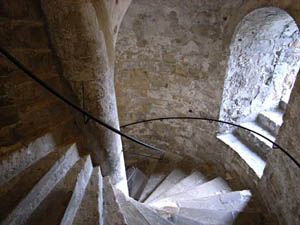
Other stairways were generally in stone. The most famiar are the stone spiral staircases found in many castles and church buildings.
As every schoolboy knows, spiral staircases rose almost always in
a clockwise helix. The reason for this was that a right handed attacker
would have difficulty in wielding a sword, while a defender would
enjoy much more freedom of movement for his sword hand.
| |
|
A staircase within the walls of Carcassonne
- essentially using the design of a flying butress
|
 |
| |
|
A Spiral Staircase. Note how the central
pillar
is created from the inner end pieces of the stone steps
|
 |
|
| |
| Dover Castle |
 |
| |
| Dolbadarn Castle, Gwynedd |
 |
| |
|
|
Doors & Door Locks
Doors were generally wooden, nailed together and not particularly
well fitting. They were hung on iron pintels set into the stonework.
A wicket gate is a small gate or door, particularly one built into
a larger one. The cricket term "wicket" comes from this
term.
| |
 |
| |
|
This 16th Century Gunpowder Store at Fort
Liberia above Villefranche-le-Conflent had double doors
|
 |
| |
| |
 |
| |
|
Doors were often reinforced with Iron bands
and studs - making it difficult to break through with an axe
or ram
|
 |
| |
|
Door at Salses
|
 |
| |
|
Door at Salses
|
 |
|
| |
 |
| |
| |
 |
| |
|
Door at Salses
|
 |
| |
|
Door at Salses
|
 |
| |
|
Door at Salses
|
 |
| |
|
Door at Salses
|
 |
| |
| |
| |
| |
|
|
Fireplaces
 Romans
used tubes inside the walls to draw smoke out of bakeries but real
chimneys appeared only in northern Europe in the 12th century The
earliest extant example of an English chimney is at Conisborough
Keep in Yorkshire, which dates from 1185 AD.
Before that domestic fires were located where they always had been, in the middle of the main room, the Hall. Halls often had a lantern built into the roof over the fire to let out the smoke (and less desirably the heat)
Fireplaces evolved very slowly. First the fire was moved next to wall, with a flue through the wall. Only later were chimneys built into the castle walls.
You can often spot where fireplaces have ben added, to an old building
as the chimney has been added on the outside wall. On the left is
a photograph of an early chimney at Aydon Castle.
|
Fireplace at Salses
|
 |
| |
| |
 |
| |
| |
| |
|
|
|
|
|
Windows
Windows in a real castle are rarely seen below the top floor, although
they have been added in later times in many castles. Renaissance
windows were added to many medieval castles.
Early windows were not large, and often were not glazed. They would
have wooden shutters or perhaps a kind of waxed paper to let in
the light.
Early windows often had stone seats built into the castle walls
next to them. Ladies would sit her to sew, taking advantage of the
light in an otherwise gloomy room (see right).
 
Sometimes they were barred , either with a built in metal grill or a grill added later.
|
Assorted windows in the Chateau Comptal at
Carcassonne
|
 |
| |
|
Windows in the Chateau Comptal at Carcassonne.
Note the defensive wooden shutters.
The putlog holes suggest that this tower once bore hourds.
|
 |
| |
|
|
|
Internal Walls
Medieval wattle and daub (combage) walls are common where the walls
are not defensive - for example inside the city walls. Stone walls,
needed for defence, were far more expensive.
|
Columbage Walls inside Carcassonne
|
 |
| |
|
|
Columbage Walls inside Carcassonne
|
 |
| |
| |
| |
|
|
|
|
Roofs
| Roof made from Wooden Shingles |
 |
| |
|
Detail of Roof made from Wooden Shingles
|
 |
| |
|
Internal structure of a Tower Roof
|
 |
| |
|
Detail of Internal structure of a Tower Roof
|
 |
| |
|
Tile Roof at Carcassonne
|
 |
| |
|
| Chateau roof at Uzes |
 |
| |
|
Roof Structure
|
 |
| |
| Slate Roof |
 |
| |
|
Tile Roof at Carcassonne
|
 |
| |
|
Tile Roof at Carcassonne
|
 |
| |
|
Tile Roof at Carcassonne
|
 |
| |
|
Tile Roof at Carcassonne
|
 |
| |
|
|
|
|
Streets
|
Medieval street inside Carcassonne
|
 |
| |
|
|
|
Kitchens
Castles often had more than one kitchen, sometimes more thanf three
kitchens. These kitchens were divided based on the types of food
prepared in them. In place of a chimney, early buildings had a hole
in the roof through which some of the smoke could escape.
Kitchen was sometimes housedv in a separate sunken floor building
to keep the main building free from indoor smoke and the risk of
fire.
The kitchen remained largely unaffected by architectural advances
throughout the Middle Ages; open fire remained the only method of
heating food. European medieval kitchens were dark, smoky, and sooty
places, whence the name "smoke kitchen". In European medieval
cities around the 10th to 12th centuries, kitchens still used an
open fire hearth in the middle of the room.
In a few castles the kitchen shared the same building as the residential
quarters, but servants were strictly separated from nobles, by constructing
separate spiral stone staircases for use of servants to bring food
to upper levels. An extant example of such a medieval kitchen with
servants' staircase is at Muchalls Castle in Scotland.
With the advent of the chimney, the hearth moved from the centre
of the room to one wall, and the first brick-and-mortar hearths
were built. The fire was lit on top of the construction; vaults
underneath served to store wood. Pots made of iron, bronze, or copper
started to replace the pottery used earlier. Temperature was controlled
by hanging the pot higher or lower over the fire, or placing it
on a trivet or directly on the hot ashes.
Leonardo da Vinci invented an automated system for a rotating spit
for spit-roasting: a propeller in the chimney made the spit turn
all by itself. This kind of system was widely used in wealthier
homes. Spits were also turned by animals in treadmills, children
(scullions), suspended wieghts and later by clockwork devices
Cooking and the kitchen were the domain of the servants, and the
kitchen was set apart from the living rooms, sometimes far from
the dining hall, occasionally connected by underground passageways.
A common complaint in great houses well into the twentieth century
was that the food always arrived cold because of the distance it
had to be carried from the kitchen.
|
Medieval Castle Cupboards were often
built into the thickness of a stone wall
|
 |
| |
|
|
A spectacular kitchen at Fontvraud Abbey
in France
|
 |
| |
|
A cupboard built into the thickness of a
wall in a fortress in Saudi Arabia
|
 |
| |
|
A cupboard door - these cupboards needed
thick doors and sturdy locks as they were effectively safes
for expensive spices
|
 |
| |
|
|
Wells & Cisterns
Water supplies were critical to medieval castle life, not just
for everyday use but also as a scarce resource during sieges.
 Spring
water was ideal but more usual was a dug well. The well would have
to be wide enough to accommodate the diggers as they strove to reach
the water table.
Once the water was extracted from the well there would be various ways to distribute it around the castle.
Wells in castlesare usually found in the courtyard, or the kitchens. Water for drinking or washing would be available on each floor. This water would be provided by a cistern at a higher level which would then supply the water through piping.
 Bathing
would be in a wooden tub which might well be covered with a canopy
in cold seasons.
|
|
Looking down a well
|
 |
| |
|
A well at Carcassonne
|
 |
| |
|
A well at Carcassonne: For Health and Safety
reasons, many o0ld wells are now closed off
|
 |
| |
|
A well at Carcassonne
|
 |
|
|
Latrines & Garderobes
A garderobe is a primitive toilet in a castle or other medieval
building, usually a simple hole discharging to the outside. Such
latrines were often placed inside a small chamber. Technically it
was this chamber that was properly called a guarderobe, but it has
been extended to the privy within.
Depending on the structure of the building, garderobes could lead to cess pits or moats. Many can still be seen in Norman and Medieval castles and fortifications. They became obsolete with the introduction of indoor plumbing.
The original garderobe was a small room or large cupboard, usually adjoining a chamber or the solar and providing safe-keeping for valuable clothes and other possessions of price: cloth, jewels, spices, plate and money.
The word garderobe comes through Middle English originating from the Old French words garder (to watch, to guard) and robe (clothing).
A description of the garderobe at Donegal castle indicates that during the time when the castle garderobe was in use it was believed that ammonia was a disinfectant and that visitor's coats and cloaks were kept in the garderobe. Laundry was also stored in the garderobe.. In Danish, Dutch, German, and Spanish garderobe can mean a cloakroom. |

|
|
Prisons
Castles had always acted as prisons for noble captives. These were
not prisons in the modern sense. Rather the prisoner was held under
house arrest in a castle apartment. As Castles fell out of use after
the medieval period some, like Lincoln Castle were put to use as
real prisons for common criminals.
A dungeon is a room or cell in which prisoners are held, especially underground. Dungeons are generally associated with medieval castles, though their association with torture probably belongs more to the Renaissance period and to Church torture chambers favoured by the Inquisition.
An oubliette is a form of dungeon which was accessible only from a hatch in a high ceiling. The image of dark, damp dungeons as the scene of lengthy incarceration and unspeakable cruelty is a powerful one in popular culture.
The word dungeon comes from Old French donjon (also spelt dongon), which in its earliest usage, meant "a keep, the main tower of a castle which formed the final defensive position to which the garrison could retreat when outer fortifications were overcome". The first recorded instance of the word in English near the beginning of the 14th century also meant "an underground prison cell beneath the castle keep".
In English, the word dungeon now usually only signifies the sense of underground prison or oubliette, typically in a basement of a castle, while the alternate spelling donjon is generally reserved for the original meaning. In French the term donjon still refers to a "keep", and the term oubliette is a more appropriate translation of English "dungeon".
An oubliette (from the French oubliette - literally "forgotten place") was a form of dungeon which was accessible only from a hatch in a high ceiling. The word comes from the same root as the French oublier, "to forget," as it was used for those prisoners the captors wished to forget.
The earliest use of oubliette in French dates back to 1374, but its earliest adoption in English is Walter Scott's Ivanhoe in 1819. There is no reason to suspect that this particular place of incarceration was more than a flight of romantic elaboration on existing unpleasant places of confinement described during the Gothic Revival period.
Few Norman keeps in English castles originally contained prisons, though they were more common in Scotland. Imprisonment was not a usual punishment in the Middle Ages, so most prisoners were kept pending trial or awaiting the penalty, or for political reasons.
Purpose-built prison chambers in castles became more common after the twelfth century, when they were built into gatehouses or mural towers. Some castles had larger provision for prisoners, such as the prison tower at Caernarvon Castle. Alnwick Castle and Cockermouth Castle, both in Northumberland, had prisons in the gatehouse with oubliettes beneath them.
Although many real dungeons are simply a single plain room with a heavy door or with access only from a hatchway or trapdoor in the floor of the room above, the use of dungeons for torture, along with their association to common human fears of being trapped underground, have made dungeons a powerful metaphor in a variety of contexts. Dungeons, in the plural, have come to be associated with underground complexes of cells and torture chambers. As a result, the number of true dungeons in castles is often exaggerated to interest tourists. Many chambers described as dungeons or oubliettes were in fact storerooms, water-cisterns or even latrines.
|
| Dungeon at San Leo, Italy |
 |
| |
| The Inquisition at Work |
 |
| |
|
|
Lists (Lices)
|
Lists
(Lices) at Carcassonne
|
|
|
|
|
|
Lists
(Lices) at Carcassonne
|
|
|
|
The Lists (lices) is the area between the inner and outer walls of a castle por town with two sets of defensive walls.
Jousts were often conducted in the lists - hense the expression "to join the lists" - meaning to sign up for a fight.
 
|
| Lists (Lices) at Carcassonne |
 |
| |
| Jousting in the Lists (Lices) at Carcassonne |
 |
| |
| Jousting in the Lists (Lices) at Carcassonne |
 |
| |
| |
| |
|
|
Butts
An archery butts is an archery practice field, with mounds of earth
used for the targets. The name originally referred to the targets
themselves, but over time came to mean the platforms that held the
targets as well.

In medieval times, it was compulsory for all yeomen in England to learn archery.
For example, ‘The Butts’, in Alton, Hampshire, was an area for training archers in the Middle Ages. |

|
|
|
|
The Practicalities of Castle Building
Once the site of a castle had been selected, building material had to be selected.
An earth and timber castle was cheaper and easier to erect than one built from stone. . A castle with earthen ramparts, a motte, and timber defences and buildings could have been constructed by an unskilled workforce. The source of man-power was probably from the local lordship, and the tenants would already have the necessary skills of felling trees, digging, and working timber necessary for an earth and timber castle.
The construction of an earth and timber castle would not have been a drain on a client's funds. In terms of time, it has been estimated that an average sized motte – 5 m (16 ft) high and 15 m (49 ft) wide at the summit – would have taken 50 people about 40 working days. An exceptionally expensive motte and bailey was that of Clones in Ireland, built in 1211 for £20. The high cost of this one was attributable to the fact that labourers had to be imported.
Stone castles cost a great deal more than those built from earth and timber. Even a very small tower, such as Peveril Castle, would have cost around £200. In the middle were castles such as Orford, which was built in the late 12th century for £1,400, and at the upper end were those such as Dover, which cost about £7,000 between 1112 and 1191.
There are examples of some castles where stone was quarried on site, such as Chinon, Château de Coucy and Château Gaillard. Otherwise transport costs could increase the total costs substantially.
Spending on the scale of the vast castles such as Château Gaillard (an estimated £15,000 to £20,000 between 1196 and 1198) was easily supported by The Crown, but for lords of smaller areas, castle building was a very serious and costly undertaking. It was usual for a stone castle to take the best part of a decade to finish.
The cost of a large castle built over this time (anywhere from £1,000 to £10,000) would take the income from several manors, severely impacting a lord's finances. Costs in the late 13th century were of a similar order, with castles such as Beaumaris and Rhuddlan costing £14,500 and £9,000 respectively.
Edward I's campaign of castle-building in Wales cost £80,000 between 1277 and 1304, and £95,000 between 1277 and 1329. Renowned designer Master James of Saint George, responsible for the construction of Beaumaris, explained the cost:
In case you should wonder where so much money could go in a week, we would have you know that we have needed – and shall continue to need 400 masons, both cutters and layers, together with 2,000 less skilled workmen, 100 carts, 60 wagons and 30 boats bringing stone and sea coal; 200 quarrymen; 30 smiths; and carpenters for putting in the joists and floor boards and other necessary jobs. All this takes no account of the garrison ... nor of purchases of material. Of which there will have to be a great quantity ... The men's pay has been and still is very much in arrears, and we are having the greatest difficulty in keeping them because they have simply nothing to live on.
Not only were stone castles expensive to build in the first place, but their maintenance was a constant drain. They contained a lot of timber, which was often unseasoned and as a result needed careful upkeep. For example, it is documented that in the late 12th century repairs at castles such as Exeter and Gloucester cost between £20 and £50 annually.
Medieval machines and inventions, such as the treadwheel crane, became
indispensable during construction, and techniques of building wooden
scaffolding were improved upon from Antiquity. Finding stone for
shell keeps and castle walls was the first concern of medieval builders,
and a prominent concern was to have quarries close at hand.
|
| A Treadwheel Crane |
 |
| |
| Putlog Holes |
 |
| |
| |
| |
| Aydon Castle (Northumberland): |
 |
| |
| Great Hall - Stokesay, Shropshire (c. 1285-1305): |
 |
| |
| Hall Windows , Great Hall - Stokesay, Shropshire (c. 1285-1305):
|
 |
| |
hall and north tower, from west,
Stokesay, Shropshire (c. 1285-1305): |
 |
| |
| |
| Garderobe at Aydon Castle (Northumberland): |
 |
| |
| |
| Keep at Hedingham Castle, Essex (c. 1140): |
 |
| |
| |
| |
 |
| |
| Beaumaris |
 |
| |
 |
| |
 |
| |
 |
| |
| |
| |
| |
|
|
|
|
|
|
|
|