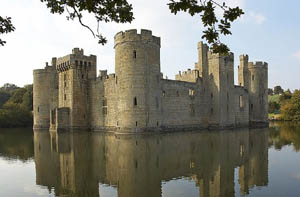
Castle Architecture - Gates
- Gates
- Elevated Doorways
- Flanking Towers
- The Portcullis
- The Drawbridge
- Barbicans
- Narbonne Gate
- Chateau Comptal
- Aude Gate
- Postern Gates
Gates & Barbicans
Gateways, like all openings, were recognised weak points in any defensive fortress. For this reason defenders tended to take two simple precautions. The first was to minimise the number of openings, including gateways. The second was to provide additional defense for gateways.
The first was acheived by severely restricting the number of gateways. Except for postern gates, a typical castle would have only a single entrance gate. Some had not at all - everthing that came in did so by being hoisted up over the walls, and everything that left did so be being thrown over the walls or hoisted down.
Towns would also have few gateways, often one, rarely more than four, even for the largest cities.
The second method - protecting gateways - offered more opportunities for imaginative solutions:

Gates
 Gates
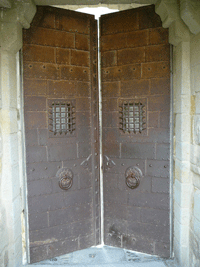
were made of wood, which made them vulnerable. To maximise the strength
they were made as thick at practicable, often with layers of wood
alternating beween vertical and horizontal.
Gates
were made of wood, which made them vulnerable. To maximise the strength
they were made as thick at practicable, often with layers of wood
alternating beween vertical and horizontal.
Some doors were reinforced by metal plates as shown on the right.
In India external doors are often fitted with long spikes to deter barging by elephants. The picture on the left is of the Lohapol gate, Jodhpur, India
In Europe the architectural style of doorways provides important clues for dating a building.


Elevated doorways
Everyone knows about moats and drawbridges - but not so many people know that most external doors in castles were well above ground level.
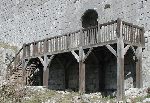
This obviously made them more difficult to attack, but how could they be used in peacetime? The answer is that there were wooden structures providing access for pedestrians, and sometimes for horses too.
You can see an outstanding example at the White tower in the Tower of London (right), and a slighly less impressive example at Montségur (left)


Flanking Towers
Flanking towers provided the means to house a number of defensive features including meutriers, draw bridges, port cullises, etc
Below is a diagram showing a model of Carcassone. The main ("Narbonne") gate is flanked by twin towers which guard the gateway and also the barbican and drawbridge just outside the gates.


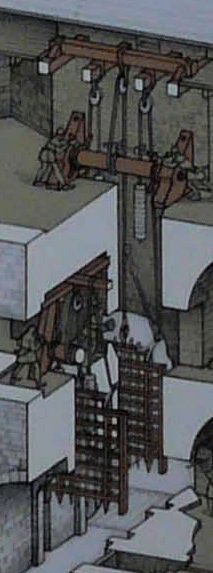
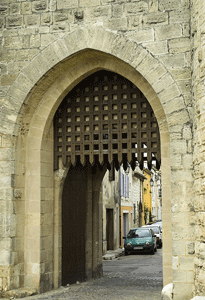
The Portcullis



The Drawbridge
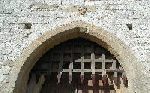
Medieval castles were usually defended by a ditch or moat, crossed by wooden bridge. In early castles the bridge might be designed to be destroyed or removed in the event of an attack, but drawbridges became common. A typical arrangement was to have the drawbridge immediately outside a gatehouse, consisting of a wooden deck with one edge hinged or pivoting at the gatehouse threshold, so that in the raised position the bridge would be flush against the gate, forming an additional barrier to entry. It would be backed by one or more portcullises and gates. Access to the bridge could be resisted with missiles from machicolations above or arrow slits in flanking towers.
 The
bridge (or sometimes just the end part of the bridge - as at Doornenburg
shown on the right) would be raised or lowered using ropes or chains
attached to a windlass in a chamber in the gatehouse above the gate-passage.
Only a very light bridge could be raised in this way without any
form of counterweight, so some form of bascule arrangement is normally
found. The bridge may extend into the gate-passage beyond the pivot
point, either over a pit into which the internal portion can swing
(providing a further obstacle to attack), or in the form of counterweighted
beams that drop into slots in the floor.
The
bridge (or sometimes just the end part of the bridge - as at Doornenburg
shown on the right) would be raised or lowered using ropes or chains
attached to a windlass in a chamber in the gatehouse above the gate-passage.
Only a very light bridge could be raised in this way without any
form of counterweight, so some form of bascule arrangement is normally
found. The bridge may extend into the gate-passage beyond the pivot
point, either over a pit into which the internal portion can swing
(providing a further obstacle to attack), or in the form of counterweighted
beams that drop into slots in the floor.
The raising chains could themselves be attached to counterweights; in some cases a portcullis provides the weight, as at Alnwick.
By the 14th Century a bascule arrangement was provided by lifting arms (called "gaffs") above and parallel to the bridge deck whose ends were linked by chains to the lifting end of the bridge; in the raised position the gaffs would fit into slots in the gatehouse wall ("rainures") which can often still be seen, as at Herstmonceux Castle.
Inside the castle the gaffs were extended to bear counterweights, or might form the side-timbers of a stout gate which would be against the roof of the gate-passage when the drawbridge was down, but would close against the gate-arch as the bridge was raised.


Barbicans
Barbicans are defensive structures controlling access to a gateway. They are fortified outposts or gateways, typically forming the outer defence to a fortified city or castle, (The Barbican in London marks the site of a barbican defending an important entrance to the City of London)
Barbicans sometimes take the form of a tower situated over a gate or bridge which was used for defensive purposes.
Usually barbicans were situated outside the main line of defences and connected to the city walls with a walled road called the neck. With improvements in artillery in the 15th century, barbicans lost their importance. Few barbicans were built in or after the 16th century.
The old Cite of Carcassonne possesses no fewer than four barbicans. They are all different and give a good idea of the range of structures described as barbicans.
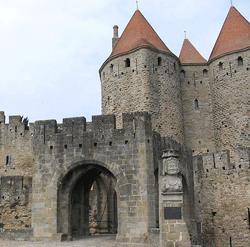
Barbican at the Narbonne Gate, Carcassonne
The main entrance to Carcassonne was the Narbonne Gate, a substantial gate in the inner curtain wall. It was defended by a barbican, shown on the right, in the outer curtain wall.


Barbican at the Chateau Comptal at Carcassonne from the Cité


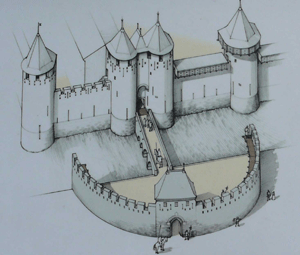


Barbican at the Aude Gate at Carcassonne

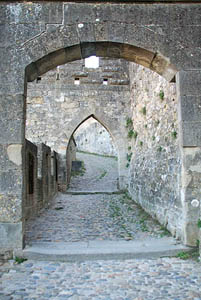


The Fourth Barbican at Carcassonne


Postern Gates


Learn More about Castle Architecture
- External & Natural defenses:
- Towers:
- Walls:
- Gateways:
- Prisons:
- Domestic Elements:
- Training for War
- The Practicalities of Castle Building