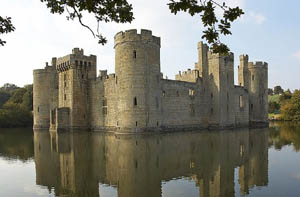
Castle Architecture - Towers
Towers:
Towers come in numerous varieties and serve several purposes. Here we will look at the following:
- The Keep (Donjon)
- Citadels
- Watch Towers
- Wall Towers (Towers and Curtain walls)
- Bartizans (Echaugettes)
The Keep or Donjon
An old and simple system is the Motte and Bailey, familiar to many from school history lessons. A defensive tower built on top of a mound is surrounded by a fence and an outer ditch. The tower may be made of wood or stone and the mound may be natural or man-made. The motte is the mound, and the Bailey is the fence. A baileywick - "fenced-town" - was originally the area circumscribed by the bailey and controled by a Bailiff.
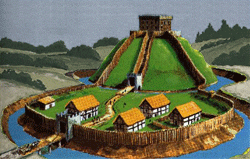 This
Motte and Bailey model is recognisable at the forerunner of any
catle or fortified town. The keep remains as a citadel and the baily
becomes a surrounding wall or encient. The French name for a Kepp
is donjon.
This
Motte and Bailey model is recognisable at the forerunner of any
catle or fortified town. The keep remains as a citadel and the baily
becomes a surrounding wall or encient. The French name for a Kepp
is donjon.
Incidentally, when castles fell out of use in Tudor times, they were often used as gaols (US jails). The donjon in particular became associated with prisons, and the name became attached to places of imprisonment. This, combined with memories of seigneural and ecclesiastical torture chanbers, seems to be resonsible for the word donjon developing into the English word dungeon - no longer a tower, but a place of underground imprisonment.
Citadels
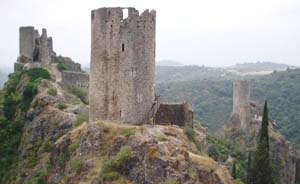
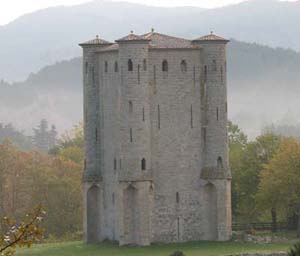
The citadel was the final line of defence. It could stand alone - as at Beaucaire - even after the castle and its town had fallen.
The illustration on the right is Krak les Chevaliers - a castle build on the lands of the Counts of Tripoli - the family of St-Gilles, also Counts of Toulouse.
Krak most clearly shows the design of concentric rings of defense, the defenders falling back if necessary to the citadel shown on the top left of the illustration.
Krak can still be seen today. It was never taken by force, but its great weakness was its lack of water.

Watch Towers (Guettes)
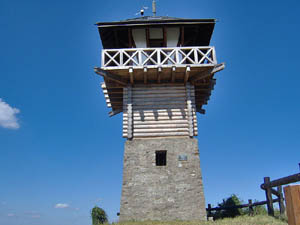
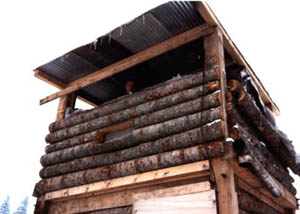
A watchtower is a type of fortification used in many parts of the world. Its main purpose is to provide a high, safe place from which a sentinel or guard may observe the surrounding area. It differs from a turret in that it is usually a freestanding structure.
The Romans built numerous towers as part of a system of communications, one example being the towers along Hadrian's Wall in Britain. Each tower was in sight of the next in the line, and a simple system of semaphore signalling was used between them.
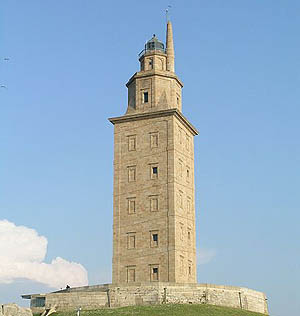 The Romans also built many lighthouses,
such as the Tower of Hercules in northern Spain, which survives
as a working building, and the equally famous lighthouse at Dover
Castle, which survives to about half its original height as a ruin.
The Romans also built many lighthouses,
such as the Tower of Hercules in northern Spain, which survives
as a working building, and the equally famous lighthouse at Dover
Castle, which survives to about half its original height as a ruin.
In medieval Europe, many castles and manor houses, or similar fortified buildings, were equipped with watchtowers. In some of the manor houses of western France, the watchtower equipped with arrow or gun loopholes was one of the principal means of defense.
Scotland saw the construction of Peel towers that combined the function of watchtower with that of a keep or tower house that served as the residence for a local notable family.
Mediterranean countries, and Italy in particular, saw the construction of numerous coastal watchtowers since the early Middle Ages, connected to the threat of Saracen attacks from the various Muslim states existing at the time (such as the Balearic Islands, Ifriqiya or Sicily). From the 16th century many were restored against the Barbary pirates.
Notable examples of military Mediterranean watchtowers include the towers that the Knights of Malta had constructed on the coasts of Malta. These towers ranged in size from small watchtowers to large structures armed with numerous cannon. They include the Wignacourt, and de Redin.
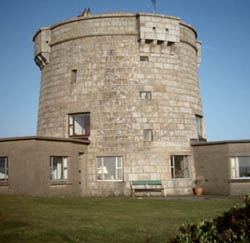 The Martello Towers that the
British built in the UK and elsewhere in the British Empire were
defensive fortifications that were armed with cannon and that were
often within line of sight of each other. One of the last Martello
Towers to be built was Fort Denison in Sydney harbour. The most
recent descendants of the Martello Towers are the flak towers that
the various combatants erected in World War II as mounts for anti-aircraft
artillery.
The Martello Towers that the
British built in the UK and elsewhere in the British Empire were
defensive fortifications that were armed with cannon and that were
often within line of sight of each other. One of the last Martello
Towers to be built was Fort Denison in Sydney harbour. The most
recent descendants of the Martello Towers are the flak towers that
the various combatants erected in World War II as mounts for anti-aircraft
artillery.
In modern warfare the relevance of watchtowers has decreased due to the availability of alternative forms of military intelligence, such as reconnaissance by spy satellites and unmanned aerial vehicles.

Wall Towers and Curtain Walls
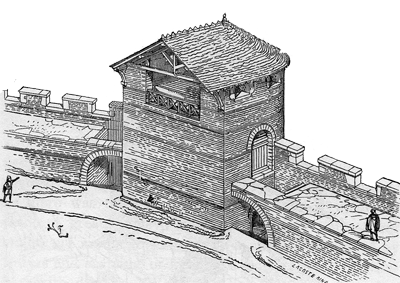
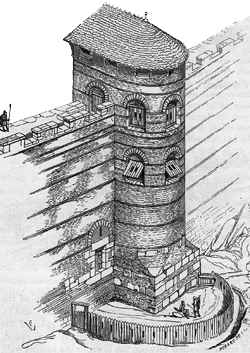
The Romans discovered that walled fortresses were more easily defended if towers were built into the defensive walls. These towers made it easy to give covering fire for the walls.
Although the upper parts are later, the the Roman pattern is preserved in the inner wall or enceint at Carcassonne.
Bartizans (Echaugettes)
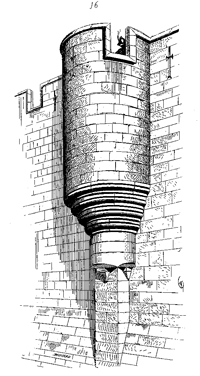
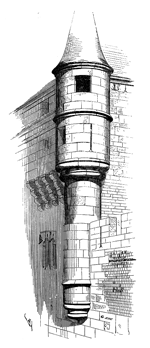
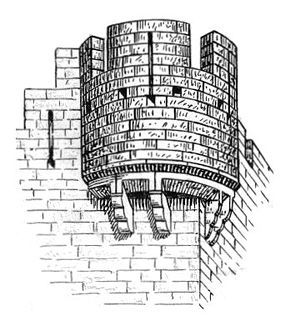
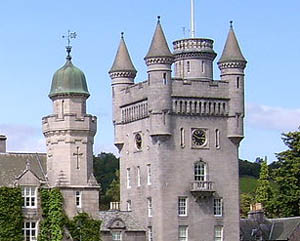
Not all towers reach down to the ground. some are built into walls, emerging from the curtain wall or from a corner.
A bartizan (or Echaugette) is an overhanging, wall-mounted turret projecting from the walls of medieval fortifications from the early 14th century up to the 16th century. They protect a warder and enable him to see around him.
Bartizansgenerally are furnished withoyletsorarrow slits.
Here are a couple of examples.
Learn More about Castle Architecture
- External & Natural defenses:
- Towers:
- Walls:
- Gateways:
- Prisons:
- Domestic Elements:
- Training for War
- The Practicalities of Castle Building