 |
Castle Glossary |
   |
 |
|
|
|
|
|
|
|
|
|||
| Barbacan - Defense
works at the gateway of a castle or city. There is a
specacular semi-circular barbican at the Château
Comtal at Carcassonne. |
Barbacane - Ouvrage fortifié avancé, servant à défendre la porte d'une ville ou d'un château. | ||||
| Basse-Cour - The outer court of a castle. | Basse-Cour - Cour extérieure protégée par les murailles d'un château. | ||||
| Bastille - A temporary
fortified position used by besiegers to provide cover. |
Bastille - Ouvrage temporaire placé par l'assaillant lors d'un siège. | ||||
| Bastion - Ouvrage avancé
à deux flancs et deux faces faisant saillie, placé généralement
sur l'enceinte d'un château. |
Bastion - Ouvrage avancé à deux flancs et deux faces faisant saillie, placé généralement sur l'enceinte d'un château. | ||||
| Belfry- A siege tower (now used of bell towers because of an invalid assumption that the word had something to do with bells). | Beffroi : Tour d'attaque
mobile. Elle est poussée par l'assaillant contre l'enceinte
d'un château |
||||
| Bossing - Rough projecting
surfaces to the building blocks, typically found external
walls of castles of a certain age.
According to several text on catapults, bossing was a means of strengthening a wall against heavy shot. The projection dispersed the energy of the stone shot and prevented a direct energy transfer to the wall. It was also possibly used to give an impression of strength and possibly to save costs of stone cutting. |
Bossage - Parement de pierre formant une bosse plus ou moins saillante par rapport à ses arêtes. | ||||
| Breteche- A pojecting piece of wall, generally over a doorway, acting as a maciolation or murther hole.. |
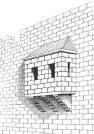 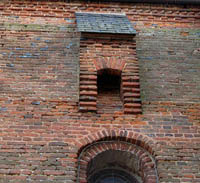 |
Brattice- Logette à mâchicoulis faisant saillie, utilisée comme ouvrage de défense. | |||
| Canonnier: A gun round
or oval port built into a wall - the natural successor
to a loophole for arrows after the untroduction of firearms. |
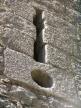 ' '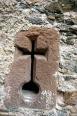 |
Canonnière : Meurtrière pour le tir au canon, elle est généralement ovale ou ronde | |||
| Châtelet - A small fortification designed to defend an access route such as bridge or road. | Châtelet - Petit château
fort destiné à la défense d'un pont, d'une route ou
d'une voie d'accès. |
||||
| Chemin de ronde -
A walkway on top of a castle wall, generally protected
by the battlements, allowing forces to move around the
upper levels of the outer walls of a castle or city
without descending to ground level. |
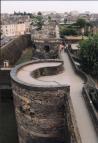 |
Chemin de ronde - Chemin au sommet des murs, souvent protégé par un parapet. | |||
|
Cistern : A stone water tank, indispensible for fortified positions without a well. |
Citerne : Réservoir
dans lequel on recueille et conserve les eaux de pluie. |
||||
| Citadel- A refuge of final defence within a castle or city. Typically dominating the fortifications, the citadel could hold out even after the rest of the castle or city had fallen. | Citadelle - Ouvrage
fortifié, situé dans l'enceinte des remparts de la ville,
disposant de puissants moyens de défense et dominant
la ville antique ou médiévale. |
||||
| Colombage : Wattle and daub. | Colombage : Technique
de charpente en pan de bois. |
||||
| Conciergerie : The guard room of a castle, often situated over the main gateway from where the portcullis was controlled. Also used of the guard themselves. | Conciergerie : Logement des soldats de la garde, nommée également le corps de garde | ||||
| Constable : Originally the "Count of the stable" in charge of the horses, later a military advisor of the king. | Connétable : Initialement chargé
de l'entretien des chevaux, le connétable devient le
conseiller militaire du roi ou du prince. Parfois véritable
chef des armées, il peut jouer un rôle politique. |
||||
|
Courtine - A wall linking bastions or towers. |
Courtine - Elément de muraille reliant deux
bastions ou deux tours flanquantes. |
||||
| Crenel. Battlement
on top of a castle wall. The built up parts are merlons
and the gaps crenels, together making a crenalation.
|
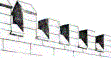 Crenelations |
Créneau (du latin crena, entaille) - Partie creuse d'un rempart. | |||
|
Curtain Wall : A wall around a tower, castle, city or other fortified place. |
Chemise : Muraille enveloppant une tour ou
quelque édifice fortifié. |
||||
| Dovecot, where pigeons
(not doves) were kept - both eggs and fledglings were
eaten. Sometimes separate buildings, sometimes housed
in a tower of a castle. |
Colombier : Pigeonnier, souvent circulaire et détaché mais parfois incorporé dans une tour ou autre partie de la résidence seigneuriale | ||||
| Draw Bridge- Pont mobile au dessus d'un fossé, dont le tablier se relève pour fermer l'accès au château. | Pont-Levis - Pont mobile au dessus d'un fossé, dont le tablier se relève pour fermer l'accès au château. | ||||
| Echauguette - a small
tower built into the wall or more usually a corner.
Can be described as an encorbelled brattice. |
Echauguette - Guérite placée en surplomb sur une muraille fortifiée ou une tour. | ||||
| Garderobes or Latrines
- Lieu d'aisance. |
Latrines - Lieu d'aisance. | ||||
| Hoard A wooden gallery
built on top of castle walls in times of siege, fulfilling
the role later fulfilled by crenalations and machicoulis.
(Our modern word hoarding is a derivative of
this term) |
 Hourds on a tower at Carcassonne |
Hourd (hurdel, du Francique hurd, palissade) - Galerie de bois établie en surplomb autour du sommet des murs d'un château. | |||
| Keep or Donjon The master tower of a castle, the Lord's residence. In early medieval times it would be the only tower. |
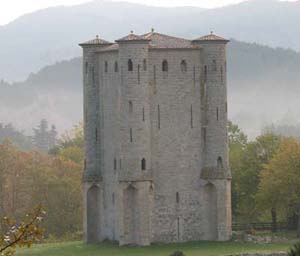 The donjon at Arques in the Languedoc |
Donjon (du latin dominus, tour du seigneur) - Tour maîtresse d'un château fort médiéval, demeure du seigneur. | |||
| Loophole- The classic arrow-slit, long and thin, in a castle wall, often in the form of a cross. |
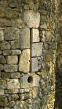  Two examples of loopholes |
Archère - Ouverture
longue et étroite dans un mur pour tirer à l'arc ou
à l'arbalète (v. Meurtrière). |
|||
| Lice - Originally a palissade, later the area between the inner and outer city walls, used for a variety purposes including tilting. There is a spectacular example at Carcassonne. |  Plan of Carcassonne |
Lice - Palissade de bois entourant les châteaux ou les sites fortifiés. | |||
| Machicolations - A projecting galerie, built in stone on top of a defensive wall, and allowing defenders to shoot down at besiegers, or drop things onto them. Specular examples at Foix. | Mâchicoulis ( de mâcher
- écraser- et coulis -action de couler) - Galerie
de pierre en surplomb au sommet d'une courtine. Les
ouvertures dans le sol permettent le jet vertical de
projectiles. |
||||
| Meurtrière- A hole through wich people can be killed. A term that covers both arrow loopholes and cannoniers. |
Examples of an arrow loop and a cannonier |
Meurtrière : Fente,
droite ou en forme de croix, pratiquée dans les tours,
donjons ou murs de fortification pour lancer des flèches
ou pour tirer des boulets de canon |
|||
| Murder Hole or Murther Hole- A defensive opening through which defenders could shoot attackers, or drop things on them (such as dead animals, sand or hot water - not, as far as is known, boiling oil) | Assommoir - Ouverture défendant généralement une porte permettant de jeter des projectiles verticalement. | ||||
| Moat - a ditch usually outside the outer defensive walls of a town or castle. Often filled with water on flat land near rivers. | Douves (du grec dokhê,
récipient) - Fossé souvent rempli d'eau entourant le
château. |
||||
| Manor - A large house without a keep or towers. Often the home of the owner of a fief. without a licence to build a castle. | Manoir - Habitation
d'un propriétaire de fief qui ne possède pas le droit
d'élever un château avec tours et donjon. |
||||
| Merlon - the part of the top of a castle wall built up higher than the rest. Crenellations consist of alternating merlons and creneaux. | Merlon - Partie pleine d'un rempart entre deux créneaux. | ||||
| Moat : A ditch, generally filled with water, surrounding a castle or fortified building. | Douve : Fossé profond
rempli d'eau ou sec entourant un château ou un manoir |
||||
| Motte - A defensive hillock - often man-made. | Motte - Terre-plein
surélevé circulaire, établi artificiellement. |
||||
| Motte and Bailey. An early form of fortification favoured by the Normans - with a large tower of a hill (Motte) and surrounded by a ditch and palisade (Bailey). | Donjon à motte : Ancien
type de château dans lequel un donjon s'élève au sommet
d'un monticule de terre avec d'autres bâtiments à l'intérieur
et à l'extérieur des bailles, le tout étant protégé
par une palissade ou un mur. |
||||
| Oubliette- A small prison, often in a cellar. The idea is that it was aplace where people could be put and then forgotten about (Oublier=to forget) | Oubliettes - Fosses, ou cachots souterrains dans lesquels les prisonniers sont "oubliés" jusqu'à leur mort. | ||||
|
|
||||
| Port Cullis - An iron or wooden grill which can be lowered quickly to block a gateway. | Herse (du latin hirpex) - Grille de fer ou de bois coulissant de haut en bas. | ||||
| Postern a gate, usually
small and discrete in an external wall of a town or
castle, allowing the defenders to sneak out. Used either
to escape or more often to mount a surprise counter
attack. |
Poterne (posterle, du latin posterala, porte de derrière) - Petite porte dérobée qui servait à fuir ou à faire entrer des renforts à l'insu des assiégeants. | ||||
| Puttock Hole: A hole cut into a stone wall to act as a socket into which the end of wooden scaffolding spar would fit. They were used in the construction of castles, and were often left - presumable so that the scaffolding could be re-erecred for later maintenence. | Trou de boulin : Trou ou encastrement taillé dans un mur et destiné à recevoir une poutre | ||||
| Ravelin : A large defensive work, generally triangular of lozenge shaped, and filled with earth, designed to protect a vulnerable point, such as a door, from direct fire. Developed by the great de Vauban in the seventeenth century. | Ravelin : Important ouvrage défensif triangulaire, souvent entièrement solide, destiné à protéger un point vulnérable (par exemple un portail) du tir direct | ||||
| Redoute - A small defensive position, isolated from the main fortification and self contained. | Redoute - Petit ouvrage de fortification isolé et fermé. | ||||
| Spiral staircase : A helical staircase with a vertical axis. | Escalier en vis : Escalier tournant où l'axe est plein | ||||
| Tour flanquante - Tour permettant d'effectuer des tirs parallèles au mur à défendre.. | Tour flanquante - Tour
permettant d'effectuer des tirs parallèles au mur à
défendre. |
||||
| Trebuchet : A military siege engine used for throwing large stones.. | Trébuchet : Lance-pierres militaire. | ||||
|
|
||||

 |
|
|
|
|
|
||||
|
|||||||||


| :::: Link to us :::: Castle and Manor Houses Resources ::: © C&MH 2010-2014 ::: contact@castlesandmanorhouses.com ::: Advertising ::: |