Castles and Manor Houses Home Page

Medieval Life


Medieval life in a castle was harsh by modern standards, but much better than life for the majority of peo[ple at the time - in French the expression "La vie du chateau" denotes a life of luxury.

The civilisation of the ancient pagan world had disapeared. Along with theatres, libraries, schools and hippodromes went luxuries such as running water, central heating, public baths, public lavatories, and sophisticated lighting. Christians did not need baths and they used dark corners for lavatories as God intended. Light was provided by candles or oil lamps, rarely by the sort of effective torches depicted in hollywood films.

In early medieval times fires were still placed in the centre of thegreat hall, often with a sort of lantern tower above to let the smoke out. Later castles featured fires against the wall with a flue to carry the smoke away.

Life during the Middle Ages began at sunrise, when a guard trumpeted the day's start. Servants would have already risen, ensuring that fires were lit in the kitchen and great hall and preparing a small breakfast for the lower orders. The fist of the two main meals of the day for the nobles was not served until between 10am and noon.

Floors had to be swept, cleared of any debris, and basins washed out. Once the lord and his lady had arisen, chambermaids ventured into their apartments, swept and emptied chamber pots and wash basins. Laundresses began the day's wash.

If devout, the lord and his family entered the chapel for morning mass. Once mass was complete, the lord started the day's business. He was the castle's chief administrator when he was in residence, and largely king of his own domain, which included his castle, his estates, and his subjects.

A lord might be granted possession of more than one manor, barrony or earldom so he had to divide his time among all of his properties. His powers were political, judicial, fiscal, and included the policing and defence of his territory. Like his king, he administered justice, inlicted punishment, collected dues from his subjects, and in some cases minted his own coins.

When the lord had obligations that took him away from the castle his main representative was the steward. The steward had substantial power of his own, because he had to know virtually everything that went on at the castle and in the surrounding estates. He had to be skilled at accounting and legal matters, as well as personnel management. Other key members of the household staff included the chamberlain (in charge of the great chamber/hall), the chaplain, the keeper of the wardrobe, the butler (also known as the bottler, he ensured there was enough drink stored in the buttery), the cook, the chandler (who made candles), and the marshal (who was in charge of the stables). Each of these individuals had their own staff to manage.

The lady of the castle was served by ladies-in-waiting and chambermaids. She spent much of the day overseeing their work, as well as supervising the activities in the kitchen staff. The lady also kept an eye on her large group of spinners, weavers, and embroiderers who had the enormous responsibility of keeping everyone clothed, and offering the lady companionship.

Ladies and sometimes clerics were responsible for educating the young pages who, at the age of 7, came to the castle to learn religion, music, dance, hunting, reading, and writing before moving into knight's service as squires.

At 14, young boys became squires, and the lord placed them under the guidance of a knight who would teach them about chivalry, how to wield a sword, how to ride a horse into battle, and so on. A squire's goal was knighthood, which could be attained at the age of 21 when boys officially became men. Many knights became highly skilled warriors and spent peacetime traveling to tournaments to pitch themselves into individual combat with other aspiring knights. Tournaments were good training grounds for real warfare, and could be enormously profitable.

When a group of soldiers was stationed at a castle, they comprised its garrison. Individual members included the knights, squires, a porter (to tend the main door), guards, watchmen, and men-at-arms. They might need to defend their lord and his household in an instant. Each soldier had his own place in an attack and his own skill to rely upon. Some were crossbowmen, archers, or lancers. Some wielded swords.

Livestock roamed inside the stables, blacksmiths clanged out ironwork in the forges, soldiers practiced their skills, and children played when lessons were completed. Various craftsmen worked in the inner ward, including cobblers (making shoes), armorers, coopers (who made casks), hoopers (who helped the coopers build the barrels), billers (making axes), and spencers (who dispensed).

Interior walls were used to support timber structures, like the workshops and the stables. Sometimes, stone buildings also leaned against the walls. Servants were constantly bustling, taking care of the needs of the household. Fires burned. The well and cisterns offered water. At mid-morning, dinner was served. This was the main meal of the day, and often featured three or four courses, as well as entertainment. After dinner, the day's activities would resume, or the lord might lead his guests on a hunt through the grounds of his deer park.

The evening meal, supper, was generally eaten late in the day, sometimes just before bedtime. While not as large as dinner, this meal ensured residents would never be hungry when they settled down to sleep off the day's labors.

Holidays - literally Hoy Days - were times for letting loose of inhibitions and forgetting the stresses of life. The peasants as well as the castle's household found time for pleasure, and made up for their struggles as best they could.

The castle always had to be ready for an attack. If the lord of the castle found out there was going to be a battle, he brought more food to the castle in case of a siege.

If the battle started and the lord was not at home, the lady organized the army. A siege was an army strategy; the attacking army surrounded the castle to stop supplies from coming to the castle. Usually a siege only lasted a few weeks, but could last months or even years. in 143 BC the city of Carthage withstood a siege for 3 years.


Rooms in a Medieval Castle


Officers & Servants in a Medieval Castle

Medieval Clothing

Medieval Food & Cooking


Medieval Drinks


Medieval Gardens

Medieval Warfare

Tournaments, Jousts & Melees

Medieval Taxes

Medieval Games & Passtimes

Angels and Dragons


Urban II
 
 
Infected Monks
 
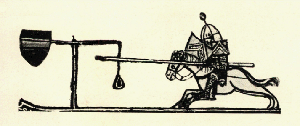
Tilting at a Quintain


Rooms in a Medival Castle


Rooms in a medieval are largely recognisable by their modern counterparts in more modest homes. Kitchens are still kitchens. So are pantries and larders. So are cellars. Bed chambers are now known as bedrooms. Latrines have become lavatories and bathrooms. Halls have morphed into entrance halls and dining rooms have taken over one of their main functions. Solars, Cabinets and Boudoirs have become sitting rooms, libraries and dressing rooms. Ice houses have been replaced by refrigerators.

Below are the main rooms found in medieval castles and large manor houses.

Bower at Smithills


The Great Hall

A great hall is the main room of a royal palace, nobleman's castle or a large manor house in the Middle Ages, and in the country houses of the 16th and early 17th centuries. Great halls were found especially in France, England and Scotland, but similar rooms were also found in some other European countries.

In the medieval period the room would simply have been referred to as the "hall" unless the building also had a secondary hall, but the term "great hall" has been predominant for surviving rooms of this type for several centuries to distinguish them from the different type of hall found in post-medieval houses.

A typical great hall was a rectangular room between one and a half and three times as long as it was wide, and also higher than it was wide. It was entered through a screens passage at one end, and had windows on one of the long sides, often including a large bay window. There was often a minstrel's gallery above the screens passage. At the other end of the hall was the dais where the top table was situated. The lord's family's more private rooms lay beyond the dais end of the hall, and the kitchen, buttery and pantry were on the opposite side of the screens passage.

Even the royal and noble residences had few living rooms in the Middle Ages, and a great hall was a multifunction room. It was used for receiving guests and it was the place where the household would dine together, including the lord of the house, his gentleman attendants and at least some of the servants. At night some members of the household might sleep on the floor of the great hall. From time to time it might also serve as the lord's courtroom.

The great hall would often have one of the larger fireplaces of the palace, manor house or castle, frequently large enough to walk and stand inside it. It was used for warmth and also for some of the cooking, although for larger structures a medieval kitchen would customarily lie on a lower level for the bulk of cooking. Commonly the fireplace would have an elaborate overmantle with stone or wood carvings or even plasterwork which might contain coats of arms, heraldic mottoes (usually in Latin), caryatids or other adornment.

In the upper halls of French manor houses, the fireplaces were usually very large and elaborate. Typically, the great hall had the most beautiful decorations in it, as well as on the window frame mouldings on the outer wall. Many French manor houses have very beautifully decorated external window frames on the large mullioned windows that light the hall. This decoration clearly marked the window as belonging to the lord's private hall. It was where guests slept.

In western France, the early manor houses were centered around a central ground-floor hall. Later, the hall reserved for the lord and his high-ranking guests was moved up to the first-floor level. This was called the salle haute or upper hall (or "high room"). In some of the larger three-storey manor houses, the upper hall was as high as second storey roof. The smaller ground-floor hall or salle basse remained but was for receiving guests of any social order.[1] It is very common to find these two halls superimposed, one on top of the other, in larger manor houses in Normandy and Brittany. Access from the ground-floor hall to the upper (great) hall was normally via an external staircase tower. The upper hall often contained the lord's bedroom and living quarters off one end.

Occasionally the great hall would have an early listening device system allowing conversations to be heard in the lord's bedroom above. In Scotland these devices are called a laird's lug. In many French manor houses there are small peep-holes from which the lord could observe what was happening in the hall. This type of hidden peep-hole is called a judas in French.

Many great halls survive. Two very large surviving royal halls are Westminster Hall and the Wenceslas Hall in Prague Castle. Penshurst Place in Kent, England has a little altered 14th century example. Surviving 16th century and early 17th century specimens in England, Wales and Scotland are numerous, for example those at Longleat (England), Burghley House (England), Bodysgallen Hall (Wales), Muchalls Castle (Scotland) and Crathes Castle (Scotland).

By the late 1700s the great hall was beginning to lose its purpose. The greater centralization of power in royal hands meant that men of good social standing were less inclined to enter the service of a lord in order to obtain his protection. As the social gap between master and servant grew, there was less reason for them to dine together and servants were banished from the hall. In fact, servants were not usually allowed to use the same staircases as nobles to access the great hall of larger castles in early times; for example, the servants' staircases are still extant in places such as Muchalls Castle. The other living rooms in country houses became more numerous, specialized and important, and by the late 17th century the halls of many new houses were simply vestibules, passed through to get to somewhere else, but not lived in.

Many colleges at Durham, Cambridge, Oxford and St Andrews universities have halls on the great hall model which are still used as dining rooms on a daily basis, the largest in such use being that of University College, Durham. So do the Inns of Court in London and King's College School in Wimbledon. The "high table" (often on a small dais at the top of the hall, farthest away from the screens passage) seats dons (at the universities) and Masters of the Bench (at the Inns of Court), whilst students (at the universities) and barristers or students (at the Inns of Court) dine at tables placed at right angles to the high table and running down the body of the hall, thus reproducing the hierarchical arrangement of the medieval household.

From the 16th century onwards halls lost most of their traditional functions to more specialised rooms, both for family members and guests (e.g. dining parlours, drawing rooms), and for servants (e.g. servants halls and servants bedrooms in attics or basements) . The halls of 17, 18th and 19th country houses and palaces usually functioned almost entirely as vestibules, even if they were architecturally impressive. There was a revival of the great hall concept in the late 19th and early 20th centuries, with large halls used for banqueting and entertaining (but not as eating or sleeping places for servants) featuring in some houses of this period as part of a broader medieval revival, for example Thoresby Hall.


Great Hall at Hampton Court Palace
 
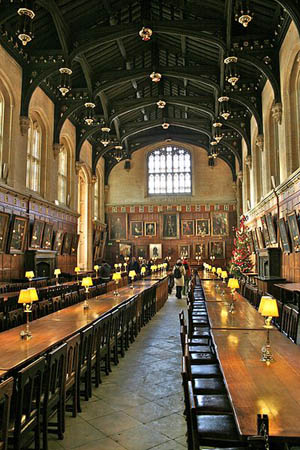
The Great Hall at Christ Church College, Oxford
 
The Great Hall at Lincoln's Inn
 
The Great Hall in Barley Hall, York, restored to replicate its appearance in around 1483. Notice the fireplace in the centre of the room.
 
The Great Hall of Gainsborough Old Hall - Note the fireplace in the centre of the room and also the three doorways to the buttery, pantry and kitchens.

Bed Chambers

The room in the castle called the Lords and Ladies Chamber, or the Great Chamber,  was intended for use as a bedroom and used by the lord and lady of the castle - it also afforded some privacy for the noble family of the castle. This type of chamber was  originally a partitioned room which was added to the end of the Great Hall. The Lords and Ladies chamber were subsequently situated on an upper floor when it was called the solar.

The lord and lady's personal attendants were fortunate to stay with their master or mistress in their separate sleeping quarters. However, they slept on the floor wrapped in a blanket, but, at least on the floor, they could absorb some of the warmth of the fireplace.Even during the warmest months of the year, the castle retained a cool dampness and all residents spent as much time as possible enjoying the outdoors. Oftentimes, members wrapped blankets around themselves to keep warm while at work (from which we derive the term bedclothes).

The lord, his family and guests had the added comfort of heavy blankets, feather mattresses, fur covers, and tapestries hanging on the walls to block the damp and breezes, while residents of lesser status usually slept in the towers and made due with lighter bedclothes and the human body for warmth.

 
Viollet-le-Duc's impression of a XIV to XV Century Castle Bed chamber


The Solar

The room in the castle called the Solar was intended for sleeping and private quarters and used by the Lord's family. It became a private sitting room favoured by the family. The solar suite of rooms was extended to include a wardrobe.

The solar was a room in many English and French medieval manor houses, great houses and castles. In such housest a need was felt for more privacy to be enjoyed by the head of the household, and, especially, by the senior women of the household. The solar was a room for their particular benefit, in which they could be alone (or sole) and away from the hustle, bustle, noise and smells of the Great Hall.

The solar was generally smaller than the Great Hall, because it was not expected to accommodate so many people, but it was a room of comfort and status, and usually included a fireplace and often decorative woodwork or tapestries/wall hangings.

In manor houses of western France, the solar was sometimes a separate tower or pavilion, away from the ground-floor hall and upper hall (great hall) to provide more privacy to the feudal lord and his family.

The etymology of solar is often mistaken for having to do with the sun but this is not so. This misconstrual may result from the common usage of the solar; embroidery, reading, writing, and other generally solitary activities. These activities would need good sunlight, and it is true that most solars were built facing south to take maximum advantage of daylight hours, but that characteristic was neither required nor the source of the name. The name fell out of use after the sixteenth century and its later equivalent was the drawing room.


Solar at Kentwell
 
Solar at Smithills, Bolton

Bathrooms, Lavatories and Garderobes

Bathrooms, so common in the classical world dissappeared in Medival Europe - except in monasteries. Except in certain circumstances baths were not required for ordinary people - until Victorian times cleanliness was fundamentally ungodly.

Baths were taken in transportable wooden tubs, In summer the sun could warm the water and the bather. The tub could be moved inside when the weather worsened.

Privacy was ensured with a tent or canopy.

In English a garderobe has come to mean a primitive toilet in a castle or other medieval building, usually a simple hole discharging to the outside. Such toilets were often placed inside a small chamber, leading by association to the use of the term garderobe to describe them.

Technically garderobes were small rooms or large cupboards (closets) in which the latrine was located. These closets were often used for storing valuables

A description of the garderobe at Donegal castle indicates that during the time when the castle garderobe was in use it was believed that ammonia was a disinfectant and that visitor's coats and cloaks were kept in the garderobe.

Depending on the structure of the building, garderobes could lead to cess pits or moats. Many can still be seen in Norman and Medieval castles and fortifications. They became obsolete with the introduction of indoor plumbing.

Given the likely updrafts in a medieval castle, a chamber pot generally remained close to the bedside.


Kitchens, Pantries, Larders and Butteries

In most households, including early castles, cooking was done on an open hearth in the middle of the main living area, to make efficient use of the heat. This was the most common arrangement for most of the Middle Ages, so the kitchen was combined with the dining hall. Towards the Late Middle Ages a separate kitchen area began to evolve. The first step was to move the fireplaces towards the walls of the main hall, and later to build a separate building or wing that contained a dedicated kitchen area, often separated from the main building by a covered arcade. This way, the smoke, odors and bustle of the kitchen could be kept out of sight of guests, and the fire risk to the main building reduced.

Many basic variations of cooking utensils available today, such as frying pans, pots, kettles, and waffle irons, already existed in great households. Other tools more specific to cooking over an open fire were spits of various sizes, and material for skewering anything from delicate quails to whole oxen. There were also cranes with adjustable hooks so that pots and cauldrons could easily be swung away from the fire to keep them from burning or boiling over. Utensils were often held directly over the fire or placed into embers on tripods.

There were also assorted knives, stirring spoons, ladles and graters. In wealthy households one of the most common tools was the mortar and sieve cloth, since many medieval recipes called for food to be finely chopped, mashed, strained and seasoned either before or after cooking. This was based on a belief among physicians that the finer the consistency of food, the more effectively the body would absorb the nourishment. It also gave skilled cooks the opportunity to elaborately shape the results. Fine-textured food was also associated with wealth; for example, finely milled flour was expensive, while the bread of commoners was typically brown and coarse. A typical procedure was farcing (from the Latin farcio, "to cram"), to skin and dress an animal, grind up the meat and mix it with spices and other ingredients and then return it into its own skin, or mold it into the shape of a completely different animal.

The kitchen staff of huge noble or royal courts occasionally numbered in the hundreds, including: pantlers, bakers, waferers, sauciers, larderers, butchers, carvers, page boys, milkmaids, butlers and scullions. Major kitchens of households had to cope with the logistics of daily providing at least two meals for several hundred people. Guidelines on how to prepare for a two-day banquet include a recommendation that the chief cook should have at hand at least 1,000 cartloads of "good, dry firewood" and a large barnful of coal.

A cook at the stove with a cook's trademark ladle; woodcut illustration from Kuchenmaistrey, the first printed cookbook in German, woodcut, 1485.
 
 
Kitchen

Pantry

A pantry is a room where food, provisions or dishes are stored and served in an ancillary capacity to the kitchen. The derivation of the word is from the same source as the Old French term paneterie; that is from pain, the French form of the Latin pan for bread.

In a late medieval hall, there were separate rooms for the various service functions and food storage. A pantry was where bread was kept and food preparation associated with it done. The head of the office responsible for this room was referred to as a pantler. .


Larder

A larder is a cool area for storing food prior to use. Larders were commonplace in houses before the widespread use of the refrigerator. Essential qualities of a larder are that it should be:as cool as possible, close to food preparation areas, constructed so as to exclude flies and vermin, easy to keep clean, and equipped with shelves and cupboards appropriate to the food being stored.

In the northern hemisphere, most houses would arrange to have their larder and kitchen on the north or east side of the house where it received least sun.

Many larders have small unglazed windows with the window opening covered in fine mesh. This allows free circulation of air without allowing flies to enter. Many larders have tiled or painted walls to simplify cleaning. Older larders and especially those in larger houses have hooks in the ceiling to hang joints of meat or game. Others have insulated containers for ice.

A pantry may contain a a stone slab or shelf used to keep food cool in the days before refrigeration was domestically available. In the late medieval hall, a thrawl would have been appropriate to a larder. In a large or moderately large nineteenth century house, all these rooms would have been placed as low in the building as possible, or as convenient, in order to use the mass of the ground to retain a low summer temperature. For this reason, a buttery was usually called the cellar by this stage.

In medieval households the larderer was an officer responsible for meat and fish, as well as the room where these commodities were kept. . The Scots term for larder was the spence, and so in Scotland larderers (also pantlers and cellarers) were known as spencers. This is one of the derivations of the modern surname.

The office only existed as a separate office in larger households. It was closely connected with other offices of the kitchen, such as the saucery and the scullery.

Larder
 
Larder


Buttery

A buttery was a domestic room in a castle or large medieval house. It was one of the offices pertaining to the kitchen. It was generally a room close to the Great Hall and was traditionally the place from which the yeoman of the buttery served beer and candles to those lower members of the household not entitled to drink wine.

The room takes its name from the beer butts (barrels) storred there.

The buttery generally had a staircase to the beer cellar below. The wine cellars, however, belonged to a different department, that of the yeoman of the cellar and in keeping with the higher value of their contents were often more richly decorated to reflect the higher status of their contents.

From the mid-17th century, as it became the custom for servants and their offices to be less conspicuous and sited far from the principal reception rooms, the Great Hall and its neighbouring buttery and pantry lost their original uses. While the Great Hall often became a grand staircase hall or large reception hall, the smaller buttery and pantry were often amalgamated to form a further reception or dining room.


Buttery (Barleyhall, York)

Gatehouses and Guardrooms

A gatehouse is a fortified structure built over the gateway to a city or castle. The modern gatehouse is a feature of European castles, manor houses and mansions.

Gatehouses made their first appearance in the early antiquity when it became necessary to protect the main entrance to a castle or town. Over time, they evolved into very complicated structures with many lines of defence.

Strongly fortified gatehouses would normally include a drawbridge, one or more portcullises, machicolations, arrow loops and possibly even murder-holes where stones would be dropped on attackers. In the late Middle Ages, some of these arrow loops might have been converted into gun loops (or gun ports).

Sometimes gatehouses formed part of town fortifications, perhaps defending the passage of a bridge across a river or a moat, as Monnow Bridge in Monmouth. York has four important gatehouses, known as "Bars", in its city walls.

The French term for gatehouse is logis-porche. This could be a large, complex structure that served both as a gateway and lodging or it could have been composed of a gateway through an enclosing wall. A very large gatehouse might be called a châtelet (small castle).

At the end of the Middle Ages, gatehouses in England and France were often converted into beautiful, grand entrance structures to manor houses or estates. Many of them became a separate feature free-standing or attached to the manor or mansion only by an enclosing wall. By this time the gatehouse had lost its defensive purpose and had become more of a monumental structure designed to harmonize with the manor or mansion.

Gatehouse at Stirling Castle in Scotland


Chapels & Oratories


Throughout the medieval period Christianity of the form currently in power was obligatory, with the intermitent exception of Jews. Almost everyone was obliged to profess Christian belief and to act acordingly. Only the most powerful nobles (like Frederick II) were able to express disbelief without risking their lives.

The room in the castle called the Chapel was intended for prayer and used by all members of the castle household. It was usually close to the Great hall. It was often built two stories high, with the nave divided horizontally. The Lord's family and dignitaries sat in the upper part and the servants occupied the lower part of the chapel

An Oratory was intended for use as a private chapel. It was a room attached to the chapelthat could be used for private prayer by the Lord's family.

Today, the owners of Many Castles and Manor Houses will (for a fee) allow people to get married in their Castle chapels with the reception then taking place in the Castle.

Click here for a list of Castles offering Weddings and Civil Partnerships ›››

The Chapel at windsor Castle

Cabinets and Boudoirs

Heating the main rooms in large palaces or mansions in the winter was difficult, and small rooms were more comfortable. They also offered more privacy from servants, other household members, and visitors. Typically such a room would be for the use of a single individual, so that a house might have two or more. Names varied: cabinet, closet, study (from the Italian studiolo), or office.

A cabinet was one of a number of terms for a private room in the castles and palaces of Early Modern Europe, serving as a study or retreat, usually for a man. A cabinet would typically be furnished with books and works of art, and sited adjacent to his bedchamber (evolving into the equivalent of the Italian Renaissance studiolo and the modern English studio). Such a room might be used as a study or office, or just a sitting room.

In the Late Medieval period, such requirements for privacy had been served by the solar of the English gentry house.

Cabinets could be used for small private meetings - for example between the king and his ministers. Since the reign of King George I, the Cabinet – which takes its name from the room – has been the principal executive group of British government, and the term has been adopted in most English-speaking countries. Phrases such as "cabinet counsel", meaning advice given in private to the monarch, occur from the late 16th century.

The word c abinet in English was often used for strongrooms, or treasure-stores - the tiny but exquisite Elizabethan tower strongroom at Lacock Abbey might have been so called - but also in the wider sense.

In Elizabethan England, such a private retreat would most likely be termed a closet, the most recent in a series of developments in which people of means found ways to withdraw from the public life of the household as it was lived in the late medieval great hall. This sense of "closet" has continued use in the term "closet drama", which is a literary work in the form of theatre, intended not to be mounted nor publicly presented, but to be read and visualised in privacy. Two people in intimate private conversation are said to be "closetted".

Much later closets were ideal locations for lavatories - which thus became known as water closets or WCs.

There is a rare surviving cabinet or closet with its contents probably little changed since the early 18th century at Ham House in Richmond, London. It is less than ten feet square, and leads off from the Long Gallery, which is well over a hundred feet long by about twenty wide, giving a rather startling change in scale and atmosphere. As is often the case (at Chatsworth House for example), it has an excellent view of the front entrance to the house, so that comings and goings can be discreetly observed. Most surviving large houses or palaces, especially from before 1700, have such rooms, but (again as at Chatsworth) they are very often not displayed to visitors.


Boudoirs

A boudoir is a lady's private bedroom, sitting room or dressing room. The term derives from the French verb bouder, meaning "to pout" - because the room was seen as a "pouting room".

Historically, the boudoir formed part of the private suite of rooms of a lady, for bathing and dressing, adjacent to her bedchamber. In this it was the female equivalent of the male cabinet.

In later periods, the boudoir was used as a private drawing room, and was used for other activities, such as embroidery or entertaining intimate acquaintances.

Panelled Cabinet
 
Cabinet room at 10 Downing Street


Storerooms, Undercrofts & Cellars


Casemate

A casemate was originally a vaulted chamber usually constructed underneath the rampart. It was intended to be impenetrable and could be used for sheltering troops or stores.

Place of Arms

The room in the castle called the Place of Arms was a large area in a covered way, where troops could assemble.

Undercroft

An undercroft is traditionally a cellar or storage room, often vaulted.

While some were used as simple storerooms, others were rented out as shops. For example, the undercroft rooms at Myres Castle in Scotland circa 1300 were used as the medieval kitchen and a range of stores. The undercroft beneath the House ofLlords in the Palace of Westminster in London was rented out to the conspirators behind the Gunpowder Plot in 1605.

Many early medieval undercrofts were vaulted or groined, such as the vaulted chamber at Beverston Castle or the groined stores at Myres Castle.

Undercrofts were commonly built in England and Scotland throughout the thirteenth and early fourteenth centuries.

Buildings with historic examples

England

  • Banqueting House, Palace of Whitehall, London
  • Blakeney Guildhall, Blakeney, Norfolk
  • Bradenstoke Abbey, Wiltshire
  • Coventry Cathedral, Coventry, West Midlands
  • Canterbury Cathedral, Canterbury, Kent
  • Carlisle Cathedral, Carlisle, Cumbria
  • Dragon Hall, Norwich, Norfolk
  • Durham Castle, Undercroft, Durham
  • Eastbridge Hospital, Canterbury, Kent
  • Forde Abbey, Dorset.
  • Fountains Abbey, North Yorkshire
  • Jurnet's House, Norwich, Norfolk
  • Moyse's Hall Museum, Bury St Edmunds, Suffolk
  • Norton Priory, Runcorn, Cheshire
  • Rufford Abbey, Nottinghamshire
  • St Nicholas Priory, Exeter, Devon
  • St Pancras Station, London
  • Warwick Castle, Warwickshire
  • Westminster Abbey, London
  • Windsor Castle
  • Wingfield Manor, Derbyshire
  • York Minster, York, North Yorkshire


Other examples

  • Dublin Castle, Dublin, Ireland
  • Dundrennan Abbey, Dundrennan, Dumfries and Galloway, Scotland
  • Cardiff Castle, Cardiff, Wales
  • Castell Coch, Cardiff, Wales


Undercroft at Fountains abbey
 
Undercroft of the House of Lords in 1605
 
Undercroft of Banquetting House, Whitehall
 
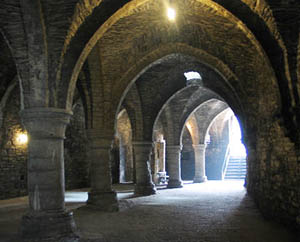
Gravensteen Castle (1180), Ghent (Belgium):
 

Ice Houses

An ice-house was just that: a special insulated house to keep ice. During the winter, ice and snow would be taken into the ice house and packed with insulation, often straw or sawdust. It would remain frozen for many months, often until the following winter, and could be used as a source of ice during summer months. The main application of the ice was the storage of perishable foods, but it could also be used simply to cool drinks, or allow ice-cream and sorbet desserts to be prepared.

ice houses are found in ha-ha walls, house and stable basements, woodland banks, and even open fields.

The most common designs involved underground chambers, usually man-made, and built close to natural sources of winter ice such as freshwater lakes. Ice houses varied in design depending on the date and builder, but were mainly conical or rounded at the bottom to hold melted ice. They usually had a drain to take away any water. In some cases ponds were built nearby specifically to provide the ice in winter.

The ice house was formally introduced to Britain around 1660, although there are occasional examples surviving from the medieval period. British ice houses were commonly brick lined, domed structures, with most of their volume underground. The idea for formal ice houses was brought to Britain by travellers who had seen similar arrangements in Italy, where peasants collected ice from the mountains and used it to keep food fresh inside caves.

Usually only castles and large manor houses had purpose-built buildings to store ice. Many examples of ice houses exist in the UK some of which have fallen into a poor state of repair. Good examples of 19th-century ice houses can be found at Ashton Court, Bristol, Grendon, Warwickshire, and at Christchurch Mansion, Ipswich, Suffolk, Moggerhanger Park, Bedfordshire Petworth House, Sussex, Danny House, Sussex, Ayscoughfee Hall, Spalding, Rufford Abbey, and Eglinton Country Park in Scotland and Parlington Hall in Yorkshire. Game larders and venison larders were sometimes marked on ordnance survey maps as ice houses.

The idea was old even in Medieval times. Ice houses originally invented in Persia were buildings used to store ice throughout the year. An inscription from 1700 BC in northwest Iran records the construction of an icehouse, "which never before had any king built." In China, archaeologists have found remains of ice pits from the seventh century BC, and references suggest they were in use before 1100 BC. Alexander the Great around 300 BC stored snow in pits dug for that purpose. In Rome in the third century AD, snow was imported from the mountains, stored in straw-covered pits, and sold from snow shops.

The entrance to a medieval ice house at St. Germain's House near Edinbugh
 
The ice-house at Coome Park undergoing restoration
 
Rufford Abbey Ice House 1
 

Dovecotes


A dovecote is a building intended to house pigeons or doves.

Dovecotes may be square or circular free-standing structures or built into the end of a house or barn. They generally contain pigeonholes for the birds to nest. Pigeons and doves were an important food source historically in Western Europe and were kept for their eggs, flesh, and dung.

In Medieval Europe, the possession of a dovecote was a symbol of status and power and was regulated by law. Only nobles had this special privilege known as droit de colombier.

Their location is chosen away from large trees that can house raptors and shielded from prevailing winds and their construction obeys a few safety rules: tight access doors and smooth walls with a protruding band of stones (or other smooth surface) to prohibit the entry of climbing predators such as rats, martens, and weasels. The exterior facade was, if necessary, only evenly coated by a horizontal band, in order to prevent their ascent.

Dovecote materials can be very varied and shape and dimension extremely diverse:

  • the square dovecote with quadruple vaulting: built before the fifteenth century ( Roquetaillade Castle, Bordeaux) or Saint-Trojan near Cognac)
  • the cylindrical tower: fourteenth century to the sixteenth century, it is covered with curved tiles, flat tiles, stone lauzes roofing and occasionally with a dome of bricks. A window or skylight is the only opening.
  • the dovecote on stone or wooden pillars, cylindrical, hexagonal or square;
  • the hexagonal dovecote (like the dovecotes of the Royal Mail at Sauzé-Vaussais);
  • the square dovecote with flat roof tiles in the seventeenth century and a slate roof in the eighteenth century;
  • the lean-to structure against the sides of buildings.
  • Inside a dovecote could be virtually empty (boulins being located in the walls from bottom to top), the interior reduced to only the structure of a rotating ladder, or "potence", allowing the collection of eggs or squabs and maintenance.

The oldest known dovecotes are the fortified dovecotes of Upper Egypt, and the domed dovecotes of Iran. In the dry regions, the droppings were in great demand and were collected on uniformly cleaned braids.

Dovecotes were built by the Romans, who knew them as Columbaria. They seem to have introduced them to Gaul. The presence of dovecotes is not noted in France before the Roman invasion of Gaul by Caesar. The pigeon farm was then a passion in Rome: the Roman columbarium , generally round, had its interior covered with a white coating of marble powder. Varro, Columella and Pliny the Elder wrote works on pigeon farms and dovecote construction.


Dovecotes of France

The French word for dovecote is pigeonnier or colombier. In some French provinces, especially Normandy, dovecotes were built of wood in a very stylized way. Stone was the other popular building material for these old dovecotes. These stone structures were usually built in circular, square and occasionally octagonal form. Some of the medieval French abbeys had very large stone dovecotes on their grounds.

In Brittany the dovecote was sometimes built directly into the upper walls of the farmhouse or manor-house. In rare cases, it was built into the upper gallery of the lookout tower (for example at the Toul-an-Gollet manor in Plesidy, Brittany). Dovecotes of this type are called tour-fuie in French.

Some of the larger château-forts such as the Château de Suscinio in Morbihan, still have a complete dovecote standing on the grounds, outside the moat and walls of the castle.

The dovecote interior, the space granted to the pigeons, is divided into a number of boulins (pigeon holes). Each boulin is the lodging of a pair of pigeons. These boulins can be in rock, brick or cob (adobe) and installed at the time of the construction of the dovecote or be in pottery (jars lying sideways, flat tiles, etc.), in braided wicker in the form of a basket or of a nest. It is the number of boulins that indicates the capacity of the dovecote. The one at the chateau d'Aulnay with its 2,000 boulins and the one at Port-d'Envaux with its 2,400 boulins of baked earth are among the largest ones in France.

In the Middle Ages, particularly in France, the possession of a colombier à pied (dovecote on the ground accessible by foot), constructed separately from the corps de logis of the manor-house (having boulins from the top down), was a privilege of the seigneurial lord. He was granted permission by his overlord to build a dovecote or two on his estate lands. For the other constructions, the dovecote rights (droit de colombier) varied according to the provinces. They had to be in proportion to the importance of the property, placed in a floor above a henhouse, a kennel, a bread oven, even a wine cellar. Generally the aviaries were integrated into a stable, a barn or a shed, and were permitted to use no more than 2.5 hectares of arable land.

Although they produced an excellent fertilizer (known as colombine), the lord's pigeons were often seen as a nuisance by the nearby peasant farmers, in particular at the time of sowing of new crops. In numerous regions where the right to possess a dovecote was reserved solely for the nobility , the complaint rolls very frequently recorded formal requests for the suppression of this privilege and a law for its abolition, which was finally ratified on 4 August 1789 in France.

Many ancient manors in France have a dovecote (still standing or in ruins) in one section of the manorial enclosure or in nearby fields.

The Romans may have introduced dovecotes or columbaria to Britain since pigeon holes have been found in Roman ruins at Caerwent. However it is believed that doves were not commonly kept there until after the Norman invasion. The earliest known examples of dove-keeping occur in Norman castles of the 12th century (for example, at Rochester Castle, Kent, where nest-holes can be seen in the keep), and documentary references also begin in the 12th century. The earliest surviving, definitely-dated free-standing dovecote in this country was built in 1326 at Garway in Herefordshire.

Many ancient manors in the United Kingdom have a dovecote (still standing or in ruins) in one section of the manorial enclosure or in nearby fields.

Early purpose-built doocots in Scotland are of a "beehive" shape, circular in plan and tapering up to a domed roof with a circular opening at the top. In the late 16th century they were superseded by the "lectern" type, rectangular with a monopitch roof sloping fairly steeply in a suitable direction.

Phantassie Doocot is an unusual example of the beehive type topped with a monopitch roof, and Finavon Doocot of the lectern type is the largest doocot in Scotland, with 2,400 nesting boxes. Doocots were built well into the 18th century in increasingly decorative forms, then the need for them died out though some continued to be incorporated into farm buildings as ornamental features. The 20th century saw a revival of doocot construction by pigeon fanciers, and dramatic towers clad in black or green painted corrugated iron can still be found on wasteland near housing estates in Glasgow and Edinburgh.

Colombier at Manoir d'Ango near Dieppe
 
Schematic showing the interior of a dovecote
 
Interior of Dovecote at Penmon Priory
 
Dovecote at Nymans Gardens, West Sussex, England
 
Ross Doocot

Apartments

Apartments are not modern inventions. Great castles were often divided into apartments, each apartment belonging to an important resident - for example the Lord's widowed mother, his brothers and sisters, and visiting dignatories.

This model, once common in all great houses, survives among British royaly. Most royal palaces are divided into apartments, each belonging to a senior member of the Royal Family.


Kensington Palace - the official residence of The Duke and Duchess of Gloucester; the Duke and Duchess of Kent; and Prince and Princess Michael of Kent.
 

Officers & Servants in a Medieval Castle

From the household of the king to the humblest peasant dwelling, more or less distant relatives and varying numbers of servants and dependents would cohabit with the master of the house and his immediate family.

The structure of the medieval household was largely dissolved by the advent of privacy in the modern period.

As a result of the military nature of the medieval noble household, its composition was predominately male. Towards the end of the medieval period the ratio levelled out somewhat, but at an earlier date the feminine element of the household consisted only of the lady and her daughters, their attendants, and perhaps a few domestics to perform particular tasks such as washing. Many of the male servants were purely military personnel; there would be a gatekeeper, as well as various numbers of knights and esquires to garrison the castle as a military unit. Yet many of these would also serve other functions, and there would be servants entirely devoted to domestic tasks. At the lower level, these were simply local men recruited from the localities. The higher level positions – in particular those attending on the lord – were often filled by men of rank: sons of the lord's relatives, or his retainers.

The presence of servants of noble birth imposed a social hierarchy on the household that went parallel to the hierarchy dictated by function. This second hierarchy had at its top the steward (alternatively seneschal or majordomo), who had the overriding responsibility for the domestic affairs of the household. Taking care of the personal wellbeing of the lord and his family were the Chamberlain, who was responsible for the chamber or private living-quarters, and the Master of the Wardrobe, who had the main responsibility for clothing and other domestic items. Of roughly equal authority as the steward was the marshal. This officer had the militarily vital responsibility for the stables and horses of the household (the "marshalsea"), and was also in charge of discipline. The marshal, and other higher-ranking servants, would have assistants helping them perform their tasks. These – called valet de chambres, grooms or pages, ranking from top to bottom in that order – were most often young boys, although in the larger royal courts the valet de chambres included both young noble courtiers, and often artists, musicians and other specialists who might be of international repute. Assigning these the office of valet was a way of regularising their position within the household.

Administration & Household

  • Seneschal, Majordom or Steward
  • Constable - Horses, grooms and pages
  • Marshal - Marshalsea, Military, arms and discipline, knights, squires, men at arms
  • Chamberlain - Chambers, valet de chambres
  • Master of the Wardrobe - clothing and other domestic items


In addition to these offices there was a need for servants to take care of the hunting animals. The master huntsman, or the veneur, held a central position in greater noble households. Likewise, the master falconer was a high-ranking officer, often of noble birth himself.

One of the most important functions of the medieval household was the procuration, storage and preparation of food. This consisted both in feeding the occupants of the residence on a daily basis, and in preparing larger feasts for guests, to maintain the status of the lord. The kitchen was divided into a pantry (for bread, cheese and napery) and a buttery (for wine, ale and beer). These offices were headed by a pantler and a butler respectively. Depending on the size and wealth of the household, these offices would then be subdivided further. The following is a list of some of the offices one could expect to find in a large medieval aristocratic or royal household:

  • Cooks, scullions etc - Kitchen
  • Pantler - Pantry
  • Buttler - Buttery
  • Confectioner - Confectionery
  • Cellerer - Cellar
  • Poulterer - Poultry
  • Spicer - Spicery
  • Larderer - Larder
  • Scalding-house
  • Saucery


In addition there would be staff taking care of the Scullery (&scullion), Chandlery (where candles were made), Ewery, Laundry and Napery.

The chapel was a part of every large household. Household chapels would be staffed by varying numbers of clerics. Chaplains, confessors and almoners could serve in administrative capacities as well as the religious ones. clerics were chancellors in large households. The original chancellors were the Cancellarii of Roman courts of justice—ushers who sat at the cancelli or lattice work screens of a basilica or law court, which separated the judge and counsel from the audience. In medieval households they might be responsible for record keeping, accounting and finances.

The households of medieval kings were in many ways simply aristocratic households on a larger scale. In some ways though, they were different. One major difference was the way in which royal household officials were largely responsible for the governance of the realm, as well as the administration of the household. The 11th century Capetian kings of France, for instance, "ruled through royal officers who were in many respects indistinguishable from their household officers." These officers – primarily the seneschal, constable, butler, chamberlain and chancellor – would naturally gain extensive powers, and could exploit this power for social advancement. One example of this is the Carolingians of France, who rose from the position of royal stewards – the Mayors of the Palace – to become kings in their own right. It was the father of Charlemagne, Pepin the Short, who gained control of government from the enfeebled Merovingian king Childeric III. Another example is the royal House of Stuart in Scotland, whose family name bore witness to their background of service.

Eventually the central positions of the royal household became little else than honorary titles bestowed upon the greatest families, and not necessarily even dependent on attendance at court. By the thirteenth century, the offices of constable, butler, steward and chamberlain had become the hereditary right of certain high noble families.

The royal household differed from most noble households in the size of their military element. If a king was able to muster a substantial force of household knights, this would reduce his dependence on the military service of his subjects. This was the case with Richard II of England, whose one-sided dependence on his household knights – mostly recruited from the county of Cheshire – made him unpopular with his nobility and contributed to his downfall.

The medieval aristocratic household was not fixed to one location, but could be more or less permanently on the move. Greater nobles would have estates scattered over large geographical areas, and to maintain proper control of all their possessions it was important to physically inspect the localities on a regular basis. As the master of the horses, travel was the responsibility of the marshal. Everything in the noble household was designed for travel, so that the lord could enjoy the same luxury wherever he went. Even baths and window glass were moved around.

Particularly for kings, itineration was a vital part of governance, and in many cases kings would rely on the hospitality of their subjects for maintenance while on the road. This could be a costly affair for the localities visited; there was not only the large royal household to cater for, but also the entire royal administration. It was only towards the end of the medieval period, when means of communication improved, that households, both noble and royal, became more permanently attached to one residence.

Aristocratic society centered on the castle originated, as much of medieval culture in general, in Carolingian France, and from there spread over most of Western Europe. In other parts of Europe, the situation was different. On the northern and western fringes of the continent, society was kin-based rather than feudal, and households were organised correspondingly. In Ireland, the basis for social organisation was the "sept", a clan that could comprise as many as 250 households, or 1250 individuals, all somehow related.

Towards the end of the Middle Ages, the functions and composition of households started to change. This was due to two factors. First, the introduction of gunpowder to the field of warfare rendered the castle a less effective defence, and did away with the military function of the household. The result was a household more focused on comfort and luxury, and with a significantly larger proportion of women.

The second factor was the early modern ascendancy of the individual, and focus on privacy. Already in the later Middle Ages castles had begun to incorporate an increasing number of private chambers. Once the castle was discarded to the benefit of palaces or stately homes, this tendency was reinforced. This did not mean an end to the employment of domestic servants, or even in all cases a reduction in household staff. What it did mean was a realignment whereby the family became the cornerstone of the household.

Thomas Howard, third Duke of Norfolk by Hans Holbein the Younger. He is carrying his batton signifying his position as Earl Marshal.
 
William Marshal ("The Marshal")
The greatest knight in Christendom
 
The Lord Chancellor
 
Falconer
 
Cellerer
 
anding over the sword of the Constable of France to Bertrand Duguesclin.
JeanFouquet, Illuminaded MS XV Century


Medieval Clothing


Most people in the Middle Ages wore woollen clothing, with undergarments (if any) made of linen.

Among the peasantry, wool was generally shorn from the sheep and spun into the thread for the cloth by the women of the family. Dyes were common, so even the lower class peasants frequently wore colourful clothing. Using plants, roots, lichen, tree bark, nuts, crushed insects, molluscs and iron oxide, virtually every colour could be achieved. Dyes came from different sources, some of them more expensive than others. Even the humble peasant could have colourful clothing. Dyed fabric would fade if it was not mixed with a mordant. Bolder shades required either longer dyeing times or more expensive dyes. Fabrics of the brightest and richest colours cost more and were therefore most often found on nobility and the very rich. Brighter colours, better materials, and a longer jacket length were usually signs of greater wealth.

Men wore stockings (hose) and tunics. Noblemen wore tunics or jackets with hose, leggings and breeches. The wealthy also wore furs and jewellery.

Women wore long gowns with sleeveless tunics and wimples to cover their hair. Sheepskin cloaks and woollen hats and mittens were worn in winter for protection from the cold and rain. Women wore flowing gowns and elaborate headwear, ranging from headdresses shaped like hearts or butterflies to tall steeple caps and Italian turbans.

Throughout much of the Middle Ages and in most societies, undergarments worn by both men and women didn't substantially change. They consisted of a shirt or undertunic, stockings or hose, and, for men at least, underpants.

Illuminations, woodcuts, and other period artwork illustrate medieval people in bed in different attire; some are unclothed, but just as many are wearing simple gowns or shirts, some with sleeves. We have virtually no documentation regarding what people wore to bed, but from these images it is clear that that those who wore night dress would have been clad in an under-tunic, possibly the same one they had worn during the day.

Leather boots were covered with wooden patens to keep the feet dry. Outer clothes were almost never laundered, but the linen underwear was regularly washed. The smell of wood smoke that permeated the clothing seemed to act as a deodorant.

Clothing of the aristocracy and wealthy merchants tended to be elaborate and changed according to the dictates of fashion.

Fur was often used to line the garments of the wealthy. Jewellery was lavish, much of it imported. Gem cutting had not been invented until the fifteenth century, so most stones were not lustrous. Ring brooches were the most popular item from the twelfth century on. Diamonds became popular in Europe in the fourteenth century. By the mid-fourteenth century there were laws to control who wore what jewellery. Knights were not permitted to wear rings.

Sometimes clothes were garnished with silver, but only the wealthy could wear such items.

Virtually everyone wore something on their heads in the Middle Ages, to keep off the sun in hot weather, to keep their heads warm in cold weather, and to keep dirt out of their hair. as with every other type of garment, hats could indicate a person's job or station in life and could make a fashion statement. Hats were especially important, and to knock someone's hat off his or her head was a grave insult that, depending on the circumstances, could even be considered assault.

Types of men's hats included wide-brimmed straw hats, close-fitting coifs of linen or hemp that tied under the chin like a bonnet, and a wide variety of felt caps. Women wore veils and wimples; among the fashion-conscious nobility of the High Middle Ages, some fairly complex hats and head rolls were in vogue.

Both men and women wore hoods, sometimes attached to capes or jackets but sometimes standing alone. Some of the more complicated men's hats were hoods with a long strip of fabric in the back that could be wound around the head. A common accoutrement for men of the working classes was a hood attached to a short cape that covered just the shoulders.

Most of the holy orders wore long woollen habits in emulation of Roman clothing. . St. Benedict stated that a monk's clothes should be plain but comfortable and they were allowed to wear linen coifs to keep their heads warm. Benedictines wore black; the Cistercians, undyed wool or white. Franciscans wore grey, and later brown.

Silk was the most luxurious fabric available to medieval Europeans, and it was so costly that only the upper classes, and churchmen, could afford it. While its beauty made it a highly-prized status symbol, silk has practical aspects that made it much sought-after. It is lightweight yet strong, resists soil, has excellent dyeing properties and is cool and comfortable in warmer weather.

Western Europeans imported silks from Byzantium, but also import them from India and the Far East,. Wherever it came from, the fabric was so costly that its use was reserved for church ceremony and cathedral decorations.

Muslims, who had conquered Persia and acquired the secret of silk, brought the knowledge to Sicily and Spain.From there, it spread to Italy. By the 13th century European silk was competing successfully with Byzantine products. For most of the Middle Ages, silk production spread no further in Europe, until factories were set up in France in the 15th century.

Laws dating back to the Romans restricted ordinary people in their expenditure. These were called Sumptuary Laws. The word Sumptuary is derived from the Latin word for expenditure.

English Sumptuary Laws were imposed to curb the expenditure of the people. Sumptuary laws might apply to food, beverages, furniture, jewellery and clothing. These Laws were used to control behaviour and ensure that a specific class structure was maintained. Penalties for violating Sumptuary Laws could be harsh - fines, the loss of property, title and even life.

The first record of sumptuary legislation is an ordinance of the City of London in 1281 which regulated the apparel, or clothing, of workman. These related to workers who had working clothes supplied by their employer as a part of their wages.

The second record of sumptuary legislation occurred during the reign of King Edward II (1284-1327) related to food expenditure. King Edward II issued a proclamation against 'outrageous consumption of meats and fine dishes' by nobles.

The next records of sumptuary legislation occurred during the reign of King Edward III (1312-1377). King Edward III passed these Sumptuary Laws to regulate the dress of various classes of the English people, promote English garments and to preserve class distinctions by means of costume, clothes and dress.

The sumptuary legislation of 1336 attempted to curb expenditure and preserve class distinction. One of acts stated the following:

no knight under the estate of a lord, esquire or gentleman , nor any other person, shall wear any shoes or boots having spikes or points which exceed the length of two inches, under the forfeiture of forty pence.

The sumptuary legislation of 1337 was designed to promote English garments and restrict the wearing of furs. English Sumptuary legislation passed in 1363 included the following:

  • Women were, in general, to be dressed according to the position of their fathers or husbands
  • Wives and daughters of servants were not to wear veils above twelve pence in value
  • Handicraftsmen's and yeomen's wives were not to wear silk veils
  • The use of fur was confined to the ladies of knights with a rental above 200 marks a year
  • The wife or daughter of a knight was not to wear cloth of gold or sable fur
  • The wife or daughter of a knight-bachelor not to wear velvet
  • The wife or daughter of an esquire or gentleman not to wear velvet, satin or ermine
  • The wife or daughter of a labourer were not to wear clothes beyond a certain price or a girdle garnished with silver
  • Cloth of gold and purple silk were confined to women of the royal family
  • The importation of silk and lace by Lombards and other foreigners were forbidden


These Sumptuary Laws distinguished social categories and made members of each class easily distinguished by their clothing


Medieval Food & Cooking


Feasting and enjoying food was an important part of medieval life, because during a war there wasn't very much to eat. Nobles had to pay for food and wages for his household.

Bread was the basic food in the Middle Ages, it could be made with barley, rye, and wheat. Wealthy people used thick slices of brown bread as bowls called trenchers to soak up juice and sauce from the food.

Flour made for the castle was ground at the lord's own mill by his miller. Millers produced different kinds of flour, fine, to make white bread for the king or lord, and brown bread for the servants.

Birds like chickens, geese, and ducks were keptr. On special occasions the wealthy ate swan and peacock. Beef and venison were well liked, so was pork.

Mustard was a favorite ingredient.

Medieval people liked fish and fresh meat that was not salted yet. Meat was salted in huge wooden vats so that the food would not spoil.

Salt was expensive but large quantities were bought every year. Most people ate with their fingers and their own knives; forks were introduced towards the end of the Middle Ages. Many people thought forks were silly, but every one had to behave properly at mealtime.

There were many rules on the correct way to eat and where people sat at the table.

Before 1100 honey was the only way to sweeten food because spices were expensive because they came from the Far East.

Herbs were used to season food and make remedies for the ill.

Crusaders brought new foods like raisins, dates, and figs to Europe.

Cereals remained the most important staples during the early Middle Ages, as rice was a late introduction to Europe and the potato was only introduced in 1536 (and for centuries was used almost exclusively to feed animals). Barley, oat and rye among the poor, and wheat for the governing classes, were eaten as bread, porridge, gruel and pasta by all members of society. Fava beans and vegetables were important supplements to the cereal-based diet of the lower orders.

Meat was more expensive and therefore more prestigious and in the form of game was common only on the tables of the nobility and poachers. The most prevalent butcher's meats were pork and chicken and other domestic fowl. Beef, which required greater investment in land, was less common.

Cod and herring were mainstays among the northern populations, and dried, smoked or salted made their way far inland. A wide variety of other saltwater and freshwater fish were also eaten - castles generally had their own fishponds.

Slow transportation and inefficient food preservation techniques,(drying, salting, smoking and pickling) made long-distance trade of many foods expensive. Because of this, the food of the nobility was more prone to foreign influence than the cuisine of the poor, and dependent on exotic spices and expensive imports. As each level of society imitated the one above it, innovations from international trade and foreign wars from the 12th century onwards gradually disseminated through the upper middle class of medieval cities. Aside from economic unavailability of luxuries such as spices, decrees outlawed consumption of certain foods among certain social classes,

Sumptuary laws limited the conspicuous consumption among the nouveau riche. Social norms also dictated that the food of the working class be less refined, since it was believed there was a natural resemblance between one's labor and one's food, so manual labor required coarser, cheaper food.

A type of refined cooking developed in the late Middle Ages that set the standard among the nobility all over Europe. Common seasonings in the highly spiced sweet-sour repertory typical of upper-class medieval food included verjuice, wine and vinegar in combination with spices such as black pepper, saffron and ginger. These, along with the widespread use of sugar or honey gave many dishes a sweet-sour flavor.

Almonds were very popular as a thickener in soups, stews, and sauces, particularly as almond milk.


The cuisines of the cultures of the Mediterranean Basin had since antiquity been based on cereals, particularly various types of wheat. Porridge and gruel, and later bread became the basic food staple that made up the majority of calorie intake for most of the population. From the 8th to the 11th centuries, the proportion of various cereals of the diet rose from about 1⁄3 to 3⁄4. Dependence on wheat remained significant throughout the medieval era, and spread northwards. In colder climates, wheat was usually unaffordable for most people, and was associated with the higher classes. The centrality of bread in religious rituals such as the Eucharist meant that it enjoyed an especially high prestige among foodstuffs. Only olive oil and wine had a comparable value, but both remained exclusive outside of the warmer wine- and olive-growing regions.

In the British Isles, northern France, the Low Countries, the northern German-speaking areas, Scandinavia and the Baltic the climate was generally too harsh for the cultivation of grapes and olives. In the south, wine was the common drink for both rich and poor alike (though the commoner usually had to settle for cheap second pressing wine) while beer was the commoner's drink in the north and wine an expensive import. Citrus fruits (though not the kinds most common today) and pomegranates were common around in the Mediterranean. Dried figs and dates occurred in the north, but were used rather sparingly in cooking.

Olive oil was a ubiquitous ingredient around the Mediterranean, but remained an expensive import in the north where oil of poppy, walnut, hazel and filbert was the most affordable alternative. Butter and lard, especially after the terrible mortality during the Black Death, was used in considerable quantities in the northern and northwestern regions.

Food


Drinks


from the Luttrell Psalter (England, c. 1325-35)


from the Luttrell Psalter (England, c. 1325-35)
 
from the Luttrell Psalter (England, c. 1325-35)


Food preparation

All types of cooking involved the use of open fires. Stoves did not appear until the 18th century, and cooks had to know how to cook directly over an open fire.

Ovens were used, but they were expensive to construct and only existed in fairly large households and bakeries. Castles, of course would have their own ovens - often several different ones. Outside of castles it was common for a community to have shared ownership of an oven to ensure that the bread baking essential to everyone was made communal rather than private. There were also portable ovens designed to be filled with food and then buried in hot coals, and even larger ones on wheels that were used to sell pies in the streets of medieval towns.

Almost all cooking was done in simple stewpots, since this was the most efficient use of firewood and did not waste precious cooking juices, making potages and stews the most common dishes. Overall, most evidence suggests that medieval dishes had a fairly high fat content, or at least when fat could be afforded. This was considered less of a problem in a time of back-breaking toil, famine, and a greater acceptance—even desirability—of plumpness; only the poor or sick, and devout ascetics, were thin.

Fruit was readily combined with meat, fish and eggs. It was considered important to make sure that the dish agreed with contemporary standards of medicine and dietetics. This meant that food had to be "tempered" according to its nature by an appropriate combination of preparation and mixing certain ingredients, condiments and spices; fish was seen as being cold and moist, and best cooked in a way that heated and dried it, such as frying or oven baking, and seasoned with hot and dry spices; beef was dry and hot and should therefore be boiled; pork was hot and moist and should therefore always be roasted. In some recipe collections, alternative ingredients were assigned with more consideration to the humoral nature than what a modern cook would consider to be similarity in taste. In a recipe for quince pie, cabbage is said to work equally well, and in another turnips could be replaced by pears.

The completely edible shortcrust pie did not appear in recipes until the 15th century. Before that the pastry was primarily used as a cooking container in a technique known as 'huff paste' . Recipe collections show that gastronomy in the Late Middle Ages developed significantly. New techniques, like the shortcrust pie and the clarification of jelly with egg whites began to appear in recipes in the late 14th century and recipes began to include detailed instructions instead of being mere memory aids to an already skilled cook.


Fowl roasting on a spit. Under the spit is a narrow, shallow basin to collect the drippings for use in sauces or for basting the meat; The Decameron, Flanders, 1432.


Cereals

The period between c. 500 and 1300 saw a major change in diet that affected most of Europe. More intense agriculture on an ever-increasing acreage resulted in a shift from animal products, meat and dairy products to various grains and vegetables as the staple of the majority population. Before the 14th century bread was not as common among the lower classes, especially in the north where wheat was more difficult to grow. A bread-based diet became gradually more common during the 15th century and replaced warm intermediate meals that were porridge- or gruel-based. Leavened bread was more common in wheat-growing regions in the south, while unleavened flatbread of barley, rye or oats remained more common in northern and highland regions, and unleavened flatbread was also common as provisions for troops.

The most common grains were rye, barley, buckwheat, millet, and oats. Rice remained a fairly expensive import for most of the Middle Ages and was grown in northern Italy only towards the end of the period. Wheat was common all over Europe and was considered to be the most nutritious of all grains, but was more prestigious and thus more expensive. The finely sifted white flour that modern Europeans are most familiar with was reserved for the bread of the upper classes. As one descended the social ladder, bread became coarser, darker, and its bran content increased. In times of grain shortages or outright famine, grains could be supplemented with cheaper and less desirable substitutes like chestnuts, dried legumes, acorns, ferns, and a wide variety of more or less nutritious vegetable matter.

One of the most common constituents of a medieval meal, either as part of a banquet or as a small snack, were sops, pieces of bread with which a liquid like wine, soup, broth, or sauce could be soaked up and eaten. Another common sight at the medieval dinner table was the frumenty, a thick wheat porridge often boiled in a meat broth and seasoned with spices. Porridges were also made of every type of grain and could be served as desserts or dishes for the sick, if boiled in milk (or almond milk) and sweetened with sugar. Pies filled with meats, eggs, vegetables, or fruit were common throughout Europe, as were turnovers, fritters, doughnuts, and many similar pastries. By the Late Middle Ages biscuits and especially wafers, eaten for dessert, had become high-prestige foods and came in many varieties. Grain, either as bread crumbs or flour, was also the most common thickener of soups and stews, alone or in combination with almond milk.


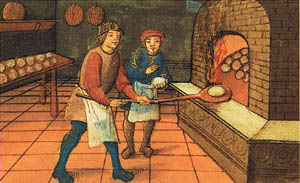
A baker with his assistant. As seen in the illustration, round loaves were among the most common.
 
Selling Bread


Fruit


Fruit was popular and could be served fresh, dried, or preserved, and was a common ingredient in many cooked dishes.[

Since sugar and honey were both expensive, it was common to include many types of fruit in dishes that called for sweeteners of some sort. The fruits of choice in the south were lemons, citrons, bitter oranges (the sweet type was not introduced until several hundred years later), pomegranates, quinces, and, of course, grapes. Further north, apples, pears, plums, and strawberries were more common. figs and dates were eaten all over Europe, but remained rather expensive imports in the north.


Vegetables


Vegetables such as cabbage, beets, onions, garlic and carrots were common foodstuffs. Many of these were eaten daily by peasants and workers, but were less prestigious than meat.

Cookbooks, intended mostly for those who could afford such luxuries, which appeared in the late Middle Ages, only contained a small number of recipes using vegetables as the main ingredient. The lack of recipes for many basic vegetable dishes, such as potages, has been interpreted not to mean that they were absent from the meals of the nobility, but rather that they were considered so basic that they did not require recording.

Carrots were available in many variants during the Middle Ages: among them a tastier reddish-purple variety and a less prestigious green-yellow type. Various legumes, like chickpeas, fava beans and peas were also common and important sources of protein, especially among the lower classes. With the exception of peas, legumes were often viewed with some suspicion by the dietitians advising the upper class, partly because of their tendency to cause flatulence but also because they were associated with the coarse food of peasants.

Common and often basic ingredients in many modern European cuisines like potatoes, kidney beans, cacao, vanilla, tomatoes, chili peppers and maize were not available to Europeans until the late 15th century after European contact with the Americas, and even then it often took a long time for the new foodstuffs to be accepted by society at large.

Harvesting cabbage; Tacuinum Sanitatis, 15th century.


Fish and Seafood

Although less prestigious than other animal meats, and often seen as merely an alternative to meat on fast days, seafood was the mainstay of many coastal populations.

"Fish" to the medieval person was also a general name for anything not considered a proper land-living animal, including marine mammals such as whales and porpoises. Also included were the beaver, due to its scaly tail and considerable time spent in water, and barnacle geese, due to lack of knowledge of where they migrated. Such foods were also considered appropriate for fast days.

Especially important was the fishing and trade in herring and cod in the Atlantic and the Baltic Sea. The herring was of unprecedented significance to the economy of much of Northern Europe, and it was one of the most common commodities traded by the Hanseatic League.

Kippers made from herring caught in the North Sea could be found in markets as far away as Constantinople.

While large quantities of fish were eaten fresh, a large proportion was salted, dried, and, to a lesser extent, smoked. Stockfish, cod that was split down the middle, fixed to a pole and dried, was very common, though preparation could be time-consuming, and meant beating the dried fish with a mallet before soaking it in water.

A wide range of molluscs including oysters, mussels and scallops were eaten by coastal and river-dwelling populations, and freshwater crayfish were seen as a desirable alternative to meat during fish days. Compared to meat, fish was much more expensive for inland populations, especially in Central Europe, and therefore not an option for most. Freshwater fish such as pike, carp, bream, perch, lamprey, and trout were common.


Fishing lamprey in a stream; Tacuinum Sanitatis, 15th century.


Meat

Wild game were popular among those who could obtain it, but most meat came from domesticated animals.

Beef was not as common as today because raising cattle was labor-intensive, requiring pastures and feed, and oxen and cows were much more valuable as draught animals and for producing milk. Animals slaughtered because they were no longer able to work were not particularly appetizing and were therefore less valued. Far more common was pork, as pigs required less attention and cheaper feed.

Domestic pigs often ran freely even in towns and could be fed on just about any organic kitchen waste, and suckling pig was a sought-after delicacy. Mutton and lamb were fairly common, especially in areas with a sizeable wool industry, as was veal.

Every part of the animal was eaten, including ears, snout, tail, tongue, and womb. Intestines, bladder and stomach could be used as casings for sausage or even illusion food such as giant eggs. Among the meats that today are rare or even considered inappropriate for human consumption the hedgehog and porcupine, occasionally mentioned in late medieval recipe collections.

A wide range of birds was eaten, including swans, peafowl, quail, partridge, storks, cranes, larks, linnets and other songbirds that could be trapped in nets, and just about any other wild bird that could be hunted. Swans and peafowl were domesticated to some extent, but were only eaten by the social elite, and more praised for their fine appearance as stunning entertainment dishes, entremets, than for their meat.


Geese and ducks had been domesticated but were not as popular as the chicken, the fowl equivalent of the pig.

Meats were more expensive than plant foods. Though rich in protein, the calorie-to-weight ratio of meat was less than that of plant food. Meat could be up to four times as expensive as bread. Fish was up to 16 times as costly, and was still expensive even for coastal populations. This meant that fasts could mean an especially meager diet for those who could not afford alternatives to meat and animal products like milk and eggs.

It was only after the Black Death had eradicated up to half of the European population that meat became more common even for poorer people. The drastic reduction in many populated areas resulted in a labor shortage, meaning that wages shot up. It also left vast areas of farmland untended, making them available for pasture and putting more meat on the market.

A 14th century butcher shop. A pig is being bled in preparation for slaughter. A whole pig carcass and cuts are hanging from a rack and various cuts are being prepared for a customer.
 
pie
 
Meat Hall, Ghent

Dairy products

Milk was an important source of animal protein for those who could not afford meat. It would mostly come from cows, but milk from goats and sheep was also common. Plain fresh milk was not consumed by adults except the poor or sick, and was usually reserved for the very young or elderly.

Poor adults would sometimes drink buttermilk or whey or milk that was soured or watered down. Fresh milk was overall less common than other dairy products because of the lack of technology to keep it from spoiling. On occasion it was used in upper-class kitchens in stews, but it was difficult to keep fresh in bulk and almond milk was generally used in its stead.

Cheese was far more important as a foodstuff, especially for common people, and it has been suggested that it was, during many periods, the chief supplier of animal protein among the lower classes. Many varieties of cheese eaten today, like Dutch Edam, Northern French Brie and Italian Parmesan, were available and well-known in late medieval times. There were also whey cheeses, like ricotta, made from by-products of the production of harder cheeses.

Cheese was used in cooking for pies and soups, the latter being common fare in German-speaking areas. Butter, another important dairy product, was in popular use in the regions of Northern Europe that specialized in cattle production in the latter half of the Middle Ages, the Low Countries and Southern Scandinavia. While most other regions used oil or lard as cooking fats, butter was the dominant cooking medium in these areas. Its production also allowed for a lucrative butter export from the 12th century onward.

Preparing and serving cheese; Tacuinum Sanitatis, 14th century


Herbs & Spices

Spices were among the most luxurious products available in the Middle Ages, the most common being black pepper, cinnamon (and the cheaper alternative cassia), cumin, nutmeg, ginger and cloves.

They all had to be imported from plantations in Asia and Africa, which made them extremely expensive, and gave them social cachet such that pepper for example was hoarded, traded and conspicuously donated in the manner of gold bullion.

It has been estimated that around 1,000 tons of pepper and 1,000 tons of the other common spices were imported into Western Europe each year during the late Middle Ages. The value of these goods was the equivalent of a yearly supply of grain for 1.5 million people.

While pepper was the most common spice, the most exclusive, though not the most obscure in its origin, was saffron, used as much for its vivid yellow-red color as for its flavor, for according to the humours, yellow signified hot and dry, valued qualities; turmeric provided a yellow substitute, and touches of gilding at banquets supplied both the medieval love of ostentatious show and Galenic dietary lore: at the sumptuous banquet that Cardinal Riario offered the daughter of the King of Naples in June 1473, the bread was gilded.[

Among the spices that have now fallen into obscurity are grains of paradise, a relative of cardamom which almost entirely replaced pepper in late medieval north French cooking, long pepper, mace, spikenard, galangal and cubeb.

Sugar, unlike today, was considered to be a type of spice due to its high cost and humoral qualities.[ Few dishes employed just one type of spice or herb, but rather a combination of several different ones. Even when a dish was dominated by a single flavorer it was usually combined with another to produce a compound taste, for example parsley and cloves or pepper and ginger.

Common herbs such as sage, mustard, and parsley were grown and used in cooking all over Europe, as were caraway, mint, dill and fennel. Many of these plants grew throughout all of Europe or were cultivated in gardens, and were a cheaper alternative to exotic spices. Mustard was particularly popular with meat products and was described by Hildegard of Bingen (1098–1179) as poor man's food. While locally grown herbs were less prestigious than spices, they were still used in upper-class food, but were then usually less prominent or included merely as coloring. Anise was used to flavor fish and chicken dishes, and its seeds were served as sugar-coated comfits.

Surviving medieval recipes frequently call for flavoring with a number of sour, tart liquids. Wine, verjuice (the juice of unripe grapes or fruits) vinegar and the juices of various fruits, especially one those with tart flavors were almost universal and a hallmark of late medieval cooking. In combination with sweeteners and spices, it produced a distinctive "pungeant, fruity" flavor.

Equally common, and used to complement the tanginess of these ingredients, were (sweet) almonds. They were used in a variety of ways: whole, shelled or unshelled, slivered, ground and, most importantly, processed into almond milk. This last type of non-dairy milk product is probably the single most common ingredient in late medieval cooking and blended the aroma of spices and sour liquids with a mild taste and creamy texture.

Salt was a ubiquitous and indispensable in medieval cooking. Salting and drying was the most common form of food preservation and meant that especially fish and meat were often heavily salted. Many medieval recipes specifically warn against oversalting and there were recommendations for soaking certain products in water to get rid of excess salt.

Salt was present during more elaborate or expensive meals. The richer the host, and the more prestigious the guest, the more elaborate would be the container in which it was served and the quality and price of the salt. Wealthy guests were provided with salt cellars made of pewter, precious metals or other fine materials, often intricately decorated. The rank of a diner also decided how finely ground and white the salt was. Salt for cooking, preservation or for use by common people was coarser; sea salt, or "bay salt", in particular, had more impurities, and was described in colors ranging from black to green. Expensive salt, on the other hand, looked like the standard commercial salt common today.


Puddings ( Sweets and Desserts)

The term "dessert" comes from the Old French desservir, "to clear a table", literally "to un-serve", and originated during the Middle Ages. It would typically consist of dragées and mulled wine accompanied by aged cheese, and by the Late Middle Ages could also include fresh fruit covered in sugar, honey or syrup and boiled-down fruit pastes.

Sugar, from its first appearance in Europe, was viewed as much as a drug as a sweetener; its long-lived medieval reputation as an exotic luxury encouraged its appearance in elite contexts accompanying meats and other dishes that to modern taste are more naturally savoury.

There was a wide variety of fritters, crêpes with sugar, sweet custards and darioles, almond milk and eggs in a pastry shell that could also include fruit and sometimes even bone marrow or fish.

Marzipan in many forms was well-known in Italy and southern France by the 1340s and is assumed to be of Arab origin.

Anglo-Norman cookbooks are full of recipes for sweet and savory custards, potages, sauces and tarts with strawberries, cherries, apples and plums.

English chefs also had a penchant for using flower petals such as roses, violets, and elder flowers.

An early form of quiche can be found in Forme of Cury, a 14th century recipe collection, as a Torte de Bry with a cheese and egg yolk filling.

In northern France, a wide assortment of waffles and wafers was eaten with cheese and hypocras or a sweet malmsey as issue de table ("departure from the table").

The ever-present candied ginger, coriander, aniseed and other spices were referred to as épices de chambre ("parlor spices") and were taken as digestables at the end of a meal to "close" the stomach.

Like their Muslim counterparts in Spain, the Arab conquerors of Sicily introduced a wide variety of new sweets and desserts that eventually found their way to the rest of Europe. Just like Montpellier, Sicily was once famous for its comfits, nougat candy (torrone, or turrón in Spanish) and almond clusters (confetti).

From the south, the Arabs also brought the art of ice cream making that produced sorbet and several examples of sweet cakes and pastries; cassata alla Siciliana (from Arabic qas'ah, the term for the terra cotta bowl with which it was shaped), made from marzipan, sponge cake and sweetened ricotta and cannoli alla Siciliana, originally cappelli di turchi ("Turkish hats"), fried, chilled pastry tubes with a sweet cheese filling.


Food Preservation

Even if food was plentiful in the summer, it was rarely so in the winter. Food had to be preserved to carry people through to the next season of plenty. Also preserved food became even more important in times of siege.

Food preservation methods were the same as had been used since antiquity (and did not change much until the invention of canning in the 19th century). The most common and simplest method was to expose foodstuffs to heat or wind to remove moisture, thereby prolonging the durability if not the flavour of almost any type of food from cereals to meats; the drying of food worked by drastically reducing the activity of various water-dependent microorganisms that cause decay. In warm climates this was mostly achieved by leaving food out in the sun, and in the cooler northern climates by exposure to strong winds (especially common for the preparation of stockfish), or in warm ovens, cellars, attics, and even in living quarters.

Subjecting food to a number of chemical processes such as smoking, salting, brining, conserving or fermenting also made it keep longer. Most of these methods had the advantage of shorter preparation times and of introducing new flavors. Smoking or salting meat of livestock butchered in the fall was a common household strategy to avoid having to feed more animals than necessary during the lean winter months. Butter tended to be heavily salted (5–10%) in order not to spoil. Vegetables, eggs or fish were also often pickled in tightly packed jars, containing brine and acidic liquids (lemon juice, verjuice or vinegar). Another method was to create a seal around the food by cooking it in sugar or honey or fat, in which it was then stored. Bacterial modification was also encouraged, however, by a number of methods; grains, fruit and grapes were turned into alcoholic drinks thus killing any bacteria, and milk was fermented and cured into a multitude of cheeses or buttermilk.


Influence of Church Teaching

Both Roman Catholic and Eastern Orthodox Churches exercised control on eating habits - most npotably through regulations about fasting. Consumption of meat was forbidden for a full third of the year for most Christians.All animal products, including eggs and dairy products (but not fish), were prohibited during Lent and on other fast days. Additionally, it was customary for Christians to fast prior to taking the Eucharist. In most of Europe, Wednesdays, Fridays, sometimes Saturdays and various other days on the calendar, including Advent, were fast days. During particularly severe fast days, the number of daily meals was also reduced to one. Even if most people respected these restrictions and usually made penance when they violated them, there were also numerous ways of circumventing the problem, a conflict of ideals and practice summarized by writer Bridget Ann Henisch:

Although animal products were to be avoided during times of penance, people found ways to vary their diets. The definition of "fish" was extended to marine and semi-aquatic animals such as whales, barnacle geese, puffins and beavers. The choice of ingredients may have been limited, but that did not mean that meals were smaller. Neither were there any restrictions against (moderate) drinking or eating sweets. Banquets held on fish days could be splendid, and they were popular occasions for serving illusion food that imitated meat, cheese and eggs; fish could be molded to look like venison, ham or bacon. Almond milk replaced animal milk as an expensive non-dairy alternative;. Faux eggs made from fish roe and almond milk were cooked in blown-out eggshells, flavoored and colored with exclusive spices.

While the poor were required to conform to the Church's rules, nobles and churchmen were not. Nobles could buy exceptions - many so caled "butter towers" around Europe were funded by selling excemptions from the requirement not eat dairy products. Monstic orders simply ignored therules for themselves, often justifying themselves by improbable interpretations of the Bible. Since the sick were exempt from fasting, there often evolved the notion that fasting restrictions did not apply in hospitals and this was extended to anywhere outside the refectory. Monk and Friars would simply eat their fast day meals outside the refectory.

Food was an important marker of social status. According to Christian teaching of the time, society consisted of the three estates of the realm: nobility, clergy, and commoners - the working class. The relationship between the classes was strictly hierarchical, with the nobility and clergy claiming worldly and spiritual overlordship over commoners. In the late Middle Ages, the increasing wealth of middle class merchants and traders meant that commoners began emulating the aristocracy, and threatened to break down some of the symbolic barriers between the nobility and the lower classes. The response came in two forms: didactic literature warning of the dangers of adapting a diet inappropriate for one's class, and sumptuary laws that limited the lavishness of commoners' banquets.

Moralists frowned on breaking the overnight fast ("breakfast") too early, and members of the Church, the nobility and cultivated gentry avoided it. For practical reasons, breakfast was still eaten by working men, and was tolerated for young children, women, the elderly and the sick.

Because the church preached against gluttony and other weaknesses of the flesh, men tended to be ashamed of needing to eat additional meals. Lavish dinner banquets and late-night reresopers (from Occitan rèire-sopar, "late supper") with considerable amounts of alcoholic beverage were considered immoral. The latter were especially associated with gambling, crude language, drunkenness, and lewd behavior.

Minor meals and snacks were common (although also discouraged by the church, and working men commonly received an allowance from their employers in order to buy nuncheons, small morsels to be eaten during breaks.

the barnacle goose was believed to reproduce not by laying eggs like other birds, but by growing in barnacles, and was hence considered acceptable food for Lent. and other fast days.
 
During the Middle Ages it was believed that beaver tails were of such a fish-like nature that they could be eaten on fast days; Livre des simples médecines, ca. 1480.
 
Rouen Butter Tower - built with the fees of the faithful buying exemption from restrictions of eating bdairy products during Lent


"Healthy" Eating

Medical science of the Middle Ages had a considerable influence on what was considered healthy and nutritious among the upper classes. One's lifestyle — including diet, exercise, appropriate social behaviour, and approved medical remedies — was the way to good health, and all types of food were assigned certain properties that affected a person's health. All foodstuffs were also classified on scales ranging from hot to cold and moist to dry, according to the four bodily humors theory proposed by Galen that dominated Western medical science from late Antiquity until the 17th century.

Medieval scholars considered human digestion to be a process similar to cooking. The processing of food in the stomach was seen as a continuation of the preparation initiated by the cook. In order for the food to be properly "cooked" and for the nutrients to be properly absorbed, it was important that the stomach be filled in an appropriate manner.

Easily digestible foods would be consumed first, followed by gradually heavier dishes. If this regimen was not respected it was believed that heavy foods would sink to the bottom of the stomach, thus blocking the digestion duct, so that food would digest very slowly and cause putrefaction of the body and draw bad humors into the stomach. It was also of vital importance that food of differing properties not be mixed.

Before a meal, the stomach would preferably be "opened" with an apéritif that was preferably of a hot and dry nature: confections made from sugar- or honey-coated spices like ginger, caraway and seeds of anise, fennel or cumin, wine and sweetened fortified milk drinks.

A meal would ideally begin with easily digestible fruit, such as apples. It would then be followed by vegetables such as lettuce, cabbage, purslane, herbs, moist fruits, light meats, like chicken or goat kid, with potages and broths. After that came the "heavy" meats, such as pork and beef, as well as vegetables and nuts, including pears and chestnuts, both considered difficult to digest. It was popular, and recommended by medical expertise, to finish the meal with aged cheese and various digestives.

The most ideal food was that which most closely matched the humor of human beings, i.e. moderately warm and moist. Food should preferably also be finely chopped, ground, pounded and strained to achieve a true mixture of all the ingredients.

White wine was believed to be cooler than red and the same distinction was applied to red and white vinegar. Milk was moderately warm and moist, but the milk of different animals was believed to differ.

Egg yolks were considered to be warm and moist while the whites were cold and moist. Skilled cooks were expected to conform to the regimen of humoral medicine. Even if this limited the combinations of food they could prepare, there was still ample room for artistic variation by the chef.

As the stomach had been opened, it should then be "closed" at the end of the meal with the help of a digestive, most commonly a dragée, which during the Middle Ages consisted of lumps of spiced sugar, or hypocras, a wine flavored with fragrant spices, along with aged cheese.


Galen, Avicena and Hipocrates - the three authorities in an age of ignorance
 
Four elements, Four Humours
 
Blood letting to tap off excess blood


Meals & Etiquette

In Europe there were typically two meals a day: dinner at mid-day and a lighter supper in the evening. The two-meal system remained consistent throughout the late Middle Ages. Smaller intermediate meals were common, but became a matter of social status, as those who did not have to perform manual labor could go without them.

As with almost every part of life, a medieval meal was generally a communal affair. The entire household, including servants, would eat together. To sneak off to enjoy private company was considered a haughty and inefficient egotism in a world where people depended very much on each other. In the 13th century, English bishop Robert Grosseteste advised the Countess of Lincoln: "forbid dinners and suppers out of hall, in secret and in private rooms, for from this arises waste and no honour to the lord and lady." He also recommended to watch that the servants not make off with leftovers to make merry at rere-suppers, rather than giving it as alms.

Towards the end of the Middle Ages, the wealthy increasingly sought to escape this regime of stern collectivism. When possible, rich hosts retired with their consorts to private chambers where the meal could be enjoyed in greater exclusivity and privacy.

Being invited to a lord's chambers was a great privilege and could be used as a way to reward friends and allies and to awe subordinates. It allowed lords to distance themselves further from the household and to enjoy more luxurious treats while serving inferior food to the rest of the household that still dined in the great hall.

At major occasions and banquets the host and hostess dined in the great hall with the other diners, with multiple courses, luxurious spices.. Before the meal and between courses, shallow basins and linen towels were offered to guests so they could wash their hands, as cleanliness was emphasized. Social codes made it difficult for women to uphold the ideal of immaculate neatness and delicacy while enjoying a meal, so the wife of the host often dined in private with her entourage or ate very little at such feasts. She could then join dinner only after the potentially messy business of eating was done. Overall, fine dining was a predominantly male affair, and it was uncommon for anyone but the most honoured of guests to bring his wife or her ladies-in-waiting. The lower ranked were expected to help the higher, the younger to assist the elder, and men to spare women the risk of sullying dress and reputation by having to handle food in an unwomanly fashion. Shared drinking cups were common even at lavish banquets for all but those who sat at the high table, as was the standard etiquette of breaking bread and carving meat for one's fellow diners.

Food was mostly served on plates or in stew pots, and diners would take their share from the dishes and place it on trenchers of stale bread, or plates of wood or pewter with the help of spoons or bare hands.( In lower-class households it was common to eat food straight off the table). Knives were used at the table, but most people were expected to bring their own, and only highly favored guests would be given a personal knife. A knife was usually shared with at least one other dinner guest, unless one was of very high rank or well-acquainted with the host. Forks for eating were not in widespread usage in Europe until the early modern period, and early on were limited to Italy. Even there it was not until the 14th century that the fork became common among Italians of all social classes. The change in attitudes can be illustrated by the reactions to the table manners of the Byzantine princess Theodora Doukaina in the late 11th century. She was the future wife of the Doge of Venice, Domenico Selvo, and caused considerable dismay among upstanding Venetians. The foreign consort's insistence on having her food cut up by her eunuch servants and then eating the pieces with a golden fork shocked and upset the diners so much that the Bishop of Ostia later interpreted her refined foreign manners as pride and referred to her as "...the Venetian Doge's wife, whose body, after her excessive delicacy, entirely rotted away."

John, Duke of Berry enjoying a grand meal. The Duke is seen sitting at the high table surrounded by numerous servants, guests and dependents. Illustration from Très Riches Heures du Duc de Berry, ca 1410.
 
Banquet given in Paris in 1378 by Charles V of France (center, blue) for Charles IV, Holy Roman Emperor (left) and his son Wenceslaus, King of the Romans. Each diner has two knives, a square salt container, napkin, bread and a plate; by Jean Fouquet, 1455–60. Paris, BnF, département des Manuscrits, Français 6465, fol. 444v. (Livre de Charles V) Le repas a lieu dans la grand salle du Palais en présence de la cour et d'une foule considérable de dignitaires.


Medieval Drinks


In the Middle Ages, however, concerns over purity, medical recommendations and its low prestige of water made it less favored.

Alcoholic beverages were always preferred. They were seen as more nutritious and beneficial to digestion than water, with the invaluable bonus of being less prone to putrefaction due to the alcohol content.

Wine was consumed on a daily basis in most of France and all over the Western Mediterranean wherever grapes were cultivated. Further north it remained the preferred drink of the bourgeoisie and the nobility who could afford it, and far less common among peasants and workers. The drink of commoners in the northern parts of the continent was primarily beer or ale. Because of the difficulty of preserving this beverage for any time (especially before the introduction of hops), it was mostly consumed fresh; it was therefore cloudier and perhaps had a lower alcohol content than the typical modern equivalent.

Plain milk was not consumed by adults except the poor or sick, being reserved for the very young or elderly, and then usually as buttermilk or whey. Fresh milk was overall less common than other dairy products because of the lack of technology to keep it from spoiling.

Juices, as well as wines, of a multitude of fruits and berries had been known at least since Roman antiquity and were still consumed in the Middle Ages: pomegranate, mulberry and blackberry wines, perry, and cider which was especially popular in the north where both apples and pears were plentiful. Medieval drinks that have survived to this day include prunellé from wild plums (modern-day slivovitz), mulberry gin and blackberry wine.

Many variants of mead have been found in medieval recipes, with or without alcoholic content. However, the honey-based drink became less common as a table beverage towards the end of the period and was eventually relegated to medicinal use.


Wine

Wine was commonly drunk and was also regarded as the most prestigious and healthy choice. According to Galen's dietetics it was considered hot and dry but these qualities were moderated when wine was watered down.

Unlike water or beer, which were considered cold and moist, consumption of wine in moderation (especially red wine) was, among other things, believed to aid digestion, generate good blood and brighten the mood.

The quality of wine differed considerably according to vintage, the type of grape and more importantly, the number of grape pressings. The first pressing was made into the finest and most expensive wines which were reserved for the upper classes. The second and third pressings were subsequently of lower quality and alcohol content. Common folk usually had to settle for a cheap white or rosé from a second or even third pressing, meaning that it could be consumed in quite generous amounts without leading to heavy intoxication. For the poorest, watered-down vinegar would often be the only available choice.

The aging of high quality red wine required specialized knowledge as well as expensive storage and equipment, and resulted in an even more expensive end product. Judging from the advice given in many medieval documents on how to salvage wine that bore signs of going bad, preservation must have been a widespread problem.

Even if vinegar was a common ingredient, there was only so much of it that could be used. In the 14th century cookbook Le Viandier there are several methods for salvaging spoiling wine; making sure that the wine barrels are always topped up or adding a mixture of dried and boiled white grape seeds with the ash of dried and burnt lees of white wine were both effective bactericides, even if the chemical processes were not understood at the time.[

Spiced or mulled wine was not only popular among the affluent, but was also considered especially healthy by physicians. Wine was believed to act as a kind of vaporizer and conduit of other foodstuffs to every part of the body, and the addition of fragrant and exotic spices would make it even more wholesome. Spiced wines were usually made by mixing an ordinary (red) wine with an assortment of spices such as ginger, cardamom, pepper, grains of paradise, nutmeg, cloves and sugar. These would be contained in small bags which were either steeped in wine or had liquid poured over them to produce hypocras and claré. By the 14th century, bagged spice mixes could be bought ready-made from spice merchants.

An abbey cellarer testing his wine. Illumination from a copy of Li livres dou santé by Aldobrandino of Siena. British Library, Sloane 2435, f. 44v.
 
A matron demonstrates how to properly treat and conserve wine.
 

Mead

Mead or honey wine is an alcoholic beverage, made from honey and water via fermentation with yeast. Its alcoholic content may range from that of a mild ale to that of a strong wine. It may be still, carbonated, or sparkling; it may be dry, semi-sweet, or sweet.

Depending on local traditions and specific recipes, it may be brewed with spices, fruits, or grain mash. It may be produced by fermentation of honey with grain mash; mead may also be flavoured with hops to produce a bitter, beer-like flavour.

Mead is known from many sources of ancient history throughout Europe, Africa and Asia, although archaeological evidence of it is ambiguous.

Around AD 550, the Brythonic speaking bard Taliesin wrote the Kanu y med or "Song of Mead." The legendary drinking, feasting and boasting of warriors in the mead hall is echoed in the mead hall Dyn Eidyn (modern day Edinburgh), and in the epic poem Y Gododdin, both dated around AD 700. In the Old English epic poem Beowulf, the Danish warriors drank Honey mead. Mead was the historical beverage par excellence and commonly brewed by the Germanic tribes in Northern Europe. Later, taxation and regulations governing the ingredients of alcoholic beverages led to commercial mead becoming a more obscure beverage until recently. Some monasteries kept up the old traditions of mead-making as a by-product of beekeeping, especially in areas where grapes could not be grown.

Mead can have a wide range of flavors, depending on the source of the honey, additives (also known as "adjuncts" or "gruit"), including fruit and spices, the yeast employed during fermentation, and aging procedure. Mead can be difficult to find commercially. Some producers have marketed white wine with added honey as mead, often spelling it "meade." This is closer in style to a Hypocras. Blended varieties of mead may be known by either style represented. For instance, a mead made with cinnamon and apples may be referred to as either a cinnamon cyser or an apple metheglin.

A mead that also contains spices (such as cloves, cinnamon or nutmeg), or herbs (such as oregano, hops, or even lavender or chamomile), is called a metheglin (pronounced A mead that contains fruit (such as raspberry, blackberry or strawberry) is called a melomel which was also used as a means of food preservation, keeping summer produce for the winter. A mead that is fermented with grape juice is called a pyment.[

Mulled mead is a popular drink at Christmas time, where mead is flavoured with spices (and sometimes various fruits) and warmed, traditionally by having a hot poker plunged into it.

Some meads retain some measure of the sweetness of the original honey, and some may even be considered as dessert wines. Drier meads are also available, and some producers offer sparkling meads. There are a number of faux-meads, which are actually cheap wines with large amounts of honey added, to produce a cloyingly sweet liqueur.[citation needed]

Historically, meads were fermented by wild yeasts and bacteria residing on the skins of the fruit or within the honey itself. Wild yeasts generally provide inconsistent results, and in modern times various brewing interests have isolated the strains now in use. Certain strains have gradually become associated with certain styles of mead. Mostly, these are strains that are also used in beer or wine production. Commercial labs have developed yeast strains specifically for mead.

Mead can be distilled to a brandy or liqueur strength. A version of this called "honey jack" can be made by partly freezing a quantity of mead and pouring off the liquid without the ice crystals (a process known as freeze distillation), in the same way that applejack is made from cider.


Beer

While wine was the most common table beverage in much of Europe, this was not the case in the northern regions where grapes were not cultivated. Those who could afford it drank imported wine, but even for nobility in these areas it was common to drink beer or ale, particularly towards the end of the Middle Ages. In England, the Low Countries, northern Germany, Poland and Scandinavia, beer was consumed on a daily basis by people of all social classes and age groups. However, the heavy influence from Arab and Mediterranean culture on medical science (particularly due to the Reconquista and the influx of Arabic texts) meant that beer was often heavily disfavored.

For most medieval Europeans, it was a humble brew compared with common southern drinks and cooking ingredients, such as wine, lemons and olive oil. Even comparatively exotic products like camel's milk and gazelle meat generally received more positive attention in medical texts. Beer was just an acceptable alternative and was assigned various negative qualities. In 1256, the Sienese physician Aldobrandino described beer in the following way:

“ But from whichever it is made, whether from oats, barley or wheat, it harms the head and the stomach, it causes bad breath and ruins the teeth, it fills the stomach with bad fumes, and as a result anyone who drinks it along with wine becomes drunk quickly; but it does have the property of facilitating urination and makes one's flesh white and smooth.”

The intoxicating effect of beer was believed to last longer than that of wine, but it was also admitted that it did not create the "false thirst" associated with wine. Though less prominent than in the north, beer was consumed in northern France and the Italian mainland. Perhaps as a consequence of the Norman conquest and the travelling of nobles between France and England, one French variant described in the 14th century cookbook Le Menagier de Paris was called godale (most likely a direct borrowing from the English "good ale") and was made from barley and spelt, but without hops. In England there were also the variants poset ale, made from hot milk and cold ale, and brakot or braggot, a spiced ale prepared much like hypocras.

That hops could be used for flavoring beer had been known at least since Carolingian times, but was adopted gradually due to difficulties in establishing the appropriate proportions. Before the discovery of hops, gruit, a mix of various herbs, had been used. Gruit did not have the same preserving properties as hops, and the end result had to be consumed quickly to avoid the inevitable spoiling. Another flavoring method was to increase the alcohol content, but this was more expensive and lent the beer the undesired characteristic of being a quick and heavy intoxicant.

In the Early Middle Ages beer was primarily brewed in monasteries, and on a smaller scale in individual households. By the High Middle Ages breweries in the fledgling medieval towns of northern Germany began to take over production.

In England and the Low Countries, the per capita annual consumption was around 275–300 liters (60–66 gallons), and it was consumed with practically every meal: low alcohol-content beers for breakfast, and stronger ones later in the day. When perfected as an ingredient, hops could make beer keep for six months or more, and facilitated extensive exports.


Spirits

The ancient Greeks and Romans knew of the technique of distillation, but the technique was "lost" and it was not practiced again on a major scale in Europe until some time around the 12th century, when Arabic innovations in the field combined with water-cooled glass alembics were introduced.

Distillation was believed by medieval scholars to produce the essence of the liquid being purified, and the term aqua vitae ("water of life") was used as a generic term for all kinds of distillates.

The early use of various distillates, alcoholic or not, was varied, but it was primarily culinary or medicinal; grape syrup mixed with sugar and spices was prescribed for a variety of ailments, and rose water was used as a perfume and cooking ingredient and for hand washing. Alcoholic distillates were also occasionally used to create dazzling, fire-breathing entremets (a type of entertainment dish after a course) by soaking a piece of cotton in spirits. It would then be placed in the mouth of the stuffed, cooked and occasionally redressed animals, and lit just before presenting the creation.

Aqua vitae in its alcoholic forms was highly praised by medieval physicians. In 1309 Arnaldus of Villanova wrote that it "prolongs good health, dissipates superfluous humours, reanimates the heart and maintains youth."

Distillation


Medieval Gardens

Medieval Castles, and to an even greater extent Monasteries, carried on an ancient tradition of garden design and intense horticultural techniques in Europe.

Gardens were funcional and included kitchen gardens, infirmary gardens, cemetery orchards, cloister garths and vineyards. Vegetable and herb gardens helped provide both alimentary and medicinal crops, which could be used to feed or treat the sick. Gardens were laid out in rectangular plots, with narrow paths between them to facilitate collection of yields. Often these beds were surrounded with wattle fencing to prevent animals from entry.

Monasteries might also have had a "green court," a plot of grass and trees where horses could graze, as well as a cellarer's garden or private gardens for obedientiaries, monks who held specific posts within the monastery.

In the kitchen gardens, fennel, cabbage, onion, garlic, leeks, radishes, and parnips might be grown, as well as peas, lentils and beans if space allowed for them.

Infirmary gardens could contain savory, costmary, fenugreek, rosemary, peppermint, rue, iris, sage, bergamot, mint, lovage, fennel and cumin, amongst other herbs.

A herber was a herb garden and pleasure garden. A Hortus Conclusus was an enclosed garden representing areligious allegory). A Pleasaunce was a large complex pleasure garden or park. The word paradise comes from a Persion word for a walled garden. The term was used by St. Gall to refer to an open court in monastery garden, where flowers to decorate the church were grown.

In the later Middle Ages, texts, art and literary works provide a picture of developments in garden design. Pietro Crescenzi, a Bolognese lawyer, wrote twelve volumes on the practical aspects of farming in the 13th century and they offer a description of medieval gardening practices. From his text we know that gardens were surrounded with stonewalls, thick hedging or fencing and incorporated trellises and arbors. They borrowed their form from the square or rectangular shape of the cloister and included square planting beds.

Grass was also first noted in the medieval garden. In the De Vegetabilibus of Albertus Magnus written around 1260, instructions are given for planting grass plots. Raised banks covered in turf called "Turf Seats" were constructed to provide seating in the garden. Fruit trees were prevalent and often grafted to produce new varieties of fruit. Gardens included a raised mound or mount to serve as a stage for viewing and planting beds were customarily elevated on raised platforms.

Medieval and particularly Renaissance gardening was heavily influenced by the writings of the ancient Greeks and Romans, notably Columella (On Agriculture), Varro (On Agriculture: Rerum rusticarum), Cato (On Agriculture: De re rustica), Palladius (On Husbandry), Pliny the Elder, Dioscorides Pedanius, of Anazarbos.(De Materia Medica)

While there isn't a clear delineation between gardens for pleasure and utilitarian gardens, orchards, etc. it's clear that some parts of some gardens were intended primarily to be a delight to the senses, and others for their end products.

"The kitchen or utilitarian garden, in contrast with the pleasure garden, contained food and medicinal plants as well as plants for strewing on floors, making hand waters, quelling insects and other household purposes."

Most every manor, abbey, and great estate would have utilitarian gardens, demesne farm fields, and perhaps woods and even vineyards or orchards in addition to some sort of pleasure garden.

One of the primary characteristics of the medieval garden was that, large or small, it was always enclosed by pole fences, hedges, banks and ditches, Stone, Brick , Wattle (a sort of basket work of willow withies, osiers, etc. woven around stakes in the ground.)

Albertus Magnus was a great admirer of lawns: "For the sight is in now way so pleasantly refreshed as by fine and close grass kept short." Most writers recommend digging out the original 'waste' plants, killing the seeds in the soil by flooding with boiling water, then laying out the lawn with turves laid in and pounded well. Another writer recommends mowing them twice a year; lawnmowing would have been done with scythes or primitive shears.

Beds could be raised or sunken:

"For instance beds could be raised and edged with boards or woven panels of willow to improve drainage, just as Columella recommended" (Hobhouse). Parkinson suggests edging your beds with either live plants or dead stuff such as tiles, lead, sheep shank bones, or boards.

Sunken beds appear to be used primarily in Islamic gardens, where the idea would be to facilitate irrigation and keep the earth from drying out. Good examples appear in the Alhambra in Spain. (Islamic gardens tended to strongly follow the Roman pattern of square layouts and canals or streams running through the garden.)

Grapes, roses and rosemary in particular were grown over trellises; gilliflowers (carnations, pinks) were trellised in their pots to keep them from falling over. Other kinds of vines were also grown that way. Lattices with climbing plants and trellises with climbing plants were used as garden walls, often starting from the back of a turfed bed or seat, and also for arches and pergolas.

Topiary animals appear in late period, either self topiary, or fastened over a frame, as in this account of Hampton Court in 1599:

"There were all manner of shapes, men and women, half men and half horse, sirens, serving-maids with baskets, French lilies and delicate crenellations all round made from dry twigs bound together and the aforesaid ever green quick-set shrubs, or entirely of rosemary, all true to the life, and so cleverly and amusingly interwoven, mingled and grown together, trimmed and arranged picture-wise that their equal would be difficult to find." (Strong, p. 33)

Trees were planted either along walls, geometrically placed in orchards (about 20 feet apart), or pleached into allees. Some trees, such as the walnut, were avoided in gardens, but fruit trees and other trees with a good smell or pleasant aspect were included in most gardens as well as adjoining orchards. Sometimes trees were trained against a wall but that may be a late period development.

There are two techniques used in forestry that are worth mentioning: pollarding and coppicing. Both were and are used to get the maximum growth of branches and wood out of farmed trees, so they wouldn't have been used much in gardens, except possibly in hedging. Coppiced trees, such as beeches, were cut down at ground level or a little above, and the stumps allowed to sprout suckers. After the suckers had grown to medium sized branches-- or the right size for fences, wattle, poles, etc-- they were harvested. Pollarding is the same process, but done much higher off the ground, beyond nibbling reach for deer, cattle, etc. Pollarding survives as a landscaping technique and as the result of trees being cut back for electric and telephone lines.

There is evidence in the pictoral representations of plants in pots either outdoors or in the house. Gillyflowers in pots appear to have been especially popular in that period, both indoors and out. Potted plants and trees are depicted placed on top of grassy beds in gardens and entryways-- these may have been tender perennials or fruit trees.

Pots made of ceramic seem to have been the norm, usually in the familar 'Italian' flowerpot style, or in the shape of urns, with either wide tops or narrow. Plants are also pictured growing from wide-mouthed jugs or crocks. Woven baskets are shown being used to transport plants from one place to another.

Potting plants were used to extend the season, as well. Thomas Hill points out that you can start your cucumbers early if you plant them out in pots, leaving them out all day in warm weather and moving them into a warm shed at night.

The Gardiner which would possesse Cucumbers timely and very soone, yea and all the yeare through, ought (after the minde of the Neopolitane [Rutilius?]) in the beginning of the the spring, to fill up old worne baskets and earthen pans without bottomes, with fine sifted earth tempered afore with fat dung, and to moisten somewhat the earth with water, after the seeds bestowed in theses, which done when warme and sunnie daies succeede, or a gentle raine falling, the baskets or pans with the plants, are then to be set abroad, to be strengthened and cherished by the sun and small showres; but the evening approching, these in all the cold season ought to be set under some warm cover or house in the ground, to be defended from the frosts and cold aire, which thus standing under a cover, or in the warme house, moisten gently with water sundry times, and these on such wise handle, untill all the Frosts, Tempests, and cold aire be past, as commonly the same ceaseth not with us, till abut the middest of May.

After these, when opportunity or an apt day serveth the Gardener shall bestow the Baskets or Pannes unto the brimme, or deeper in the earth, well laboured or trimmed before, with the rest of the diligenceto be exercised, as before uttered; which done, the Gardener shall enjoy very forward and timelier Cowcumbers than any others.

This matter may be compassed, both easier, in shorter time, and with lesser travell, if the owner, after the cutting of the waste branches, doth set them in well labored beds, for these in far shorter time and speedier, doe yeeld faire Cucumbers.

The one thing I think necessary to be learned, for the avoiding of the daily labour and paines, in the setting abroad and carrying into the house, either halfe tubs, baskets, or earthen bannes, which on this wise by greater facility may be done, if so be the Gardener bestwo the vessells with the plants in Wheel-barrowes, or such like with Wheeles; for these, to mens reason, causeth marvellous easiness, doth in the bestowing abroad, and carrying againe into the warme house, as often as need shall require.

The young plants may be defended from cold and boisterous windes, yea, frosts, the cold aire, and hot Sunne, if Glasses made for the onely purpose, be set over them, which on such wise bestowed on the beds, yeelded in a manner to Tiberius Caesar, Cucumbers all the year, in which he took great delight, as after the worthy Columella, the learned Plinie hath committed the same to memory, which every day obtained the like, as he writeth."

Tender perennials and Mediterranean trees such as the orange, bay and pomegranate were sometimes managed this way in Northern Europe during the Renaissance, raised in tubs and brought into a shed, sometimes a heated shed, in the winter. Le Menagier says to bring violets inside in pots for the winter.

Not used in every garden, but in vegetable and medicinal gardens, raised beds were often a major feature from the plan of St. Gall onward. Columella, a Roman writer, dictated:

"The ground is divided into beds, which, however, should be so contrived that the hands of those who weed them can easily reach the middle of their breadth, so that those who are going after weeds may not be forced to tread on the seedlings, but rather may make their way along paths and weed first one and then the other half of the bed."


Landsberg suggests:

"We can deduce that the minimum bed and path width would be four to five feet and one foot respectively. These beds could be simply paced out to any length that fitted the small domestic garden. In large institution gardens. . . a subdivision into perches was most likely to be used. . . subdivisions of an eighty-four foot line can also be made. . . One way of subdividing a perch of 16 1/2 feet is to lay out three beds of four feet in width, two intervening paths of wone foot, and a two-foot-six access path between one perch and the next, wide enough for barrows. Plots could be in strips of several perches in length, but one perch width is the optimum for good access from the sides."

Parkinson suggests that beds be edged with lead "cut to the breadth of foure fingers, bowing the lower edge a little outward," or "oaken inch boards four or five inches broad," or shank bones of sheep, or tiles, or "round whitish or blewish pebble stones of some reasonable proportion and bignesse." He says, with distaste, that jawbones were sometimes used as edgings in the Low Countries.

In any case, beds were almost universally rectangular, and arranged in aregular pattern, either windowpane check or checkerboard. The fashion of putting a central circular feature with semi-rectangular beds with their corners cut out appears, according to Roy Strong, to have been introduced after 1600.

Turfed seats were a major feature of 'gardens of pleasure'. Marble or stone seats also appear. One illustration shows a portable wooden bench.

Turfed seats, also called excedra, were generally built along the lines of slightly higher raised beds, the outer wals constructed with wood planks, bricks or wattles, though some illustrations show the benches with sod sides as well. Often turfed seats were arranged around the inner borders of an enclosed 'herber', providing seats as well as anchorage for the trellised plants

Tables also appear, as in one illustration of the Garden of Paradise, where the Virgin has at her elbow a marble table containing a glass of something to drink and some snacks. Dining al fresco was a popular summer activity, and there are many illustrations of couples and groups eating, drinking, and/or playing games at tables and benches set up in the garden.

Markham's English Husbandman is very emphatic about the need for a water source in a garden. The 14-16th century gardens we have depictions of generally include a water feature. They were generally surrounded by a lawn, rather than a planting of any sort.

Springs were popular, often opening into a square pool or trough from which water could be drawn or washing done. Springheads and streams could supply pools for drinking from, washing in, or even keeping fish in. Though the most popular presentation of outside bathing is Bathsheba, other illustrations show outside bathing in houses of ill repute also.

Big ornate fountains with statuary became popular in the Renaissance. Fountains were powered by hydraulics, either water from a springhead or stream, or water piped in via aqueduct. A stream might run through or around a garden (like a moat) or the runoff from a fountain or to a fountain could be made into an artificial stream or water-stairs. (The Italian villa gardens would detour an entire stream to run downhill through the property and power its fountains.)

Naomi Miller, in her article "Medieval Garden Fountains" in Medieval Gardens, Dumbarton Oaks, 1986, describes the typical fountain before the vogue for classical statuary beginning in the 14th century:

"...Throughout the late Middle Ages, whethere the fountain was placed at the center of a town square, a monastic cloister, or a Garden of Love, its form remained relatively unchanged. Defined by a circular, polygonal, or quadrilobe basin, it was rooted to the ground or raised upon a basin or steps. Water usually passed through a column; sometimes it rose from the center of the first basin to support a second one and was dispensed by one or more spouts. A more imposing fountain would usually have secondary basins used a troughs, provisions for washing, and even fish tanks. Spouts in the form of lions' heads or grotesques decorating the column were commonplace." (p. 152).


Statuary does not appear to have been a major part of early medieval gardens, except in the cases of fountains, and in abbeys, elaborate fountain-type handwashing arrangements. In the Renaissance, interest in statuary, specifically Greek and Roman statuary, boomed. From "museum" gardens designed to display and highlight one's collection of Greek and Roman statues (or copies thereof), the idea of statues as focal points for gardens and grottos took hold.

Generally, statues were in the form of people (Greek, Roman, or Christian characters), mythical animals, or birds, horses, and occasional putti (cherubim types), medusas, or heraldic beasts on the walls seem to be typical. River gods, water nymphs, goddesses with or without fountain outlets in their bosoms, children pouring water from jars, muses, mountain giants, were all popular as statuary and fountains in the last part of the 16th century. Many major English gardens from the Elizabethan period had references to Elizabeth as Diana or Cybele, or as the Rose.

Hampton Court, one of Henry VIII of England's principal seats, was enlivened by sundials and "The Kinges bestes made to be sett vp in the privie orchard . . . vij of the Kinges Bestes. That is to say ij dragons, ij greyhounds, i lyon, i horse and i Antylope . . ." (1531 household accounts, quoted by R. Strong). This fashion of having heraldic beasts carved out of wood and set up on poles in your garden seems to have spread somewhat, as the beasts appear in other places; there were also topiary beasts appearing in gardens of the period. These beasts might be painted in heraldic colors or gilded, either on appropriate parts or all over.

Eating out of doors in summer was apparently quite popular; special banqueting houses were created. Some were very odd, such as the 'Mouth of Hell' cavern in an Italian Renaissance garden, and another one constructed on a platform built on the branches of an enormous linden tree. No major landowners pleasure park was complete without one.

Artificial caves cut into a hillside, or in a walled building, generally with fountains, hydraulic toys, statuary, carvings and/or paintings were the mode at the very end of period, a trend that continued into the seventeenth and 18th centuries.

Labyrinths, in which one cannot get lost, seem to have been more popular in period than Mazes. Copying the fashion in Roman tiles (and perhaps a Roman boys' exercise), big festival or game labyrinths were made of cut turf in some places; by the sixteenth century, the inclusion of a labyrinth laid out with herbs and small shrubs seems to have been one way to use up space in a big garden.

"Hyssop, thyme, and cotton lavender, which were used in the early mazes, are small-- the grow, at the most, knee-high. Mazes made with these are therefore to be surveyed as well as walked in. Their color should be remembered, with box and yew also recommended: these were invaluable as evergreens. . Charles Estienne in his Agriculture et Maison Rustique recommends. . . 'and one bed of camomile to make seats and labyrinths, which they call Daedalus.' In the first English version of this work, translated by Richard Surflet in 1600. . .'these sweet herbes . . . some of them upon seats, and others in mazes made for the pleasing and recreating of the sight.'" Thacker, The History of Gardens.

Knotwork and Parterres (Embroidery-work) apparently began to be fashionable in the early 1500's, though its heyday was in the 1600's. Knots or pattern-work laid out in plants and/or colored stones, usually in blocks of four -- at first generally mirrored both horizontally and vertically, then, later, mirrored only along one axis and even only broken into 2. Markham gives instructions for laying out your knots. (Some knots included spots for the inclusion of the owner's heraldry, etc.)

In 1599, a observer's account of some partierres at Hampton Court (quoted by R. Strong, p. 33):

"By the entrance I noticed numerous patches where square cavities had been scooped out, as for paving stones; some of these were filled with red brick-dust, some with white sand, and some with green lawn, very much resembling a chessboard."

Elaborate, embroidery work 'partierres" were a feature of gardens in the late 1600s and early 1700s.

Major manor gardens of the latter part of the 16th century often sited the gardens so that they could be seen from the owner's principal private quarters; royalty might have two gardens, one for the king and one for the queen.

Hugh Platt, in Floraes Paradise (1608) advocated what Campbell (Charleston Kedding) calls "Sun-entrapping fruit walls, concave, niched, or alcoved . . . He suggesed lining concave walls with lead or tin plates, or pieces of glas, which would reflect the sun's heat back onto the fruit trees. He also considered warming the walls with the backs of kitchen chimneys."

Campbell also gives a good description of period references to hotbeds in Moorish agricultural manuals, in De Crescenzi, and in Thomas Hill. These hot beds were constructed by putting fresh dung in a pit and either putting soil over it and planting in the soil, covering over the plants with a shelter in inclement weather.

Peasants had mostly just a vegetable garden, perhaps with some medicinal herbs, surrounded by a wattle fence to keep the pigs, etc. out. Definitely they grew pease, beans, etc.

"The garden of the Arden peasant's holding was an important, if poorly documented, resource. Apple, cherry, plum and pear trees seem to have been common on many holdings, as in 1463 at Erdington, where nearly all peasant holdings contained orchards. The range of crops cultivated on the peasant's curtilage is poorly recorded, but the garden of Richard Sharpmore of Erdington was probably typical. In 1380 trespassing pigs ruined his vegetables, grass, beans and peas." - Andrew Watkins, "Peasants in Arden", in Richard Britnell, ed. Daily Life in the Late Middle Ages, (Stroud: Sutton Publishing, 1998), p 94.

Monasteries would have multiple gardens: vegetable gardens, an Infirmarer's garden of medicinal herbs, cloisters or orchards for pacing and praying, and perhaps herbers also. Monasteries, hermitages and almoner's establishments sometimes had separate plots for each person to work.

Description of the grounds of the Cistercian Abbey of Clairvaux in the 12th century:

"Within the enclosure of this wall stand many and various trees, prolific in bearing fruit. It resembles a wood, and since it is near the cell of the sick brethren, it offers some comfort to their infirmities, while providing at the same time a spacious place for those who walk, and a sweet place where those who are overheated can rest. Where the orchard ends the garden begins. Here too a lovely prospect presents itself to the infirm brethren; they can sit on the green edge of the great fountain, and watch the little fishes challenging one another, as it were, to war-like encounters, as they meet and play in the water."

(quoted by Paul Meyvaert, in "The Medieval Monastic Garden," Medieval Gardens, Dumbarton Oaks, 1986)

Carole Rawcliffe, in an article on Hospital Nurses and their Work, notes that hospitals and infirmaries had gardens that not only had practical function but also "contributed in less immediately obvious ways to the holistic therapy characteristic of the time." She goes on:

"During the twelfth century, the garden of the Hospital of St. John the Baptist at Castle Donington, Leicestershire, had, indeed, produced such 'powerful herbs and roots' that a local physician had gone there to seek a cure for his own tertian fever. Following a practice discernible at all levels of society, from the peasantry to the baronage, the cultivation of many hospital gardens appears to have been undertaken by women. Since it was such a large and affluent institution, the Savoy could afford to retain a gardener, who took his orders from the matron, as well as the physician and the surgeon. He grew herbs, fruits, and other plants 'for the relief and refreshment of the poor who flock to this hospital.' These were used in cooking, for the preparation of medicines and medicinal baths and for other 'health giving purposes' which probably included the production of scented candles and fumigants for dispelling the miasma of disease. . . "

"In smaller houses, such as St. Giles' Hospital, Norwich, the sisters themselves grew and processed whatever plants might be needed. Their walled garden, with its thatched pentice, was but one of several green spaces in the precinct, which included the master's ornamental garden, a great garden where trees and vegetables were cultivated, a pond yard, a piggery and a kitchen garden. During the fourteenth century surplus apples, pears, onions and leeks were sold on the open market as a cash crop; other produce included saffron, garlic, hemp and henbane. . . the hospital precincts also incorporated a great meadow, with its prelapsarian 'paradyse garden'. . ."

"At the London hospital of St. Mary Bishopgate the sisters lodged in segregated quarters . . . which gave access to their own garden. Elderly corrodians, such as Joan Lunde, who lived in a 'celle sett yn the sauthe part of the [in]ffermory' of St. Giles' Hospital, Beverly, were anxious to secure such a source of 'greate yerthely comfort'. In 1500-1 she complained to the Court of Chancery that, notwithstanding the money she had spent on maintaining the garden which formed part of her corrody, it had been given to another sister. . . The fitter and more mobile residents of English almshouses, such as those at Ewleme and Arundel, were expected to weed and tidy precinct gardens, but we have little evidence of their use by convalescent patients. At the leper hospital run by St. Albans Abbey inmates were who had been phlebotomized were permitted to rest in a private garden, but many of them appear to have been Benedictines, already accustomed to the prophylactic regimen of the monastic infirmary."

-- Carole Rawcliffe, "Hospital Nurses and their Work", in Richard Britnell, ed. Daily Life in the Late Middle Ages, (Stroud: Sutton Publishing, 1998), pp 58-61.

Castles and manors often had gardens of pleasure for walking in, with seats, private nooks screened from the wind for sitting, flowery meads for sitting and/or playing games. We see many of these in pictures of young ladies and pictures of the Virgin and Child.

Italian Renaissance gardens are characterized by lots of space, walks, statuary and 'toys'. The fashion for god and goddess statues, statues with water coming from significant points, and sculptures meant to indicate river gods, naiads, dryads, etc. was extreme; they also attempted to spotlight (or create, if necessary) Etruscan ruins on the property.

From The Decameron (Bocaccio, mid-14th century):

"After this they went into a walled garden beside the mansion, which at first glance seemed to them so beautiful that they began to examine it more carefully in detail. On its outer edges and through the centre ran wide walks as straight as arrows, covered with pergolas of vines which gave every sign of bearing plenty of grapes that year. . . . The sides of these walks were almost closed in with jasmin and red and white roses, so that it was possible to walk in the garden in a perfumed and delicious shade, untouched by the sun, not only in the early morning, but when the sun was high in the sky. . . In the midst of this garden was something which they praised even more than all the rest; this was a lawn of very fine grass, so green that it seemed nearly black, colored with perhaps a thousand kinds for flowers. This lawn was shut in with very green citron and orange trees bearing at the same time both ripe fruit and young fruit and flowers, so that they pleased the sense of smell as well as charmed the eyes with shade. And in the midst of this lawn was a fountain of white marble most marvellously carved. A figure standing on a column in the midst of this fountain threw water high up in the air, which fell back unto a crystal-clear basin with a delicious sound. . . the water which overflowed. . . ran out of the lawn by some hidden way where it reappeared again in cunningly made little channels which surrounded the lawn."

Parks often included multiple structures, many water features, and, at least according to Crescenzi, were stocked with wild beasts. The large gardens at Woodstock, perhaps orginally made for Henry II's light'o'love Rosamund, and suspected by at least one author to have been made imitation of those in the romance of Tristan and Iseult, are an example.

"Castles, manors and great monastic establishments would have both small herbers for useful and decorative plants and also grander enclosed areas in which walks could be shaded by trees and where there were artificial pools for fish as well as natural streams. . . Geoffrey de Montbray. . . came back to Normandy to sow acorns and grow oaks, beeches and other forest trees inside a park enclosed by a double ditch and a palisade" (Hobhouse)

The park at Hesdin, northern France, created in 1288, included:

"a menagerie, aviaries, fishponds, beautiful orchards, an enclosed garden named Le Petit Paradis, and facilities for tournaments. The guests were beckoned across a bridge by animated rope-operated monkey statutes (kitted up each year with fresh badger-fur coats) to a banqueting pavilion which was set amongst pools." (Landsberg, p. 22)

Compare this prescription from Crescenzi:

"Of the gardens of royal personages and powerful and wealthy lords. And inasmuch as wealthy persons can by their riches and power obtain such things as please them and need only science and art to create all they desire. For them, therefore, let a great meadow be chosen, arranged, and ordered, as here shall be directed. Let it be a place where the pleasant winds blow and where there are fountains of waters; it should be twenty 'Journaux' or more in size according to the will of the Lord and it should be enclosed with lofty walls. Let there be in some part a wood of divers trees where the wild beasts may find a refuge. In another part let there be a costly pavilion where the king and his queen or the lord and lady may dwell, when they wish to escape from wearisome occupations and where they may solace themselves."

"Let there be shade and let the windows of the pavilion look out upon the garden but not exposed to the burning rays of the sun. Let fish-pools be made and divers fishes placed therein. Let there also be hares, rabbits, deer and such-like wild animals that are not beasts of prey. And in the trees near the pavilion let great cages be made and therein place partridges, nightingales, blackbirds, linnets, and all manner of singing birds. Let all be arranged so that the beasts and the birds may easily be seen from the pavilion. Let there also be made a pavilion with rooms and towers wholly made of trees...”

Petrus Crescentiis, Opus Ruralium Commodorum. 1305.

Orchard trees that give fruit (apples, pears, plums); tender perennials such as bay, orange, pomegranate in the south and later in period, Olives and date palms in the south. Nut trees such as chestnut and almond. Pine and Cypress. Of non-fruiting trees, linden or lime trees were popular in northern Europe; William Stephen in 1180 mentions elms, oaks, ash, and willow "along watercourses and to make shady walks" (says Hobhouse); the Roman de la Rose also mentions fir, and oriental plane trees. Crescenzi says:

"Trees are to be planted in their rows, pears, apples, and palms, and in warm places, lemons. Again mulberries, cherries, plums, and such noble trees as figs, nuts, almonds, quinces, and such-like, each according to their kinds, but spaced twenty feet apart more or less."

He also suggests box, broom, cypress, dogwood, laburnum, rosemary, eonymous or spindle and tamarisk.

Albertus Magnus recommended:

"every sweet smelling herb such as rue, and sage and basil, and likewise all sorts of flowers, as the violet, the columbine, lily, rose, iris and the like. . . sweet trees, with perfumed flowers and agreeable shade, like grapevines, pears, apples, pomegranates, sweet bay trees, cypresses and such like."

He also suggested a lawn, a bench of flowering turf, seats in the center of the garden, and a fountain.

A collected Albertus Magnus quote (John Harvey's translation):

"There are, however, some places of no great utility or fruitfulness. . . these are what are called pleasure gardens. They are in fact mainly designed for the delight of the two senses, viz. sight and smell. . .[about the lawn] may be planted every sweet smelling herb such as rue, and sage and basil, and likewise all sorts of flowers, as the violet, the columbine, lily, rose, iris and the like. So that between these herbs and the turf, at the edge of the lawn set square, let therebe a higher bench of turf flowering and lovely; and somewhere in the middle provide seats so that men may sit down there to take their repose pleasurably when their senses need refreshment. Upon the lawn, too, against the heat of the sun, trees should be planted or vines trained, so that the lawn may have a delightful and cooling shade, sheltered by their leaves. For from theses trees shade is more sought after than fruit, so that not much trouble should be taken to dig about to manure them, for this might cause great damage to the turf. Care should also be taken that the trees are not too close together or too numerous, for cutting off the breeze may do harm to health. . . the trees should not be bitter ones whose shade gives rise to diseases, such as the walnut and some others; but let them be sweet trees, with perfumed flowers and agreeable shade, like grapevines, pears, apples, pomegranates, sweet bay trees, cypresses and such like."


Click here for a list of Castles with gardens to visit ›››


Medieval Warfare


Please follow this link for Medieval Warfare >>>

Please follow this link for Medieval Weapons >>>

Please follow this link for Medieval Armour >>>


Tournaments, Jousts & Melees


Tournaments were a great occasion, they often went on for several days and attracted lmany visitors.

A tournament consisted of a series of competitions using a variety of weapons, usually in sets of three per weapon (such as tilting with a lance, blows with the battle axe, strokes with the dagger, or strokes with a sword), often as part of a tournament.Other activities might include archery competitions, sword fights, and wrestling competitions.

The main event was a joust. Two men charged on horse back with wooden lances and tried to knock each other off. Both men wore armor and their horses wore richly embroidered cloth. Wielding the lances took a lot of skill, because they were long and heavy.

As one writer says (Adams, p.22) "Tournaments began in France in about 1050 when several men took part in pretend battles. Since these were dangerous, and men were killed, single combat took it place. The tournament was ideal for men to practice fighting and prove how skilled they were."

Famous jousting casualties included

  • Geoffrey II, Duke of Brittany and Earl of Richmond (son of King Henry II of England & Eleonor or Aquitaine), trampled during a joust on 19 August 1186.
  • Leopold, Duke of Austria, killed under a fallen horse during a joust in 1194.
  • The French King Henry II, killed during a joust in 1599. A jousting tournament had been arranged by the King with the dual purpose of celebrating the Peace Treaty of Cateau-Cambresis and also the marriage of his daughter Elizabeth of Valois to King Philip II of Spain. On 1st July Henry jousted against Gabriel Montgomery, captain of the King's Scottish Guard. Henry's eye was pierced by a wooden sliver from the shivvered lance of Montgomery that penetrated his brain. He died an agonising death ten days later despite the efforts of the royal surgeon

On 20 September 2007, Paul Allen, 54, died after a wood splinter from a lance penetrated his eye socket and lodged in his brain as he was being filmed for Channel 4's Time Team programme at Rockingham Castle in Northamptonshire. The splinter had gone through the slit in his helm, and into Mr Allen's left socket and entered his brain in the accident - exactly what has happened to the French King Henry in 1599.

Jousting was one of many types of martial games in the Middle Ages. These games, requiring great skill, were referred to generically as hastiludes.

Though the first recorded tournament was staged in 1050, jousting itself did not gain in widespread popularity until the 12th century. It maintained its status as a popular European sport until the early 17th century. The joust permitted a better display of individual skill and, although dangerous, offered large sums of prize money. Many knights made their fortune in these events, whilst many lost their fortune or even life. For example, Henry II of France died when his opponent's lance went through his visor and shattered into fragments, blinding his right eye and penetrating his right orbit and temple.


The skills used in tournaments were a reflection of the martial skills applied to battle where the objectiive was to try to kill or disable an opponent. The primary purpose of the jousting lance is to unhorse the other by striking them with the end of the lance while riding towards them at high speed. This is known as "tilting".

The lists, or list field, is the arena in which a jousting event or similar tournament is held. More precisely, it is a roped-off enclosure where tournament fighting takes place. In the late medieval period, castles and palaces were augmented by purpose-built tiltyards as a venue for "jousting tournaments".

The two most common kinds of horse used for jousting were warmblood chargers and coldblood destriers.

Chargers were medium-weight horses bred and trained for agility and stamina, while destriers were heavy war horses. These were larger and slower, but helpful to give devastating force to the rider's lance through its weight being about twice as great as that of a traditional riding horse. The horses were trained for ambling, a kind of pace that provided the rider with stability in order to be able to focus and aim better with the lance.

During a jousting tournament, the horses were cared for by their grooms in their respective tents. They wore caparisons, a type of ornamental cloth featuring the owner's heraldic signs. Competing horses had their heads protected by a chanfron, an iron shield for protection from otherwise lethal lance hits.

Other forms of equipment on the horse included long-necked spurs which enabled the rider to control the horse with extended legs, a saddle with a high back to provide leverage during the charge or when hit, as well as stirrups for the necessary leverage to deliver blows with the lance.


Armour

Jousting was popular from the high Middle Ages until the early 1600s, when it was replaced as the equine highlight of court festivities by large "horse-ballet" displays called carousels, although non-combat competitions such as the ring-tilt lasted until the 18th century.

During the period jousting was popular, armour evolved from chain mail (called simply mail at the time), with a solid, heavy helmet, called a "great helm", and shield.

By 1400 knights wore full suits of plate armour, called a "harness". A full harness frequently included extra pieces specifically for use in jousting, so that a light military combat suit could be reinforced with heavier, "bolt-on" protective plates on the cuirass (breastplate) and helmet, and also with jousting-specific arm and shoulder pieces, which traded mobility for extra protection. These extra pieces were usually much stronger on the side expected to take the impact of the lance.

Special jousting helmets were sometimes used, made so that the wearer could only see out by leaning forwards. If the wearer straightened up just before the impact of the lance, the eyes would be completely protected. Some later suits had a small shield built-in the left side of the armour. In some cases this was spring loaded to fly into pieces if struck properly by the opponent's lance.


Lance

In modern times, jousting is often done for show or demonstration purposes, and the lances used are usually made of light wood and prepared so that they break ("shiver") easily. Lances are often decorated with stripes or the colors of a knight's coat of arms. In a real joust, the lances were of solid oak and a significant strike was needed to shatter them. However, the (blunt) lances would not usually penetrate the steel. The harnesses worn by the knights were lined on the inside with plenty of cloth to soften the blow from the lance.


Modern Jousting

Modern day jousting or tilting has been kept alive by the International Jousting Association,, which has strict guidelines for the quality and authenticity of jousters' armour & equipment, and has developed the use of breakable lance tips for safety.

Jousting under the International Jousting Association rules follows a points system where points are given for breaking the lance tip on the opposing knight's shield; note that there are no points given for unhorsing an opponent. International Jousting Association sanctioned tournaments also include skill at arms where the riders display their horsemanship and weapons handling skills with swords. They use spears for the rings and spear throw, and use the lance against a spinning quintain.

Many International Jousting Association tournaments also include a mounted melee with fully armoured riders using padded batons in place of swords for safety. International Jousting Association events are not theatrically based and they offer the public a chance to observe living history as opposed to entertainment oriented jousting.

Tent pegging is the only form of jousting officially recognized by the International Federation for Equestrian Sports. The sport involves using a lance or sword to strike and carry away a small wooden ground target. The name "tent pegging" is derived from the cavalry tactic of causing confusion in enemy camps by galloping though the camps and collapsing the tents by pulling up the tent peg anchors with well-placed lance tip strikes. The actual sport of tent pegging, however, originated in medieval India, when horse cavalrymen would try to incapacitate elephant cavalry by striking the elephants with lances on their extremely sensitive toenails.

Ring jousting is the official state sport of Maryland, and was the first official sport of any American state.

The Italian town of Foligno also holds an annual jousting tournament, the Giostra della Quintana, that dates back to the 1613. The Knights have to spear rings from the statue of the Quintana.

The Italian town of Arezzo continues to hold an annual jousting tournament, which dates to the Crusades. Jousters aim for a square target attached to a wooden effigy of a Saracen king, whose opposite arm holds a cat-o-three-tails—three leather laces with a heavy wooden ball at the end of each lace. The riders strike the target with chalk-tipped lances and score points for accuracy, but must also dodge the cat-o-three-tails after they have struck the target.

Modern theatrical jousting competitions are popular at American Renaissance fairs and similar festivals, and feature riders on horseback attempting various feats of skill with the lance, which may not always have a basis in history.

Several international organisations, such as the Society for Creative Anachronism and the International Jousting Association, promote rules to govern their jousting events.

In Port Republic, Maryland the annual Calvert County Jousting Tournament is held every August.


Melee

Melee generally refers to disorganized close combat involving a group of fighters. A melee ensues when groups become locked together in combat with no regard to group tactics or fighting as an organized unit; each participant fights as an individual.

The French term is the feminine past participle of the verb mêler "to mix". Nominalized, it refers to any confused tangle or agitated scramble, in particular unordered combat. Like other common foreign-derived terms used in English, the word is sometimes written without accents (i.e. as "melee").

During the Middle Ages, tournaments often contained a mêlée consisting of knights fighting one another on foot or while mounted, either divided into two sides or fighting as a free-for-all. The object was to capture opposing knights so that they could be ransomed, and this could be a very profitable business for such skilled knights as William Marshal.

There was a tournament ground covering several square miles in northern France to which knights came from all over Europe to prove themselves in quite real combat. This was, in fact, the original form of tournaments and the most popular between the twelfth and thirteenth centuries—jousting being a later development, and one that did not completely displace the mêlée until many more centuries had passed. The original mêlée was engaged with normal weapons and fraught with as much danger as a normal battle. Rules slowly tempered the danger, but at all times the mêlée was more dangerous than the joust.

Hastings 2006: One of Duke William's knights attacks King Harold's shield wall.
 
2003 reenactment of the 1410 Battle of Grunwald
 
Reenactment of everyday life
 
Tilting with a lance at a Renaissance Fair.
 
Codex Manesse: a picture of mêlée at a tournament
 
Jousting at Arezzo
 
Jousting at Arezzo
 
Jousting at Arezzo
 
Jousting at Arezzo
 
Jousting at Arezzo
 
Jousting at Arezzo

Medieval Games & Passtimes

Chess was widely popular and often a source of gambling entertainment; both in the traditional format and in a simpler version played with dice. Dice were easy to carry and were played in all ranks of society, including the clergy.

Some games played during the Middle Ages are still played today, including bowling, prisoner's base, blind man's bluff (also called hoodman's blind), and simple "horseplay". Draughts (checkers) were a popular pastime, as was backgammon. Children wrestled, swam, fished and played a game that was a cross between tennis and handball.

Medieval knights would incorporate training in recreation, performing gymnastics, running foot races, and tilting at quintains - devices designed so that unless the knight hit it squarely with his lance a heavy sack of sand would hit him in the back.

Spectators in the Middle Ages went to cockfights and bullbaiting.

At harvest time, villagers would bob for apples and go on hunts in the surrounding forests. Hawks were trained to hunt game birds and every medieval castle had a falconer, assigned to train young birds for this sport.

Medieval Christmas games included "King of the Bean," where a small bean would be baked inside bread or cake, and the one who found it in their portion would be crowned king of the holiday feast - a tradition that survives in some parts of Europe to this day.

http://www.gamesmuseum.uwaterloo.ca/VirtualExhibits/Brueghel/imgmap.html

Activity / Sports Games

  • Bocce: a form of boules. A Bocce set is composed of 9 balls. One small "target ball" called a Pallino and eight Bocce balls (four each of two different colors). In period, the Bocce balls were usually wooden, and about the size of a coconut. The Pallino was about the size of a modern golfball. The modern official size Bocce ball has a diameter of 4 1/5", a circumference of 13 1/2", a weight of 2 lbs. 2oz., and is usually made of phenolic resin. The Pallino, also made of phenolic resin, is still about the size and weight of a modern golfball.
  • Bowling.
  • Curling
  • Pall-Mall


Dice games - knuckle-bones

Board Games

  • Alquerque
  • Fierges
  • Fox & Geese
  • Game of the Goose
  • Merels
  • Nyout
  • Parchisi
  • Senet
  • Tablut
  • Wari


Card Games

  • All Fours
  • Alouette (2 or 4 players)
  • As Nas
  • Basset
  • Karnoffel
  • Tarok


puppet show, 1338-44 (Romance of Alexander)
 
doll cradle, 14th cent.  
 
Boys' Games from Hortus deliciarum
 
tops & dice, after 1278  (from excavations in Konstanz and Freiburg)
 
dice and balls, after 1278 
(from excavations in Konstanz and Freiburg)
 
Classroom scene (from Omne Bonum, English, c. 1360-75)


Games link


Medieval Taxes

As today, Taxation in medieval kingdoms was the system of raising money for the Crown to pay governmental expenses.

In England, Dduring the Anglo-Saxon period, the main forms of taxation were land taxes, although custom duties and fees to mint coins were also imposed. The most important tax of the late Anglo-Saxon period was the geld, a land tax first regularly collected in 1012 to pay for mercenaries. After the Norman Conquest of England in 1066, the geld continued to be collected until 1162, but it was eventually replaced with taxes on personal property and income.

The Viking expansion to England necessitated the payment of tribute to the invaders in an attempt to buy off the invasions. Kings in this time levied contributions from their subjects, to pay tributes and to fight the Scandinavian invaders. In addition to these contributions, King Edgar introduced a system where periodically all the coinage was recalled and reminted, with the moneyers being forced to pay for new dies. All profits from these actions went to the king as a royal right.

1012 saw the introduction of the geld or heregeld, which was an annual tax first assessed by King Æthelred the Unready to pay for mercenaries to fight the invasion of England by King Sweyn Forkbeard of Denmark. After the conquest of England by Sweyn's son Cnut the Great, the geld was continued. This was a tax based on the ownership of land, and was based on the number of hides owned. The amount due from each hide was variable. It was abolished by King Edward the Confessor in 1051, but was possibly reinstated in 1052.

There was no formal division between the household of the king and the government in the Anglo-Saxon or the Norman period, although gradually the household itself began to separate from the government. Thus, income from taxation merged with other income to fund the king and the government without any distinctions such as in the modern world.

Under the Norman and Angevin kings, the government had four main sources of income:

  • income from lands owned directly by the king, or his demesne lands,
  • income that derived from his rights as a feudal overlord, the feudal rights such as feudal aid or scutage
  • taxation, and
  • income from the fines and other profits of justice.


By the time of King Henry I, most revenues were paid into the Exchequer, the English Treasury, and the first records of the Exchequer date from 1130, in the form of the first surviving Pipe Roll for that year.

From the reign of King Henry II, Pipe Rolls form a mostly continuous record of royal revenues and taxation. However, not all revenue went into the Exchequer, and some occasional taxes and levies were never recorded in the Pipe Rolls.

Taxation itself took a number of forms in this period. The main tax was the geld, still based on the land, and unique in Europe at the time as being the only land tax that was universal on all the king's subjects, not just his immediate feudal tenants and peasants. It was still assessed on the hide, and the usual rate was 2 shillings per hide. Because it was assessed on landowners, it only applied to free men who owned land, and thus serfs and slaves were exempt. Other exemptions were granted to favoured subjects or were a right that went with certain governmental offices.

The geld was unpopular, and because of the increasing number of exemptions, yielded smaller amounts. During the reign of King Stephen, it is unclear if the geld was collected at all, as no financial records survive. However, when King Henry II came to the throne, the geld was collected once more. After 1162, however the geld was no longer collected.

In 1194, in part from need to raise the huge sums required for the ransom of King Richard I who was captive in Austria, a new land tax was instituted. This was the carucage, and like the geld it was based on the land. The carucage was imposed six times in all, but it produced smaller sums than other means of raising revenue and was last collected in 1224.

A new type of tax was imposed starting in 1166, although it was not an annual tax. This was the tax on moveable property and income, and it could be imposed at varying rates. In 1194, as part of the attempts to raise Richard's ransom, a 25% levy on all personal property and income was imposed.[

In other years, other rates were set, such as the thirteenth imposed in 1207. Likewise, the Saladin tithe, imposed in 1188 to raise funds for a proposed crusade by King Henry II, was levied at the rate of 10% of all goods and revenues, with some exceptions for a knight's horse and armour and clerical vestments. Also excluded were those who had pledged to go on crusade with the king.

Besides taxes on land and taxes on personal property, this period saw the introduction of taxes on trade. In 1202, King John imposed a custom duty of a fifteenth of the value of all goods imported or exported. It appears, however, that these duties were discontinued in 1206.

During the reign of King Henry III, the king and government sought consent from the nobles of England for taxes the government wished to impose. This led in 1254 to the start of the Parliament of England, when the nobles advised the king to summon knights from each shire to help advise and consent to a new tax. In the 1260s, men from the towns were included with the knights, forming the beginnings of the House of Commons of England.

By the middle of the 1200s, the tax on moveable property had become fixed by convention at a fifteenth for those in the country, and a tenth for those living in towns. An innovation in 1334 was the replacement of the individual assessments by a lump sum assessment for each community.

In 1275, King Edward I reestablished a customs duty, by setting a rate of a mark on each sack of wool (weighing 364 pounds (165 kg)) or 300 wool-fells, and a mark on a last of hides. Edward then added another tax, the maltolt, in 1294, on sacks of wool, which was in addition to the previous customs duty. These taxes were removed in 1296, but in 1303 they were reimposed but only on non-English merchants. Over the next 40 years, the maltolt was the subject of dispute between the king and Parliament, with the final result being that the tax was kept at a lower rate but that Parliament's consent was required to impose it.

Revenues from the traditional sources of taxation declined in later medieval England, and a series of experiments in poll taxes began to be imposed in 1377. By 1381, the unpopularity of these taxes had contributed to the Peasants' Revolt. Later experiments in income taxes during the 1400s did not manage to raise the sums needed by the government, and other taxes, such as taxes on parishes, were attempted.

In addition the Church levied a range of oppressive taxes, fees and levies.


I want to   a   in      


   ::::   Link to us   ::::   Castle and Manor Houses Resources   :::    © C&MH 2010   :::   contact@castlesandmanorhouses.com   :::