Here you can read about the development of castles throughout the ages, from ancient times to the modern day.
Castles have evolved in line with weapons technology, but the principals of attack and defence have remained unchanged. Many modern military techniques are just modernised traditional techniques.
We can often castles just by looking at them . A Norman keep or a concentric ground plan, or architectural features are invaluable clues. Most castles were continually being updated - arrow loops being converted into gun ports for example. To further complicate matters some features such as battlements were replicated in later times even when they were no longer needed.
From the sixteenth century magnates started building for comfort rather than defence, at least in the more secure areas of Europe, giving rise first to great country houses and then to romantic and decorative castles.
Roman forts were generally located in permanent military encampments called castra. In English, the terms Roman Fortress, Roman Fort and Roman Camp are generally used to denote these castra.
In classical Latin the word castrum denotes a legionary encampment, whether temporary, semi permanent or permanent. A large encampment was a castrum, and a small one a castellum.
The best known type of castrum is the Camp. This was a military town designed to house and protect the soldiers along with their equipment and supplies when they were not fighting or marching. More permanent camps were castra stativa, "standing camps". Less permanent castra were castra aestiva or aestivalia, "summer camps", in which the soldiers were housed in tents. Summer was the military campaign season. For the winter the soldiers retired to castra hiberna containing barracks of more solid materials, public buildings and stone walls.
The Camp allowed the Romans to keep a rested and supplied army in the field. Neither the Celtic nor Germanic armies had this capability. They found it necessary to disperse after a few days. Even when assembled, their open camps invited attack.
When legions were far from a permanent camp they needed to construct a temporary castrum. Regulations required a major unit in the field to retire to a properly constructed fort every day. To this end a marching column carried in a baggage train of wagons and on the backs of the soldiers, the equipment needed to build and stock the camp. Camps were the responsibility of engineering units with specialists of many types, officered by architecti, "chief engineers", who requisitioned manual labour from the soldiers at large as required.
Architecti could throw up a camp in a few hours while under enemy attack. Judging from the names, they seem to have used a selection of standardised camp plans, selecting the one depending on the length of time a legion would spend in it: tertia castra, quarta castra, etc., "a camp of three days", "four days", etc.
The standard was a linear plan for a camp or fort: a square for camps to contain one legion or smaller unit, a rectangle for two legions, each legion being placed back-to-back with headquarters next to each other. Laying it out was a geometric exercise conducted by officers called metatores. The process started in the centre of the planned camp at the site of the headquarters tent or building (principia). Streets and other features were marked with coloured pennants or rods.
The base fortification (munimentum) was placed within a wall (vallum). The vallum was quadrangular aligned on the cardinal points of the compass. Construction crews dug a trench (fossa), throwing the excavated material inward, to be formed into the rampart (agger). On top of this a palisade of stakes (sudes or valli) was erected. Soldiers carried these stakes on the march.
Over the course of time, the palisade might be replaced by a fine brick or stone wall, and the ditch serve also as a moat. A legion-sized camp always placed towers at intervals along the wall with positions between for the division artillery. This basic pattern was to endure long after the fall of the Roman Empire, being copied for centuries in generation after generation of castle.
Around the inside periphery of the vallum was a clear space, the intervallum, which served as an access route to the vallum and as a storage space for cattle (capita) and booty (praeda). Legionaries were quartered in a peripheral zone inside the intervallum, which they could rapidly cross to take up position on the vallum. Inside of the legionary quarters was a peripheral service road (Via sagularis).
Every camp included a very wide main street, which ran through the camp on a north-south axis. The names of streets in many cities formerly occupied by the Romans suggest that the street was called cardo or Cardus Maximus. Typically the main street was the via principalis. The central portion was used as a parade ground and headquarters area. The "headquarters" building was called the praetorium because it housed the base commander, praetor ("first officer"), and his staff.
On one side of the praetorium was the quaestorium, the building of the supply officer, or quaestor ("seeker"). On the other side was the forum, a small duplicate of an urban forum, where public business could be conducted. Along the Via Principalis were the homes or tents of tribunes in front of the barracks of the units they commanded.
At one end the Via Principalis passed through the vallum in the "right principal gate” (Porta principalis dextra ) and at the other in the "left principal gate (Porta principalis sinistra), which were gates fortified with towers (turres). (Which was on the north and which on the south depends on whether the praetorium faced east or west, which is one of the many details of Roman camps that remains unknown.)
The central region of the Via Principalis with the buildings for the command staff was a square called the Principia. Across this at right angles to the Via Principalis was the Via Praetoria, so called because the praetorium interrupted it. The Via Principalis and the Via Praetoria divided the camp into four quarters.
Across the central plaza (principia) to the east or west was the main gate, the Porta praetoria. Marching through it and down "headquarters street" a unit ended up in formation in front of the headquarters where the standards of the legion were displayed.
On the other side of the praetorium the Via Praetoria continued to the wall,which it passed through the back gate (Porta Decumana). Supplies came in through it and so it was also called the Porta quaestoria.
The street plan of various present-day cities still retains traces of a Roman camp, for example Marsala in Sicily.
Due to local archaeology, the locations and layouts of Roman castra are rapidly becoming known. Both amateurs and professionals are involved in excavation and publication. Internet sites giving photographs and the texts of inscriptions are numerous.
Arbeia Roman Fort (reconstructed entrance gate)
Basic ideal plan of a Roman castrum.
(1)Principia
(2)Via Praetoria
(3)Via Principalis
(4)Porta Principalis Dextra
(5)Porta Praetoria (main gate)
(6)Porta Principalis Sinistra
(7)Porta Decumana (back gate)
Deva Victrix castrum (modern Chester), reconstructed
Prysg Field Barracks, Isca Augusta
Mediobogdum ( Hardknott Pass)
Military bathhouse at Vindolanda
Early Europen Fortifications
It was not until the Bronze Age that hill forts were developed in Europe, which then proliferated across Europe in the Iron Age. These structures used earthworks rather than stone as a building material. Many earthworks survive today, along with evidence of palisades to accompany the ditches.
In Europe, oppida emerged in the 2nd century BC; these were densely inhabited fortified settlements, such as the oppidum of Manching, and developed from hill forts.
The Romans encountered fortified settlements such as hill forts and oppida when expanding their territory into northern Europe. Although primitive, they were often effective, and were only overcome by the use of siege engines and other siege warfare techniques. The Romans' own fortifications (castra) varied from simple temporary earthworks thrown up by armies on the move, to elaborate permanent stone constructions.
A typical Oppidum in Gaul
Motte & Bailey castles
A motte-and-bailey is a form of castle situated on a raised earthwork and surrounded by a protective fence.
Many Motte and Bailey were built in Britain, Ireland and France in the 11th and 12th centuries. They were relatively cheap yet effective defensive fortification that could repel most small attacks.
In the early 11th century, the motte – an artificial mound surmounted by a palisade and tower – was the most common form of castle in Europe, except in Scandinavia.
The motte and bailey remained the dominant form of castle in England, Wales, and Ireland well into the 12th century. At the same time, castle architecture in mainland Europe became more sophisticated.
The Motte
A motte is a mound, either natural or artificial, topped with a tower known as a keep. The earth for an artificial mound would be taken from a ditch, dug around the motte or around the whole castle. The outer surface of the mound could be covered with clay or strengthened with wooden supports.
Most early mottes were topped with wooden structures, which could be built with readily available materials and without highly skilled labour. Many such structures were later replaced with stone keeps.
There are two surviving examples of castles with two mottes, one is Lewes Castle and the other Lincoln Castle.
The Bailey
A bailey is an enclosed courtyard, typically surrounded by a wooden palisade overlooked by the motte. It was used as a living area by vassals who served the lord of the castle, generally including a blacksmith, a miller and most of the necessary craftsmen of the age.
A castle could have more than one bailey, sometimes an inner and an outer, such as at Warkworth Castle, where expansion of the castle led to enclosure of a new bailey with a wall. Alternatively, the multiple baileys could flank the motte, as at Windsor Castle.
The bailey was often enclosed inside another wooden palisade and surrounding ditch, adding an extra layer of protection. It was connected to the motte by a timber drawbridge, which could be separated from the bailey as a last defence mechanism.
There was in many cases another drawbridge at the entrance into the bailey that could similarly be raised for protection. The bailey would typically contain a hall, stables for the horses and cattle, a chapel, and huts for the nobleman's people. There were often shops inside the bailey for local merchants.
Motte and bailey castles later evolved into Norman castles that evolved
later into even better Concentric castles. Indeed the concentric
design is already latent here, with the keep involving into an inner
castle and the bailey an outer castle.
Motte crowned with stone shell-keep and multi-angular keep, Gisors, France
Norman Castles
Normans' favoured traditional Motte and Bailey style castles but with an important difference. Instead of building in wood, they built in stone. Royal Norman castles had absolutely massive stone keeps that impress even today.
In England, where they were never popular the Norman's built a network of massive castles with huge stone keeps - partly for defence and partly to discourage ideas of rebellion. These structures sent out a very strong signal that the Normans were here to stay.
The keep (or donjon) was at the centre of the change in castle architecture in the 12th century. Central towers proliferated, and typically had a square plan, with walls 3 to 4 m (9.8 to 13 ft) thick. Their decoration emulated Romanesque architecture, and sometimes incorporated double windows similar to those found in church bell towers.
Donjons provided a residence of the lord of the castle.. The design emphasis of donjons changed to reflect a shift from functional to decorative requirements, imposing a symbol of lordly power upon the landscape. This sometimes led to compromising defence for the sake of display.
Norman architecture was characterised by rounded arches (particularly over windows and doorways) and massive proportions. They spread their new style (called Romanesque) to England and Italy. The encastellation of these regions with keeps in their north French style fundamentally altered the military landscape.
Many Norman castles survive from the reign of the first Norman King of England, William - now known as William the Conqueror but then known as William the Bastard. Among them are the Tower of London, Windsor Castle, Durham Castle and Norwich Castle. Notable examples in Wales are Chepstow and Pembroke.
Although the vast number of Norman castles were built following the Battle of Hastings and the Norman conquest, a few English timber Motte and Bailey Norman castles had been constructed by Normans who had been invited to England by King Edward the Confessor before 1066. William himself built some wooden castles before he switched to stone. Stone Castles took so long to build that William laid plans to build Norman Timber Castles when he mounted his invasion. Pre-built wooden castles were loaded on to the Norman invasion fleet.
The first pre-built Norman Wooden Castle was erected at Pevensey Bay in 1066. Temporary wooden Motte and Bailey castles were quickly replaced by the permanent stone Norman castles dominated by their massive keeps.
Norman Castles were typically built on the highest ground in the area, often adjoined Rivers and overlooking towns and harbours. They often made use of existing sites of Roman or Saxon forts and burhs. If no suitable motte existed then the Normans simply built one - as at Norwich.
In Italy, the Normans incorporated elements of the native Islamic, Lombard, and Byzantine architecture into their own, initiating a style known as Sicilian Romanesque. In England, the period of Norman architecture immediately succeeds that of the Anglo-Saxon and precedes the Early Gothic.
The White Tower in the Tower of London a
is
a Norman Keep
Pembroke Castle, Wales
Concentric Castles and Crusader Castles
A concentric castle is a castle with two or more concentric curtain walls, where the outer wall is lower than the inner and can be defended from it.
Concentric castles resemble one enclosure castle nested inside the other, generally without a central free-standing keep. Where the castle includes a particularly strong tower (donjon), such as at Krak or Margat, it projects from the inner enceinte providing a sort of citadel - a castle within a castle within a castle.
The word concentric does not imply that these castles were circular in plan. The layout was rectangular where the terrain permitted (Belvoir, Beaumaris), or an irregular polygon where curtain walls of a spur castle followed the contours of a hill (Krak, Margat).
The relationship of the concentric castle to other forms of fortification is complex. The Roman and Byzantine castrum may be regarded a precursor, as its design also emphasized defence of the curtain wall and corner towers, as opposed to a keep as favoured by the Normans.
In German-speaking countries, many castles had double curtain walls with a narrow ward between them, called a Zwinger (English lists, French lices). These double walls were usually added at vulnerable points like the gate, but rarely as fully developed as the in concentric castles.
The concentric design may well have originated in the Crusader states. The earliest example of a concentric castle is the crusader castle of Belvoir (c 1168), whose regular rectangular layout has been described as one castrum nested inside another. Some historians have plausibly argued that the concentric defence arose as a response to advances in siege technology in the crusader states from the 12th to the 13th centuries.
In a concentric castle the outer wall protected the inner one from siege engines, while the inner wall and the projecting towers provided flanking fire from crossbows. In addition, the strong towers served as platforms for trebuchets for shooting back at the besiegers.
Walls typically include intramural towers, arrow slits, and wall-head defences such as crenellations or machicolations all aimed at an active style of defence. In addition, the gate and posterns are typically strengthened using a bent entrance with flanking towers. Krak des Chevaliers in Syria is the best preserved of the concentric crusader castles.
While a concentric castle has double walls and towers on all sides, the defences are not necessarily uniform in all directions. There can be a concentration of defences at a vulnerable point. At Krak des Chevaliers, this is the case at the southern side, where the terrain permits an attacker to deploy siege engines.
Concentric castles were expensive to build, so that only the powerful military orders, the Hospitallers and Templars, or kings such as Edward I, could afford to build and maintain them.
The concentric layout particularly suited the requirements of military orders such as the Hospitallers in resembling a monastery and housing a large garrison of brothers. Such castles were beyond the means of feudal barons. Consequently, concentric castles coexisted with more modest enclosure castles and tower keeps even in the crusader states.
Concentric castles appeared in Europe in the 13th century, with the castles built in Wales by Edward I providing some outstanding examples, in particular Beaumaris Castle, although Beaumaris remains unfinished. As Beaumaris was built on flat terrain, it was necessary to build walls and towers facing in all directions, giving a very regular, almost square, floor plan to the castle. Some influence from crusader fortification has been conjectured.
The principle of an outer and inner wall was also used in fortified cities, such as the Theodosian Walls of Constantinople and the city wall of Carcassonne. The concept of mutually reinforcing lines of defence with flanking fire was continued in later periods, such as the early modern fortifications of de Vauban, where outer defence works were protected and overlooked by others and their capture did not destroy the integrity of the inner citadel.
Beaumaris Castle in Wales- Photograph
Beaumaris Castle in Wales - sketch of how it would have looked if completed
Krak des Chevaliers, a crusader castle in \syria - The classic castle within a castle
Cathar castles (in French châteaux cathares) are castles in the Midi – the South of modern France – dating from the Middle Ages and associated with the religion of the Cathars. Most of them are in the Languedoc.
The Cathars were a religious group who disagreed with the Roman Catholic Church on many points. They refused to eat meat, they were pacifists, they refused to discriminate against Jews or women, they abhorred wealth and luxury, they practiced poverty, they accepted suicide, contraception and euthanasia,. they refused to swear oaths or to kill. They refused to pay tithes to another Church. For these and several other reasons they were condemned as heretics.
The Catholic Church organised a crusade against them, the infamous Albigensian Crusade. The Cathars and their sympathisers took refuge in local strongholds, especially the defensible castles and castra located on mountain tops. These are the sites of so-called Cathar Castles.
For two generations Catholic armies and later Inquisitors undertook the extirpation of the Cathars, frequently besieging them in their spectacular mountaintop eiries.
All of the main "Cathar Castles" advertised to tourists as romantic vestiges of the Cathar period are no such thing. They are generally castles built by the French after the Cathar Crusade, and used to defend their new border with Aragon. These castles were slighted, or left to decay, after the Treaty of the Pyrenees in the seventeenth century. They are often built on the site of earlier castles occupied by vassals and allies of the Counts of Toulouse during the Cathar period.
Broadly there are five categories of "Cathar Castle".
Genuine Cathar Castles, advertised as Cathar Castles: There are very few of these, although you may find a few vestiges near to existing structures (eg castles at Peyrepertuse, and Puivert). Carcassonne probably has the best claim to be a Cathar Castle, followed by three quarters of Lastours (Cabaret).
There are also castles of interest because of their links with events during the Cathar period, for example: Avignonet, where Cathar sympathisers helped some particularly unpleasant Inquisitors into their next incarnations. Villerouge Termenès, a castle belonging the the Archbishop of Narbonne, where the last known Cathar Parfait in the Languedoc was burned alive, and Montaillou, the home of Beatrice de Plannissols, a major character in the events following the arrest of a whole village by the Inquisition on suspicion of Cathar sympathies.
In 1659, Louis XIV and the Philip IV of Spain signed the Treaty of the Pyrenees, sealed with the marriage of the Infanta Marie Therese to the French King. The treaty modified the frontiers, giving Roussillon to France and moving the frontier south to the crest of the Pyrenees, the present Franco-Spanish border. The fortresses thus lost their importance. Some maintained a garrison for a while, a few until the French Revolution, but they slowly fell into decay, often becoming shepherds' shelters or bandits hideouts.
The term Medieval Castle is something of a "catch-all" as no two castles are identical. Styles varied from period to period and region to region, and builders would often incorporate features at will, drawing on their knowledge of existing castles.
Historians have tried to categorise Medieval Castles, depending on factors such as whether there is a free-standing keep or a keep built into the curtain walls, or no keep at all.
For present purposes a castle is defined as a Medieval Castle if it was built for defence before the use of gunpowder became common, and no other more specific term is applicable (such as concentric).
Canarvon Castle, Wales
Castra, Fauxbourgs and Bastides
Castra - Fortified Towns
The word castrum denotes a Roman fort but it also has a second meaning. It also denotes a defended town or city. In medieval times most substantial towns possessed many features associated with castles, including surrounding walls and gates that could be closed and locked at night.
A vestige of these times is the practice of offering the keys of the city to honoured guests. Only the most trusted citizens were entrusted with the keys to the city gates.
In the popular mind there is a clear distinction between castles and towns, but in medieval times the distinction was far more hazy. A large castle might accommodate a whole township with its walls. Similarly a town might look indistinguishable from a castle.We do not know for sure whether many "Cathar Castles" were really castles or castra, and it may well be that the distinction is arbitrary - contemporary chroniclers sometimes made a distinction, but often did not, and often failed to use the the same terms as each other for the same places.
Sometimes a castle within city walls looks like one massive castle - an excellent example is Carcassonne, shown on the right. There is a large castle, the château Comptal, set within the fortified cite.
The castle has its own curtain walls and towers and a semi circular barbican within the cite. Even if the cite were taken by an enemy the château comptal could still hold out.
The City itself is like a giant castle, with two rings of city walls and intramural towers, and its own barbican at the Narbonne gate.
As the castle is set against the city walls (or perhaps the city walls represent the castle's bailey) an addition entrance into the city leads straight into the castle. (There is third barbican here, at the Aude gate). This provides the maximum possible flexibility for defenders.
When towns were taken, besiegers would often destroy the city walls, partly to deter a repeat and partially as a punishment. The destruction of the city walls of Toulouse by Simon de Montfort in the thirteenth century left scars that still sting today. Simon's death while besieging the rapidly rebuilt city walls is still widely celebrated.
Fauxburgs
Fauxburgs are literally "False Towns". They were towns that often grew up spontaneously outside of the city walls. In time they became permanent features and sometimes their inhabitants would build their own city walls.
From a military point of view fauxburgs were a mixed blessing. On the one hand they made the city bigger, with more defenders. On the other they tended to weaken overall defences. Attackers would often go for the fauxburgs first, and then use them as bases to attack the city itself, enjoying the benefits of adjacent stronghold, often with common gates and always with shared walls.
Circulades
In many areas even small villages, hamlets or even farms needed to be defended. This was especially true in areas such as the Languedoc, that saw centuries of invasion and lawlessness.
Circulades were small fortified settlements, often located on hill tops - successors to what had earlier been called oppida.
Circulades and other small fortified towns are often called bastides - which is confusing because the term has a completely different meaning:
Bastides
Bastides are towns built in medieval Languedoc, Gascony and Aquitaine during the thirteenth and fourteenth centuries. Almost seven hundred new towns were built between 1222 (Cordes-sur-Ciel, Tarn) and 1372 (La Bastide d'Anjou, Tarn) in an effort by the French to colonize the wilderness especially of what is now southwest France,
Bastides began to appear in numbers under the terms of the Treaty of Paris (1229), which permitted Raymond VII of Toulouse to build new towns in his shattered domains, though not to fortify them. When Alphonse of Poitiers inherited the County of Toulse, under a marriage stipulated by the treaty, this "bastide founder of unparalleled energy" consolidated his regional control in part through the founding of bastides.
These bastides were also an attempt by landowners to generate revenues from taxes on trade rather than tithes (taxes on production). Farmers who elected to move their families to bastides were no longer vassals of the local lord — they became free men; thus the creation of bastides was a force in the waning of feudalism.
New inhabitants were encouraged to work the land around the bastide, which in turn attracted trade in the form of merchants and markets. The lord taxed dwellings in the bastides and all trade in the market. The legal footing on which the bastides were set was that of paréage with the local ruling power, based on a formal written contractual agreement between the landholder and the ruler (the count of Toulouse, King of France or King of England. The landholder might be a cartel of local lords or the abbot of a local monastery.
Responsibilities and benefits were carefully framed in a charter that delineated the franchises ("liberties") and coutumes ("customs") of the bastide. Feudal rights were invested in the sovereign, with the local lord retaining some duties as enforcer of local justice and intermediary between the new inhabitants — required to build houses within a specified time, often a year — and the representatives of the sovereign. Residents were granted a houselot, a kitchen garden lot (casale) and a cultivable lot (arpent) on the periphery of the bastide's lands. First constructions of the hall and the church were often of carpentry: stone constructions came after the successful founding of the bastide.
There has been some scholarly debate about the exact definition of a bastide. They are now generally described as any town planned and built as a single unit, by a single founder. The majority of bastides have a grid layout of intersecting streets, with wide thoroughfares that divide the town plan into insulae, or blocks, through which a narrow lane often runs, and a central market square surrounded by arcades (couverts) through which the axes of thoroughfares pass, with a covered weighing and measuring area.
The market square often provides the module into which the bastide is subdivided The Roman model, the castrum with its grid plan and central forum, was inescapable in a region where Roman planning precedents remained in medieval cities like Béziers, Narbonne, Toulouse, Orange and Arles.
Most bastides were built in the Lot-et-Garonne, Dordogne, Gers and Haute-Garonne départements of France, because of the altitude and quality of the soil, and some were placed in important defensive positions. The best-known today is probably Andorra la Vella, but the most populated is Villeneuve-sur-Lot, the "new town on the River Lot".
When the cite of Carcassonne fell the French did not trust the locals to continue living in such a strategic stronghold. The king therefore obliged the inhabitant to move out and found a new town without city walls. This late Medieval settlement survives today as the Ville Basse also known as the Bastide de St-Louis, on the other side of the River Aude from the old cite. It was later allowed to build its own city walls, some of which survive. As in many other French cities, the outer defensive ditches have been filled in to provide spectacular wide boulevards.
Carcassonne - The Old Cite, Aude, France
Carcassonne - The Château Comptal , Aude, France
An Opidum
Aerial view of a Circulade
Plan of the Bastide St-Louis at Carcassonne, Aude, France
Dubrovnik
Cordes sur Ciel (rising above the clouds), France
Star Forts - Post-gunpowder castles
A star fort, or trace italienne, is a fortification in the style that evolved during the age of gunpowder when cannon came to dominate the battlefield.
It was first seen in the mid-15th century in Italy. Passive ring-shaped (enceinte) fortifications of the Medieval era proved vulnerable to damage or destruction by cannon fire, when it could be directed from outside against a perpendicular masonry wall. In addition, an attacking force that could get close to the wall was able to conduct undermining operations in relative safety, as the defenders could not shoot at them from nearby walls.
In contrast, the star fortress was a very flat structure composed of many triangular or lozenge shaped bastions designed to cover each other, and a (typically dry) ditch.
Further structures, such as ravelins, hornworks or crownworks, and detached forts could be added to create a complex symmetrical structure.
Star fortifications were further developed in the late fifteenth and early sixteenth centuries primarily in response to the French invasion of the Italian peninsula. The French army was equipped with new cannon and bombards that were easily able to destroy traditional fortifications built in the Middle Ages. In order to counteract the power of the new weapons, defensive walls were made lower and thicker. They were built of many materials, usually earth and brick, as brick does not shatter on impact from a cannonball as stone does.
Another important design modification were the bastions that characterized the new fortresses. In order to improve the defence of the fortress, covering fire had to be provided, often from multiple angles. The result was the development of star-shaped fortresses.
The design was employed by Michelangelo in the defensive earthworks of Florence, and refined in the sixteenth century by Alcazar Peruzzi and Scamozzi. The design spread out of Italy in the 1530s and 1540s. It was employed heavily throughout Europe for the following three centuries. Italian engineers were heavily in demand throughout Europe to help build the new fortifications.
The late-seventeenth-century architect Menno van Coehoorn and Marshal de Vauban, Louis XIV's military engineer, are considered to have taken the form to its logical extreme. "Fortresses... acquired ravelins and redoubts, bonnettes and lunettes, tenailles and tenaillons, counterguards and crownworks and hornworks and curvettes and fausse brayes and scarps and cordons and banquettes and counterscarps..."
The star-shaped fortification had a formative influence on the patterning of the Renaissance ideal city: "The Renaissance was hypnotized by one city type which for a century and a half—from Filarete to Scamozzi—was impressed upon all utopian schemes: this is the star-shaped city."
In the nineteenth century, the development of the explosive shell changed the nature of defensive fortifications and star forts became obsolete.
The predecessors of star fortifications were medieval fortresses, usually placed on high hills. From there, arrows were shot at the enemies, and the higher the fortress was, the further the arrows flew. The enemies' hope was to either ram the gate or climb over the wall with ladders and overrun the defenders. For the invading force, these fortifications proved difficult to overcome.
When the newly effective manoeuvrable siege cannon came into military strategy in the fifteenth century, the response from military engineers was to arrange for walls to be embedded into ditches fronted by earth slopes so that they could not be attacked by direct fire and to have the walls topped by earth banks that absorbed and largely dissipated the energy of plunging fire.
Where conditions allowed, as in Fort Manoel in Malta, ditches were cut into the native rock, and the wall at the inside of the ditch was simply unquarried native rock. As the walls became lower, they also became more vulnerable to assault. Worse still, the rounded shape that had previously been dominant for the design of turrets created "dead space", or "dead" zones which was relatively sheltered from defending fire, because direct fire from other parts of the walls could not be shot around the curved wall. To prevent this, what had previously been round or square turrets were extended into diamond-shaped points to give storming infantry no shelter.
Ditches and walls channeled attacking troops into carefully constructed killing grounds where defensive cannons could wreak havoc on troops attempting to storm the walls, with emplacements set so that the attacking troops had nowhere to shelter from defensive fire.
A further and more subtle change was to move from a passive model of defence to an active one. The lower walls were more vulnerable to being stormed, and the protection that the earth banking provided against direct fire failed if the attackers could occupy the slope on the outside of the ditch and mount an attacking cannon there. Therefore, the shape was designed to make maximum use of enfilade (or "flanking") fire against any attackers who should reach the base of any of the walls.
Indentations in the base of each point on the star sheltered cannons. Those cannons would have a clear line of fire directly down the edge of the neighbouring points, while their point of the star was protected by fire from the base of those points.
Forts thus evolved complex shapes that allowed defensive batteries of cannons to command interlocking fields of fire. Forward batteries commanded slopes which defended walls deeper in the complex from direct fire. Defending cannons were not simply intended to deal with attempts to storm the walls, but to actively challenge attacking cannons and deny them approach close enough to the fort to engage in direct fire against the vulnerable walls.
The key to the fort's defence moved to the outer edge of the ditch surrounding the fort, known as the covered way, or covert way. Defenders could move relatively safely in the cover of the ditch and could engage in active countermeasures to keep control of the glacis, the open slope that lay outside the ditch, by creating defensive earthworks to deny the enemy access to the glacis and thus to firing points that could bear directly on to the walls and by digging counter mines to intercept and disrupt attempts to mine the fort walls.
Compared to medieval fortifications, forts became both lower and larger in area, providing defence in depth, with tiers of defences that an attacker needed to overcome in order to bring cannons to bear on the inner layers of defences.
Firing emplacements for defending cannons were defended from bombardment by external fire, but open towards the inside of the fort, not only to diminish their usefulness to the attacker should they be overcome, but also to allow the large volumes of smoke that the defending cannons would generate to dissipate.
Fortifications of this type continued to be effective while the attackers were armed only with cannons, where the majority of the damage inflicted was caused by momentum from the impact of solid shot. While only low explosives such as black powder were available, explosive shells were largely ineffective against such fortifications. The development of mortars, high explosives, and the consequent large increase in the destructive power of explosive shells. Plunging fire rendered the intricate geometry of such fortifications irrelevant. Warfare was to become more mobile.
The costs involved in creating the fortifications were huge. Amsterdam's 22 bastions cost 11 million florins. Siena bankrupted itself to pay for the adaption of its defences.
New defences were often improvised from earlier defenses. Medieval curtain walls were torn down, and a ditch was dug in front of them. The earth used from the excavation was piled behind the walls to create a solid structure. While purpose-built fortifications would often have a brick fascia because of the material's ability to absorb the shock of artillery fire, many improvised defenses cut costs by leaving this stage out and instead opted for more earth. Improvisation could also consist of lowering medieval round towers and infilling them with earth to strengthen the structures.
It was also often necessary to widen and deepen the ditch outside the walls to create a more effective barrier to frontal assault and mining. Engineers from the 1520s were also building massive, gently sloping banks of earth called glacis in front of ditches so that the walls were almost totally hidden from horizontal artillery fire. The main benefit of the glacis was to deny enemy artillery the ability to fire point blank. The higher the angle of elevation, the lower the stopping power.
The first key instance of trace italienne was at the Papal port of Civitavecchia, where the original walls were lowered and thickened because the stone tended to shatter under bombardment.
The first major battle which truly showed the effectiveness of trace italienne was the defenses of Pisa in 1500 against a combined Florentine and French army. With the original medieval fortifications beginning to crumble to French cannon fire, the Pisans constructed an earthen rampart behind the threatened sector. It was discovered that the sloping earthen rampart could be defended against escalade and was also much more resistant to cannon fire than the curtain wall it had replaced. The second siege was that of Padua in 1509. A monk engineer named Fra Giocondo, trusted with the defenses of the Venetian city, cut down the city's medieval wall and surrounded the city in a broad ditch that could be swept by flanking fire from gun ports set low in projections extending into the ditch. Finding that their cannon fire made little impression on these low ramparts, the French and allied besiegers made several bloody and fruitless assaults and then withdrew.
Salses, Aude, France - a tradition design adapted to withstand cannon
A simple design with low angled walls and earth-filled bastions
Fort Brescou, France
Lille, France
Neuhause (1680)
Bourtange fortification, restored to its 1750 condition, Groningen, Netherlands.
Bourtange fortification, - more detail
Vauban's fortification of Huningue on the Rhine, with a ravelin on the opposite site of the river acting as a sort of barbican
Perpignan
Romantic & Decorative Castles
As Europe, or at least parts of it, became more stable great magnates started to build great houses for pleasure rather than defence. In England for example the reigns of Henry VIII and Elizabeth I saw many ministers of the crown building great country houses such as Burley.
But the lure of traditional castles is strong. Many builders preferred to keep to the traditional appearance and built romantic imitation castles. You can generally spot them immediately as they have large windows on the first and second floors. (Real castles never had windows below the third floor, and often not below the top floor, and sometimes no external windows at all.) But the rule does not always hold, since some real medieval castles had windows fitted retrospectively.
Below are some categories of romantic and decorative European castle:
Loire Valley Châteaux
King Ludwig II's Castles
Neo Gothic Castles
Scottish Baronial Castles
Château de Chambord
Loire Valley Châteaux
Loire Valley châteaux, number more than three hundred. They start with the castle fortifications in the 10th century, but most famous are the renaissance château.
When the English and French kings began constructing their huge châteaux here, the nobility, not wanting or daring to be far from the seat of power, followed suit. Their presence in the lush, fertile valley began attracting the very best landscape designers.
The Loire Valley (French: Vallée de la Loire) is known as the Garden of France and the Cradle of the French Language. It is also noteworthy for the quality of its architectural heritage, in its historic towns and even more its castles, such as the Châteaux d'Amboise, Château de Chambord, Château d'Ussé, Château de Villandry and Chenonceau which illustrate the ideals of the Renaissance and the Age of the Enlightenment.
By the middle of the 16th century, King Francois I had shifted the centre of power in France from the Loire back to the ancient capital of Paris. With him went the great architects, but the Loire Valley continued to be the place where most of the French royalty preferred to spend the bulk of their time. The ascension of King Louis XIV in the middle of the 17th century made Paris the permanent site for great royal châteaux when he built the Palace of Versailles. Nonetheless, those who gained the king's favour and the wealthy bourgeoisie continued to renovate existing châteaux or build lavish new ones as their summer residence in the Loire.
In 2000, UNESCO added the central part of the Loire River valley, between Maine and Sully-sur-Loire, to its list of World Heritage Sites. In choosing this area, the committee said that the Loire Valley is: "an exceptional cultural landscape, of great beauty, comprised of historic cities and villages, great architectural monuments - the Châteaux - and lands that have been cultivated and shaped by centuries of interaction between local populations and their physical environment, in particular the Loire itself."
The French Revolution saw a number of the great French châteaux destroyed and many ransacked, their treasures stolen. The overnight impoverishment of many of the deposed nobility, usually after one of its members lost their head to the guillotine, saw many châteaux demolished.
During World War I and World War II, some châteaux were commandeered as military headquarters. Some of these continued to be used this way after the end of WWII.
Today, these privately owned châteaux serve as homes, a few open their doors to tourist visits, while others are operated as hotels or bed and breakfasts. Many have been taken over by a local government authority. Great structures like those at Chambord are owned and operated by the national government and are major tourist sites, attracting hundreds of thousands of visitors each year.
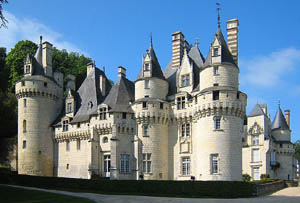
Château d'Ussé, Loire Valley, France
Château de Villandry, Loire Valley, France
Chenonceau, Loire Valley, France
Castles of Ludwig II of Bavaria
Ludwig Friedrich Wilhelm; Ludwig II of Bavaria, was king of Bavaria from 1864 until shortly before his death in 1886. He is sometimes locally referred to as Unser Kini, which means "our darling king" in Bavarian. der Märchenkönig (the Fairy tale King) in High German and as the Swan King in English.
Ludwig is sometimes also referred to as "Mad King Ludwig". He was certainly eccentric, but there is some doubt as to whether he was really mad (Ludwig was deposed on grounds of mental illness without any medical examination, and died a day later under mysterious circumstances)
King Ludwig is still revered by many in Bavaria today as his legacy of grandiose castle building realises massive tourist revenue. He commissioned the construction of several extravagant fantasy castles and was a devoted patron of the composer Richard Wagner.
Ludwig avoided formal social events whenever possible, and preferred a life of fantasy that he pursued with various creative projects. These idiosyncrasies caused tension with the king's government ministers, but not with common Bavarians. The king enjoyed traveling in the Bavarian countryside and chatting with farmers and labourers he met along the way. He also delighted in rewarding those who were hospitable to him during his travels with lavish gifts.
Ludwig used his personal fortune to fund the construction of a series of elaborate castles. In 1861 he visited Viollet-le-Duc's work at Pierrefonds, in France, which influenced the style of their construction.
In 1868, Ludwig commissioned the first drawings for two of his buildings. The first was Schloss Neuschwanstein, or "New Swanstone Castle", a dramatic Romanesque fortress with soaring fairy-tale towers. The second was Herrenchiemsee, a replica of the central section of the palace at Versailles, France, Herrenchiemsee which was to be sited on the Herren Island in the middle of the Chiemsee Lake, was meant to outdo its predecessor in scale and opulence.
The following year, he finished the construction of the royal apartment in the Residenz Palace in Munich, which was followed three years later by the addition of an opulent conservatory or Winter Garden on the palace roof. It featured an ornamental lake with gardens and painted frescoes, and was roofed over using a technically advanced metal and glass construction.
In 1869, Ludwig oversaw the laying of the cornerstone for Schloss Neuschwanstein on a breathtaking mountaintop site overlooking his childhood home, the castle his father had built at Hohenschwangau. The walls of Neuschwanstein are decorated with frescoes depicting scenes from many of Wagner's operas.
In 1872, he began construction for a special festival theatre dedicated to the works of Richard Wagner, in the town of Bayreuth. A few years later, he watched early versions of Wagner’s Ring Cycle operas there, though he avoided the public performances.
In 1878, construction was completed on Ludwig’s Schloss Linderhof, an ornate palace in neo-French Rococo style, with handsome formal gardens. The grounds contained a Venus grotto lit by electricity, where opera singers performed while Ludwig was rowed in a boat shaped like a shell. In the grounds a romantic woodsman's hut was also built around an artificial tree. The hut, referred to as Hundings Hut, is a reference to a similar structure in der Ring des Niebelungen. There is a sword embedded in the tree. In Walküre, Siegfried's father Siegmund, pulls the sword from the tree. Also in 1878, construction began on his Versailles-derived Herrenchiemsee.
In the 1880s, Ludwig’s plans proceeded undimmed. He planned construction of a new castle on the Falkenstein near Pfronten in the Allgäu (based on the tower of St Mary's Church, Baldock), a Byzantine palace in the Graswangtal and a Chinese summer palace in Tyrol. By 1885, demolition for the beginning of the Falkenstein project was underway, and the road to the site had been graded.
On 13 June 1886 Luwig's castle building career came to an abrupt end. Around6 pm, Ludwig asked a friend to accompany him on a walk along the shore of Lake Starnberg. The friend agreed, and told the guards not to follow them. The two men never returned. At 11:30 that night, searchers found both the king and his friend dead, floating in the shallow water near the shore.
Neuschwanstein Castle, Bavaria in the Clouds
Neuschwanstein Castle, Bavaria on a clear day
Neuschwanstein interior
linderhof Palace , Bavaria
Neo-Gothic Castles
Gothic architecture belonged to the Medieval period, but examples date from later periods. In 1663 a Gothic hammerbeam roof was built at the Archbishop of Canterbury's London residence, Lambeth Palace. It replaced one destroyed during the English Civil War. Also in the late 17th century, Gothic details appeared on new construction at Oxford and Cambridge, notably on Tom Tower at Christ Church, Oxford, by Christopher Wren. It is not obvious whether these instances were Gothic survival or early appearances of Gothic revival.
In England in the mid-18th century, the Gothic style was more widely revived, first as a decorative, whimsical alternative to Rococo that is still conventionally termed 'Gothick', of which Horace Walpole's Twickenham villa "Strawberry Hill" is the most famous example.
A preference for neo Gothic architecture affected church buildings even more than secular buildings. In England, partly in response to a philosophy propounded by the Oxford Movement and others associated with the emerging revival of 'high church' or Anglo-Catholic ideas during the second quarter of the nineteenth century, neo-Gothic began to become promoted by influential establishment figures as the preferred style for ecclesiastical, civic and institutional architecture. The appeal of this Gothic revival gradually widened to encompass "low church" as well as "high church" clients. This period of more universal appeal, spanning 1855-1885, is known in Britain as High Victorian Gothic.
The Houses of Parliament in London by Sir Charles Barry with interiors by a major exponent of the early Gothic Revival, Augustus Welby Pugin, is an example of the Gothic revival style from its earlier period in the second quarter of the 19th century. Built to designs. Examples from the High Victorian Gothic period include Sir George Gilbert Scott's design for the Albert Memorial in London, and William Butterfield's chapel at Keble College, Oxford.
From the second half of the nineteenth century onwards it became more common in Britain for neo-Gothic to be used in the design of non-ecclesiastical and non-governmental buildings types. Gothic details even began to appear in working-class housing schemes subsidised by philanthropy, though due to the expense, less frequently than in the design of upper and middle-class housing.
In France, simultaneously, the towering figure of the Gothic Revival was Eugène Viollet-le-Duc, who outdid historical Gothic constructions to create a Gothic as it ought to have been, notably at the fortified city of Carcassonne in the south of France and in some richly fortified keeps for industrial magnates.
Viollet-le-Duc compiled and coordinated an Encyclopédie médiévale that was a rich repertory his contemporaries mined for architectural details. He effected vigorous restoration of crumbling detail of French cathedrals, including the Abbey of Saint-Denis and famously at Notre Dame, where many of whose most "Gothic" gargoyles are Viollet-le-Duc's. He taught a generation of reform-Gothic designers and showed how to apply Gothic style to modern structural materials.
In Germany, the great cathedrals of Cologne and Ulm, left unfinished for 600 years, were brought to completion, while in Italy, Florence Cathedral finally received its polychrome Gothic façade. New churches in the Gothic style were created all over the world, including Mexico, Argentina, Japan, Thailand, India, Australia, New Zealand, Hawaii and South Africa.
As in Europe, the United States, Canada, Australia and New Zealand utilised Neo-Gothic for the building of universities, a fine example being Sydney University by Edmund Blacket. In Canada, the Canadian Parliament Buildings in Ottawa designed by Thomas Fuller and Chilion Jones with its huge centrally placed tower draws influence from Flemish Gothic buildings.
Although falling out of favour for domestic and civic use, Gothic for churches and universities continued into the 20th century with buildings such as Liverpool Cathedral, the Cathedral of Saint John the Divine, New York and São Paulo Cathedral, Brazil. The Gothic style was also applied to iron-framed city skyscapers such as Cass Gilbert's Woolworth Building and Raymond Hood's Tribune Tower.
Post-Modernism in the late 20th and early 21st centuries has seen some revival of Gothic forms in individual buildings, such as the Gare do Oriente in Lisbon, Portugal and a finishing of the Cathedral of Our Lady of Guadalupe in Mexico.
Cholmondeley Castle (pronounced Chumly) is a mansion house in the parish of Cholmondeley, Cheshire, England, built between 1801 and 1804
The Palace of Westminster, London, England
The Old Louisiana State Capitol is a building in Baton Rouge, Louisiana, United States
Hohenschwangau Castle, the older neighbour of Neuschwanstein Castle, a bavarian example of Windsor Gothic Revival in Germany
Scots Baronial Castles
Scots Baronial castles are not castles belong to Scottish barons, but imitation castles built in the "Scots Baronial" style.
The Scots Baronial style is part of the Gothic revival in architectural styles, drawing on stylistic elements and forms from castles, tower houses and mansions of the Renaissance period in Scotland, such as Craigievar Castle and Newark Castle, Port Glasgow.
The revival style was popular from the early 19th century until World War I. One of the earliest examples of Scottish Baronial style was Abbotsford House, the residence the famous novelist and poet, Sir Walter Scott, built for himself on the Tweed River in the Scottish Border Country.
Buildings of the style frequently feature towers adorned by small turrets. Roof lines are uneven, their crenulated battlements often broken by stepped gables. While small lancet windows may appear in towers and gables, large bay windows of plate glass were not uncommon, but even these would often have their individual roofs adorned by pinnacles and crenellations.
Porches, porticos and porte-cocheres, were often given the full castle treatment, an imitation portcullis on the larger houses would occasionally be suspended above a front door, flanked by heraldic beasts and other medieval architectural motifs.
This architectural style was also employed for public buildings, such as Aberdeen Grammar School. It was by no means confined to Scotland and is a fusion of the Gothic revival castle architecture first employed by Horace Walpole for his Twickenham villa, Strawberry Hill, and the ancient Scottish defensive tower houses.
In the 19th century it became fashionable for private houses to be built with small turrets and dubbed in Scottish Baronial style. In fact the architecture often had little in common with tower houses, which retained their defensive functions and fell short of 19th century ideas of comfort.
Balmoral Castle shows the final Victorian embodiment of the style. A principal keep similar to Craigievar is the heart of the castle, while a large turreted country house is attached
In Ireland a young English architect of the York School of Architecture, George Fowler Jones, designed Castle Oliver, a 110 room mansion of approx 29,000 sq ft (2,700 m2), built in a similar pink sandstone to Belfast Castle. Castle Oliver had all the classic hallmarks of the style, including battlements, porte-cochere, crow-stepped gables, numerous turrets, arrow slits, spiral stone staircases, and conical 'witch's hat' roofs.
In New Zealand it was advocated by the architect Robert Lawson who designed frequently in this style most notably at Larnach Castle in Dunedin. Other examples in New Zealand include works by Francis Petre. In Toronto Casa Loma was built on a hilltop site, 1911 – 14, for Sir Henry Pellatt, a prominent financier and industrialist. His architect, E. J. Lennox, provided him with battlements and towers, tempered by modern plumbing and other conveniences. Another Canadian example is the Banff Springs Hotel in the Banff National Park in Alberta, Canada. This hotel is still very much in use.
The style was popular in Scotland and was applied to many relatively modest dwellings by architects such as Edward Calvert. Several real Scottish castles were rebuilt in the Scottish Baronial style.
During the 19th century it became fashionable for the aristocracy to leave London to visit Scotland during the month of August for the shooting, and many aristocrats favoured this style for the shooting and sporting estates they created at this time in Scotland, often building "castles" of immense proportions such as Skibo Castle and Balmoral Castle.
The 20th-century Scottish Baronial castles have had the reputation of architectural follies. Among most patrons and architects the style fell from favour along with the Gothic revival in the early years of the 20th century.
Balmoral Castle, Scotland
Balmoral Castle, Scotland with classic scots baronial tower
Skibo Castle, Scotland
Follies
A folly is a building constructed primarily for decoration, but either suggesting by its appearance some other purpose, or so extravagant that it transcends the normal range of garden ornaments or other class of building to which it belongs.
In the original use of the word, these buildings had no other use, but from the 19-20th centuries the term was also applied to highly decorative buildings which had secondary practical functions.
In the 18th century English gardens and French landscape gardening often featured Roman temples, which symbolized classical virtues or ideals. Other 18th century garden follies represented Chinese temples, Egyptian pyramids, ruined abbeys, or Tatar tents, to represent different continents or historical eras. Sometimes they represented rustic villages, mills and cottages, to symbolize rural virtues.
The concept of the folly is ambiguous, but they generally have the following properties:
They are buildings, or parts of buildings. Thus they are distinguished from other garden ornaments such as sculpture.
They have no purpose other than as an ornament. Often they have some of the appearance of a building constructed for a particular purpose, but this appearance is a sham.
They are purpose-built. Follies are deliberately built as ornaments.
They are often eccentric in design or construction. This is not strictly necessary; however, it is common for these structures to call attention to themselves through unusual details or form.
There is often an element of fakery in their construction. The canonical example of this is the sham ruin: a folly which pretends to be the remains of an old building but which was in fact constructed in that state.
Follies began as decorative accents on the great estates of the late 16th and early 17th centuries but they flourished especially in the two centuries which followed. Many estates had ruins of monastic houses and (in Italy) Roman villas; others, lacking such buildings, constructed their own sham versions of these romantic structures. Apart from their decorative aspect, many follies originally had a use which was lost later, such as hunting towers.
Follies (French: fabriques) were an important feature of the English garden and French landscape garden in the 18th century, such as Stowe and Stourhead in England and Ermenonville and the gardens of Versailles in France. They were usually in the form of Roman temples, ruined Gothic abbeys, or Egyptian pyramids.
Painshill Park in Surrey contained almost a full set, with a large Gothic tower and various other Gothic buildings, a Roman temple, a hermit's retreat with resident hermit, a Turkish tent, a shell-encrusted water grotto, among other features. In France they sometimes took the form of romantic farmhouses, mills and cottages, as in Marie Antoinette's Hameau de la Reine at Versailles.
Sometimes they were copied from landscape paintings by painters such as Claude Lorrain and Hubert Robert. Often they had symbolic importance, illustrating the virtues of ancient Rome, or the virtues of country life. The temple of philosophy at Ermenonville, left unfinished, symbolized that knowledge would never be complete, while the temple of modern virtues at Stowe was deliberately ruined, to show the decay of contemporary morals.
Later in the 18th century, the follies became more exotic, representing other parts of the world- they included Chinese pagodas, Japanese bridges, and Tatar tents.
The Irish Potato Famine of 1845-49 led to the building of several follies. Society held that reward without labour was misguided. However, to hire the needy for work on useful projects would deprive existing workers of their jobs. The obvious solution was, construction projects termed "famine follies". These include: roads in the middle of nowhere, between two seemingly random points; screen and estate walls; piers in the middle of bogs, and so on.
Brighton Pavilion, Brighton, East Sussex, England - not strictly a folly as it was built as a working palace
Wimpole's Folly, Cambridgeshire, England, built in the 1700s to resemble Gothic-era ruins
Marie Antoinette's idyllic "hameau de la reine" at Versailles, France
Rushton Triangular Lodge, Northamptonshire, England, built in the late 16th century
Palaces
A palace is a grand residence, especially a royal residence or the home of a head of state or Church dignitary, such as a bishop, archbishop cardinal or Pope.
In parts of Europe, the term is also applied large urban buildings built as the private mansions of the aristocracy. Many historic palaces are now put to other uses such as parliaments, museums, hotels or office buildings.
The word palace comes from Old French palais (imperial residence), from Latin Palātium, the name of one of the seven hills of Rome. The original palaces on the Palatine Hill were the seat of the imperial power, while the capitol on the Capitoline Hill was the seat of the senate and the religious nucleus of Rome. Long after the city grew to the seven hills the Palatine remained a desirable residential area.
In France there has been a clear distinction between a château and a palais. The palace has always been urban, like the Palais de la Cité in Paris, which was the royal palace of France and is now the supreme court of justice of France, or the palace of the Popes at Avignon.
Château, by contrast, have always been in rural settings, supported by their demesnes, even when they were no longer actually fortified. Speakers of English think of the " Palace of Versailles" because it was the residence of the king of France, and the king was the source of power, though the building has always remained the Château de Versailles for the French, and the seat of government under the Ancien Régime remained the Palais du Louvre. The Louvre had begun as a fortified Château du Louvre on the edge of Paris, but as the seat of government and shorn of its fortified architecture and then completely surrounded by the city, it developed into the Palais du Louvre.
The townhouses of the aristocracy were also palais, although only if fairly grand - the entry level being set rather higher than in Italy. The Hôtel particulier was the term for less grandiose residences. Bishops always had a palais in the town, but their country homes were châteaux.
The usage is essentially the same in Spain and Portugal, as well as the former Austrian Empire. In Germany, the wider term was a relatively recent importation, and was used rather more restrictively.
In Italy, any urban building built as a grand residence is a palazzo; these are often no larger than a Victorian townhouse. It was not necessary to be a nobleman to have your house considered a palazzo; the hundreds of palazzi in Venice belonged to the patrician class of the city. . Each family's palazzo was a hive that contained all the family members, though it might not always show a grand architectural public front. In the 20th century palazzo in Italian came to apply by extension to any large fine apartment building, as so many old palazzi were converted to this use.
In the United Kingdom, there have been no "palaces" other than those used as official residences by royalty and bishops, regardless of whether located in town or country. Thus the Palace of Beaulieu gained its name when Thomas Boleyn sold it to Henry VIII in 1517; previously it had been known as Walkfares. Like several other palaces, the name stuck even once the royal connection ended. Blenheim Palace was built in the grounds of the disused royal Palace of Woodstock, and the name was also part of the extraordinary honour when the house was given by a grateful nation to a great general.
India has had, and still has, a large amount of palaces. While most monuments of the ancient period have been destroyed or lie in ruins, some medieval buildings have been maintained well or restored to good condition. Several medieval forts and palaces still stand proud all over India. While some royal palaces have been maintained as museums or hotels over the last decades, some palaces are still home for the members of the erstwhile royal families. These forts and palaces are the largest illustrations and legacy of the princely states of India.
Rajasthan has a large number of forts and palaces that are major tourist destinations in North India. The Rajputs were known as great soldiers. The most famous forts and palaces in Rajasthan are located in Chittor, Jodhpur, Jaipur, Udaipur , Jaisalmir, Amber and Nahargarh.
Buckingham Palace in London, England- a palace by virtue of being a royal residence.
Lambeth Palace, Lambeth, London, England - a palace by virtue of being an archbishop's residence
The Doge's Palace in Venice, Italy
The Palace of the Maharaja of Mysore , Mysore, India
Stately Homes (Châteaux)
Stately Homes
A stately home is one of about 500 large properties built in the British Isles between the mid-16th century and the early part of the 20th century, as well as converted abbeys and other church property after the Dissolution of the Monasteries. These country houses are usually distinguished from true "castles", being of later date, and having been built purely as residences. These houses were a status symbol for the great families of England, who competed with each other to provide hospitality for members of the royal household.
Famous architects and landscape architects such as Robert Adam, Sir Charles Barry, Sir Edwin Lutyens, Sir John Vanbrugh, Capability Brown and Humphry Repton were employed to incorporate new styles into the buildings. Great art and furniture collections were built up and displayed in the houses.
The agricultural collapse towards the end of the 19th century, the First World War and then World War II changed the fortunes of many houses and their owners, and now they remain as a curious mix of living museums, part-ruined houses and castles and grand family estates.
Many stately homes are owned and managed by private individuals or by trusts. The costs of running a stately home are legendarily high. Many owners rent out their homes for use as film and television sets as a means of extra income, thus many of them are familiar sights to people who have never visited them in person. The grounds often contain other tourist attractions, such as safari parks, funfairs or museums.
The phrase stately home is a quotation from the poem The Homes of England, which was originally published in Blackwood's Magazine in 1827 is by Felicia Hemans.
Owners do not usually use the phrase "stately home", a term only ever adopted by estate agents, nouveaux riches and parodists.
Country Houses
The English country house is a large house or mansion, once in the ownership of an individual who also usually owned another great house in town allowing them to spend time in the country and in the city.
Country houses and stately homes are sometimes confused—while a country house is always in the country, a stately home can also be in a town. Apsley House, built for the Duke of Wellington at the corner of Hyde Park (No. 1, London), is one example. Other country houses such as Ascott in Buckinghamshire were deliberately designed not to be stately, and to harmonise with the landscape, while some of the great houses such as Kedleston Hall and Holkham Hall were built as "power houses" to impress and dominate the landscape, and were certainly intended to be "stately homes". Today many former stately homes, while still country houses, are far from stately and most certainly not homes.
The country house was not only a weekend retreat for aristocrats, but also often a full time residence for the minor gentry who were a central node in the so-called squirearchy that ruled Britain until the Reform Act 1832
Country houses of England have evolved over the last 500 years. Before this time larger houses were more often than not fortified, reflecting the position of their owners as feudal lords. The Tudor period of stability in the country saw the first of the large unfortified mansions. Henry VIII's policy of the Dissolution of the Monasteries resulted in many former ecclesiastical properties turned over to the King's favourites, who then converted them into private country houses. Woburn Abbey, Forde Abbey and many other mansions with Abbey or Priory in their name often date from this period as private houses.
It was during the later half of the reign of Elizabeth I and her successor James I that the first architect designed mansions, thought of today as epitomising the English country house, and began to make their appearance. Burghley House, Longleat House, and Hatfield House are perhaps amongst the most well known. Hatfield House was one of the first houses in England to show the Italianate influences of the renaissance, which was eventually to see the end of the hinting-at-castle-architecture "turrets and towers" Gothic style.
By the reign of Charles I, Inigo Jones and his form of Palladianism had changed the face of British domestic architecture completely. While there were later various Gothic Revival styles, the Palladian style in various forms, interrupted briefly by baroque, was to predominate until the second half of the 18th century when, influenced by ancient Greek styles, it gradually evolved into the neoclassicism championed by such architects as Robert Adam.
Some of the best known of England's country houses tend to have been built by one architect at one particular time: Montacute House, Chatsworth House, and Blenheim Palace are examples.
However, the vast majority of the lesser-known English country houses, often owned by both gentry and aristocracy, are an evolution of one or more styles with facades and wings in various styles in a mixture of high architecture, often as interpreted by a local architect or surveyor and determined by practicality as much as the whims of architectural taste. An example is Brympton d'Evercy in Somerset, a house of many periods that is unified architecturally by the continuing use of the same mellow local Ham Hill stone.
The fashionable William Kent redesigned Rousham House only to have it quickly and drastically altered to accommodate space for the owner's twelve children. Canons Ashby, home to poet John Dryden's family, exemplifies this: a medieval farmhouse enlarged in the Tudor era around a courtyard, given grandiose plaster ceilings in the Stewart period and then given Georgian facades in the 18th century. The whole is a glorious mismatch of styles and fashions which seamlessly blend together—this could be called the true English country house. Wilton House, one of England's grandest houses, is in a remarkably similar vein; although, while the Drydens, mere squires, at Canons Ashby employed a local architect, at Wilton the mighty Earls of Pembroke employed the finest architects of the day: first Holbein, 150 years later Inigo Jones, and then Wyatt followed by Chambers. Each employed a different style of architecture, seemingly unaware of the design of the wing around the next corner. These varying "improvements", often criticised at the time, today are the qualities which make English country houses unique. Scarcely anywhere else in the world would an elite class have allowed such an indifference to style.
For the highest echelons of British society during the 18th and 19th centuries the country house served as a place for relaxing, hunting at the end of the week, with some houses having their own theatre where performances were held. For local squires their country house was their only residence. They lived lived permanently on their country estates, seldom visiting London at all. The country house was the centre of its own world, providing employment to literally hundreds of people in the vicinity of its estate.
In previous eras before state benefits were introduced, those working on an Country House estate were among the most fortunate, receiving secured employment and rent-free accommodation. At the summit of these fortunate people was the indoor staff of the country house. Until the 20th century, unlike many of their contemporaries, they slept in proper beds, wore well-made adequate clothes and received three proper meals a day, plus a small wage.
Many aristocrats owned more than one country house and would visit each according to the season: Grouse shooting in Scotland, pheasant shooting and fox hunting in England. The Earl of Rosebery, for instance, had Dalmeny House in Scotland, Mentmore Towers in Buckinghamshire and another near Epsom just for the racing season. The largest country house in England is Blenheim Palace, compared with Hopetoun House in Scotland, Castletown House in Ireland and possibly Penrhyn Castle, Chirk Castle, Erddig or Glynllifon in Wales.
The slow decline of the English country house coincided with the rise of modern industry, which provided alternative employment for large numbers of people and contributed to upwardly mobile middle classes, but its ultimate demise began immediately following World War I. The huge staff required to maintain them had either left to fight and never returned, departed to work in the munitions factories, or to fulfil the void left by the fighting men in other workplaces. Of those who returned with the cessation of war, many left the countryside for better-paid jobs in towns.
The final blow for many country houses came following World War II; having been requisitioned during the war, they were returned to the owners in poor repair. Many had lost their heirs in one or other of the World Wars. Owners who survived were required to pay penal rates of tax. Agricultural incomes from the accompanying estates had dropped. The solution was to hold contents auctions and then demolish the house and sell its stone, fireplaces, and panelling. And this is what happened to many of Britain's finest houses.
Today in Britain, country houses provide for a variety of needs. Many are owned by public bodies such as Kedleston Hall, Knole House, Lyme Park, Montacute House, Petworth House, West Wycombe Park and Waddesdon Manor. Others are owned by the National Trust. Brodsworth Hall, Kenwood House & Osborne House are owned by English Heritage and are open to the public as museums as part of the so-called "Stately home industry".
Some, including Wilton House and Chatsworth House, and many smaller houses such as Pencarrow in Cornwall and Rousham House in Oxfordshire are still owned by the families who built them, retain their treasures and are open during summer months to the public. Fewer still are owned by the original families and are not open to the public: Compton Wynyates is one. Easton Neston in Northamptonshire, one of the last of the architecturally important country houses never to have been opened to public viewing, was sold in 2005 for £15 million by Lord Hesketh.
The majority have become schools, hospitals, museums and prisons. Some, for example, Cliveden, Coworth House, Hartwell House, Peckforton Castle & Taymouth Castle, have become luxury hotels.
Examples used as schools or other educational uses include Ashridge House, Bramshill House, Dartington Hall, Harlaxton Manor, Heslington Hall, Prior Park, Scarisbrick Hall, Stowe House, Tring Park & Westonbirt House. Hewell Grange is now an open prison. Compton Verney is now an art gallery, Cusworth Hall is now the museum of South Yorkshire Life, Duff House & Paxton House are outstations of the National Gallery of Scotland, Temple Newsam House is a museum of the decorative arts, St Fagans National History Museum is based in and around St Fagans Castle, Wollaton Hall is now a natural history museum.
The National Portrait Gallery ( London) has several outstations at country houses: Montacute House is partially used to display Elizabethan and Jacobean portraits; Beningbrough Hall is used to display 18th-century portraits and Bodrhyddan Hall displays 19th-century portraits. Alton Towers has become an amusement park. Knebworth House stages rock concerts in the park. Glyndebourne has an opera house attached. Port Lympne is now a zoo, several houses also have Safari parks in the grounds: Knowsley Hall (The house has never been open to the public), Longleat & Woburn Abbey. Clouds House is used as a centre for treating alcoholics and drug addicts.
Moor Park is a golf club-house. Halton House is used by the Royal Air Force and Minley Manor is used by the army. Another common use of country houses is to convert them for multiple occupation Kinmel Hall, New Wardour Castle, Sheffield Park House & Stoneleigh Abbey whose former park Stoneleigh Park is used for exhibitions and agricultural shows. Culzean Castle, Margam Castle & Tatton Hall are at the centre of country parks. Goodwood House is a centre of both horse & motor racing. Ince Blundell Hall is now a nunnery. Toddington Manor is being convert into an art gallery and home by Damien Hirst.
Many houses are now in the ownership of Local government and operated as country house museums including Ashton Court, Aston Hall being the first to be so owned from 1864, Cardiff Castle, Heaton Hall & Tredegar House. Ditchley is owned and used for conferences by the Ditchley Foundation. Some houses have survived as conserved ruins: Kirby Hall, Lowther Castle & Witley Court. These are among the fortunate few. In Britain during the 1920s to the early 1960s, thousands of country houses were demolished including East Cowes Castle, Hamilton Palace & Nuthall Temple.
Usually listed as a building of historic interest, country houses can only be maintained under Government supervision, often interpreted by the owners as interference as the most faithful, most accurate, and most precise restoration and recreation is also usually the most expensive and the one Government inspectors insist upon. This system does, however, ensure that all work is correctly and authentically done. The negative side is that many owners cannot afford the work, so a roof remains leaking for the sake of a cheap roof tile.
Although the ownership or management of some houses has been transferred to a private trust such as Blair Castle, Burghley House, Grimsthorpe Castle and Hopetoun House. Other houses have transferred art works and furnishings under the Acceptance in Lieu scheme to ownership by various national or local museums, but are retained for display in the building. This enables the former owners to offset tax, the payment of which would otherwise have necessitated the sale of the art works, for example tapestries and furniture at Houghton Hall are now owned by the Victoria and Albert Museum.
Increasing numbers of country houses hold licenses for weddings and civil ceremonies. Another source of income is use as a film location, many of the houses listed on the page have been used for this purpose. Many of the larger houses are available for hire for Corporate entertainment. Another source of revenue is using houses for Murder mystery games.
Burghley House,, Lincolnshire, England
Chatsworth, Derbyshire, England
Longleat, England
Woburn Abbey, England
Castle Howard, England
Blenheim Palace, England
Badminton House, England
Highclere Castle is a country house in high Elizabethan style, with park designed by Capability Brown, in Hampshire, England.
Knebworth House in the parish of Knebworth in Hertfordshire, England.
Osborne House is a former royal residence in East Cowes, Isle of Wight, England. The house was built between 1845 and 1851 for Queen Victoria and Prince Albert
Belvoir Castle in the county of Leicestershire, England
Balmoral Castle, a large estate house situated in the area of Aberdeenshire, Scotland,
Longleat, England
Deer at Woburn Abbey, England
Grimsthorpe Castle, England
Fortified Houses
In the middle ages all but the most humble houses needed some form of defence. A whole spectrum existed between at one end a stout bolted door to at the other a moated castle. A common form of defence was a simple tower house - a stone house built high enough and with any windows high enough to make it difficult to attack without mounting a full siege.
Tower Houses
A tower house is a type of stone structure, built for defensive purposes as well as habitation
Tower houses appeared since the Middle Ages, especially in mountain or limited access areas, in order to command and defend strategic points with reduced forces. At the same time, they were also used as a noble's residence, around which a borough was often constructed.
After their initial appearance in Ireland, Scotland, Basque Country, Languedoc and England during the High Middle Ages, tower houses were also built in other parts of western Europe as early as the late 14th century, especially in parts of France and Italy. In Italian medieval communes, tower houses were increasingly built by the local barons as powerhouses during the inner strifes.
Tower houses are very commonly found in northern Spain, especially in the Basque Country, some of them dating back to the 8th century. They were mainly used as noble residences able to provide shelter against enemies, starting with the Visigoths, the Arabs and then petty medieval wars. Due to complex legal charters, not many of them had boroughs attached to them, and that is why they are usually found standing alone in some defensive spot, not typically a high position but a crossroad. Some of them survived well into the modern era, being even used as country residences by their traditional noble owners.
Tower houses appeared in Britain and Ireland starting from the High Middle Ages. Such buildings were constructed in the wilder parts of Britain and Ireland, particularly in Scotland, and throughout Ireland, until at least up to the 17th century. The remains of such structures are dotted around the Irish and Scottish countryside, with a particular concentration in the Scottish Borders where they include peel towers and bastle houses. Some are still intact and even inhabited today, while others stand as ruined shells.
Tower houses are often called castles, and despite their characteristic compact footprint size, they are formidable habitations and there is no clear distinction between a castle and a tower house. In Scotland a classification system has been widely accepted based on ground plan, such as the L Plan Castle style.
The few surviving round Scottish Iron Age towers known as brochs are often compared to tower houses, having mural passages and a basebatter, (a thickening of the wall that slopes obliquely, intended to prevent the use of a battering ram) although the entrances to Brochs are far less ostentatious.
In Ireland, there are well over 2,000 tower houses extant and some estimate that there were as many as 8,000 built during the Middle Ages. The construction of the majority of tower houses is thought to have commenced in the early 15th century AD and lasted until the mid-seventeenth century. After 1580 many lords built fortified houses and stronghouses although tower houses continued to be built until the guns of the Cromwellians rendered such private defenses more or less obsolete.
Tower Houses in Ireland were built mainly by the Catholic Anglo-Irish but also by the Gaelic Irish and more recent Protestant and Presbyterian settlers. Many of these structures were positioned within sight of each other and a system of visual communication is said to have been established between them, based on line of sight from the uppermost levels, although this may simply be a result of their high density. County Kilkenny has several examples of this arrangement such as Ballyshawnmore and Neigham. County Clare, although outside English control, is known to have had approximately 230 tower houses in the 17th century.. The Irish tower house was used for both defensive and residential reasons, with many chiefly families building tower houses during the 15th and 16th centuries on their demesne lands in order to assert status and provide a residence for the senior lineage of the family.
Photograph of a Peel Tower - The Tower of Hallbar in South Lanarkshire, Scotland.
Turin Tower, County Mayo, Ireland
Peel Towers or Pele Towers
Peel towers (also spelt pele) are small fortified keeps or tower houses, built along the English and Scottish borders in the Scottish Marches and North of England, intended as watch towers where signal fires could be lit by the garrison to warn of approaching danger.
By an Act of Parliament in 1455 each of these towers was required to have an iron basket on its summit and a smoke or fire signal, for day or night use, ready at hand.
A line of these towers was built in the 1430s across the Tweed valley from Berwick to its source, as a response to the dangers of invasion from the Marches. Others were built in Cumberland, Westmorland and Northumberland, and as far south as Lancashire, in response to the threat of attack from the Scots and the Border Reivers of both nationalities.
Apart from their primary purpose as a warning system, these towers were also the homes of the Lairds and landlords of the area, who dwelt in them with their families and retainers, while their followers lived in simple huts outside the walls.
The towers also provide a refuge so that, when cross-border raiding parties arrived, the whole population of a village could take to the tower and wait for the marauders to depart.
In the upper Tweed valley, going downstream from its source, they were as follows: Fruid, Hawkshaw, Oliver, Polmood, Kingledoors, Mossfennan, Wrae Tower, Quarter, Stanhope, Drumelzier, Tinnies, Dreva, Stobo, Dawyck, Easter Happrew, Lyne, Barnes, Caverhill, Neidpath, Peebles, Horsburgh, Nether Horsburgh Castle, Cardrona.
Peel towers are not usually found in larger places which have a castle, but in smaller settlements. They are often associated with a church: for example Embleton Tower in Embleton, Northumberland is an example of a so-called vicar's pele and the one at Hulne Priory is in the grounds of the priory. Hawkshaw, ancestral home of the Porteous family at Tweedsmuir in Peeblesshire, a peel tower dating from at least 1439, no longer stands but its site is marked by a cairn.
Some towers are derelict. Others have been converted for use in peacetime; Embleton Tower is now part of the (former) vicarage and that on the Inner Farne is a home to bird wardens. The most obvious conversion needs will include access, which was originally difficult, and the provision of more and larger windows.
Illustration of a Peel Tower
Bastle Houses
Bastle houses is a type on construction found along the Anglo-Scottish border, in the areas formerly plagued by border Reivers. They are farmhouses, characterised by elaborate security measures against raids. Their name is said to derive from the French word "bastille".
The characteristics of the classic bastle house are extremely thick stone walls (1 meter or so), with the ground floor devoted to stable-space for the most valuable animals, and usually a stone vault between it and the first floor. The family's living quarters were on the floor above the ground, and during the times prior to the suppression of the reivers, were only reachable by a ladder which was pulled up from the inside at night. The only windows were narrow arrow slits. The roofs were usually made of stone slate to improve the bastle's fire-resistance.
Bastle houses have many characteristics in common with military blockhouses, the main difference being that a bastle was intended primarily as a family dwelling, instead of a pure fortification.
Many bastle houses survive today; their construction ensured that they would last a very long time. They may be seen on both sides of the Anglo-Scottish Border.
The Hole Bastle, near Bellingham in Northumberland, England
Irish Fortified Houses
In Ireland at the end of the sixteenth and beginning of the seventeenth century, the Fortified House, along with the stronghouse, developed as a replacement for the tower house. 'Fortified Houses' were often rectangular, or sometimes U or L-shaped, three-storey structures with high gables and chimney stacks and large windows with hood mouldings. Some examples have square towers at the corners. The interiors were relatively spacious with wooden partitions and numerous fireplaces. In a number of cases 'Fortified Houses' were built onto pre-existing tower houses. 'Fortified Houses' were protected by gun fire from the angle towers and bartizans, and were also provided with bawn walls with gunloops, towers and protected gateways. 'Fortified Houses' were built throughout Ireland by large landowners from a variety of backgrounds, such as the Old English Earl of Clanricarde who built Portumna House in County Galway; Gaelic lords such as MacDonogh MacCarthy, Lord of Duhallow, who built Kanturk Castle in County Cork; and Cromwellian soldiers such as Sir Charles Coote, who built Rush Hall in County Offaly.
Kantuk Castle in Ireland
Country Houses & Manors (Manoirs)
A manor house is a country house, which historically formed the administrative centre of a manor, the lowest unit of territorial organization in the feudal system in Europe. A manor house was the dwelling house, or "capital messuage", of a feudal lord of a manor. Legal trials or sessions of his "court baron", or manor court, were held in the Great Hall of the Manor House. The names of manor houses often reflect this, so the manor house of the manor of Moorstones would typically be called Moorstones Manor or Moorstones Hall or Moorstone Court.
A lord might posses a number of manors, each of which would typically have a manor house. So each manor house might have been occupied only on occasional visits. Sometimes a steward or seneschal was appointed by the seigneurial lord to oversee and manage his different manorial properties. The day-to-day administration was delegated to a bailiff, or reeve.
The term Manor House is sometimes applied to country houses which belonged to gentry families, even if they were never administrative centres of a manor. It is used especially for minor late medieval fortified country houses often built more for show than for defence. The primary feature of the manor-house was its great hall, to which subsidiary apartments were added as the lessening of feudal warfare permitted more peaceful domestic life.
Although not typically built with strong fortifications as castles were, many manor-houses were partly fortified: they were enclosed within walls or ditches that often included the farm buildings as well. Arranged for defence against robbers and thieves, manor houses were sometimes surrounded by a moat with a drawbridge, and equipped with gatehouses and watchtowers; but was not generally provided with a keep, large towers or curtain walls and could not withstand a long siege.
By the beginning of the 16th century, manor-houses as well as small castles began to acquire the character and amenities of the residences of country gentlemen. This late 16th century transformation produced many of the smaller Renaissance châteaux of France and the numerous country mansions of the Elizabethan and Jacobean styles in England.
In France, the terms château or manoir are often used synonymously to describe a French manor-house. More specifically a Maison-forte ("fortified-house") is a strongly fortified manor-house, which might include two sets of enclosing walls, drawbridges, and a ground-floor hall or salle basse that was used to receive peasants and commoners. The salle basse was also the location of the manor court, with the steward or seigneur's seating location often marked by the presence of a crédence de justice or wall-cupboard (shelves built into the stone walls to hold documents and books associated with administration of the demesne or droit de justice).
The salle haute or upper-hall, reserved for the seigneur and where he received his high-ranking guests, was often accessible by an external spiral staircase. It was commonly "open" up to the roof trusses, as in similar English homes. This larger and more finely decorated hall was usually located above the ground-floor hall. The seigneur and his family's private chambers were often located off of the upper first-floor hall, and invariably had their own fireplace (with finely decorated chimney-piece) and frequently at least one latrine.
In addition to having both lower and upper-halls, many French manor-houses also had partly fortified gateways, watchtowers, and enclosing walls that were fitted with arrow or gun loops for added protection. Some larger 16th-century manors, such as the Château de Kerjean in Finistère, Brittany, were even outfitted with ditches and fore-works that included gun platforms for cannons. These defensive arrangements allowed maisons-fortes, and rural manors to be safe from a coup de main perpetrated by an armed band as there was so many during the troubled times of the Hundred Years War and the wars of the Holy League; but it was difficult for them to resist a siege undertaken by a regular army equipped with siege engines.
Avebury Manor
in Avebury, near Marlborough, Wiltshire, England.
The moated manor house of Baddesley Clinton, Warwickshire, England
The Château des Rochers-Sévigné, is a Gothic manoir of the fifteenth C located near to Vitré in the Ille-et-Vilaine, France.
Bramall Hall is a Tudor manor house in Bramhall, within the Metropolitan Borough of Stockport, Greater Manchester, England.
Town Houses (Hotels Particuliars)
A townhouse is the term used in the United Kingdom, Ireland and in many other English speaking countries to describe a residence of a member of the aristocracy in the capital or major city.
Such potentates generally owned country houses in which they lived for much of the year. During the social season when major balls took place and when parliament was in session, peers and their servants moved to live in their townhouse in London.
Today the term townhouse is used in other ways, largely under the influence of tacky realtors trying to give their tacky properties an air of prestige. In many countries it is used to describe terraced housing - the connection being that some smaller town-houses were terraced.
Even the greatest potentates, often lived in terraced houses in town. For example the Duke of Norfolk owned Arundel Castle in the country, while his London house was a terraced house called Norfolk House in St. James's Square - although that particular terraced house was over 100 feet (30 metres) wide.
Many townhouses were demolished or ceased to be used for residential purposes following the First World War. The larger town houses often came into the ownership of government institutions or private clubs. In the post World War II period large terraced houses in general in London and other British cities were divided into flats or converted into offices. However, in the early 21st century this trend is being reversed to some extent, as there is less demand for old houses as offices nowadays since open plan layouts are preferred, and the number of very rich people in London has risen.
Nowadays British property developers and estate agents often call new terraced houses townhouses, probably because the aristocratic pedigree of terraced housing is widely forgotten, and for many people the main mental association of terraced housing is with working class terraced housing. "Townhouse" still has more exclusive connotations.
Famous townhouses
Bucking Palace, London - originally the townhouse of the Duke of Buckingham, and still known to Londoners as Buckingham House, not Buckingham Palace.
Bute House, Edinbugh- Former residence of the Marquis of Bute in Edinburgh's Charlotte Square, now the official residence of the First Minister of Scotland.
Somerset House. Originally built by the Duke of Somerset and laterly used for a series of government functions.
10 Downing Street, London - a georgian terraced house, the residence of the Prime Minister of the United Kingdom
11 Downing Street, London the Chancellor of the Exchequer of the United Kingdom
Spencer House, London - formerly the London residence of the Earls Spencer
Marlborough House, London - now the home of the Commonwealth Secretariat, earlier the residence of the Prince of Wales and later Queen Mary the Queen Mother (1936-1953)
Clarence House, London- the residence of the late Queen Elizabeth the Queen Mother and now the residence of Charles, Prince of Wales
Leinster House, Dublin,- residence of the Duke of Leinster ( Ireland's premier duke) and now the seat of Oireachtas Éireann, the Irish parliament.
Powerscourt House - Dublin residence of Viscount Powersourt, a prominent Irish peer. It was converted into an award-winning shopping centre in the 1980s.
Somerset House, London, England
Buckingham Palace, Still known to Londoners as Buckingham House
Leinster House , Dublin, Ireland
Downing Street, London, England
Burghley House is a grand 16th century English country house near the town of Stamford, Lincolnshire, England.