Life In A Medieval CastleMills
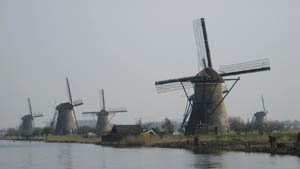
Windmills
Around the 11th-12th centuries, in England, the windmill would come into existence, conceivably by returning Christian crusaders participating in the Crusade Wars in the Middle East.
In Northern Europe, one of the earliest records of windmills were the ones in England recorded in 1185, courtesy of a rental note for a windmill in Weedly, Yorkshire. Also, in 1191, records show that a windmill in Bury St.Edmunds was constructed in defiance of the local abbot. The windmill was ultimately destroyed, as an end result.
Windmills were governed by the “miling soke” division of the manor’s charter. The windmill was the property of the lord of the manor, possessing the monopoly over the windmill. The lord was also responsible for the repairs, maintenance and amount of mills needed to meet the demands of the people.
The church also had involvement with windmills. Pope Celestine III claimed that air used by windmills belong to the church. He made the assertion that windmills must be built with the expressed consent of a papal tithe.
Tenants living on the manor were indebted to grind their corn at the lord’s mill at a fixed rate of its toll. The lord’s corn was ground free and given precedence over the rest. If the mill fell into disrepair, this would be the only reason for the lord's tenants to have their corn ground elsewhere.
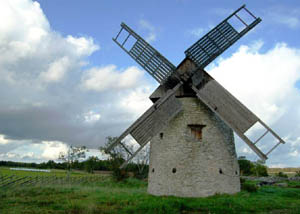
There were a few types of windmills in Europe during the 12th century. One such windmill was the vertical windmill, which made its appearance during the last quarter of the 12th century, showcased in Eastern England, Northern France and Flanders. The other was the post mill which was small and had a trestle that was poorly protected. So that means harsh weather conditions were more than enough to do damage to the post mill. With its fine and delicate structure, it was basic and among the earliest type of windmill in Europe. In order for the post mill to exist, it was prepared to rest along a vertical post. An extended lever projecting from the post mill’s rear allowed it to spin around.
 Windmills
would shortly be used as a strategic defence device against enemy
armies. They were huge in physical infrastructure, so it was possible
that it would act as a fort and tower during the Age of Castles.
Windmills
would shortly be used as a strategic defence device against enemy
armies. They were huge in physical infrastructure, so it was possible
that it would act as a fort and tower during the Age of Castles.
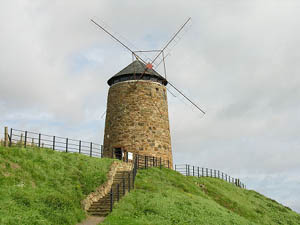
Occasionally windmills were built onto a castle tower.
In due course, as castles became a thing of the past, windmills would still see life. Thousands of windmills would show themselves along the European countryside. And even today, windmills are still used to harness the power of the wind creating power for infrastructures all over Europe.
Water Mills
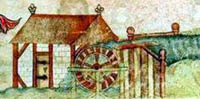
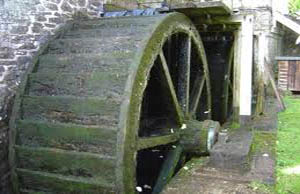
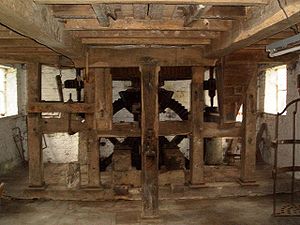
Largely unaffected from the turbulent political events following the demise of the Western Roman Empire, the importance of watermilling continued to grow under the new Germanic lords. The sharp rise in numbers of early medieval watermills coincided with the appearance of new documentary genres (legal codes, monastic charters, hagiography) which were more inclined to address such a relatively mundane device than the ancient urban-centered literary class had been. This partly explains the relative abundance of medieval literary references to watermills compared to former times.
 Nevertheless,
the quantitative growth of medieval evidence appears to be more
than a mere reflection of the changing nature of surviving sources:
by Carolingian times, references to watermills in the Frankish Realm
had become "innumerable", and at the time of the compilation
of the Domesday Book (1086), there were 5,624 watermills in England
alone, only 2% of which have not been located by modern archaeological
surveys. Later research estimates a less conservative number of
6,082, and it has been pointed out that this should be considered
a minimum as the northern reaches of England were never properly
recorded. In 1300, this number had risen to between 10,000 and 15,000.
Nevertheless,
the quantitative growth of medieval evidence appears to be more
than a mere reflection of the changing nature of surviving sources:
by Carolingian times, references to watermills in the Frankish Realm
had become "innumerable", and at the time of the compilation
of the Domesday Book (1086), there were 5,624 watermills in England
alone, only 2% of which have not been located by modern archaeological
surveys. Later research estimates a less conservative number of
6,082, and it has been pointed out that this should be considered
a minimum as the northern reaches of England were never properly
recorded. In 1300, this number had risen to between 10,000 and 15,000.
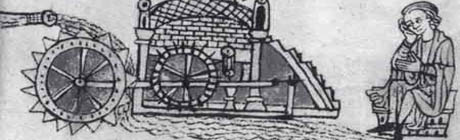
By the early 7th century, watermills were well established in Ireland, and began to spread from the former territory of the empire into the non-romanized parts of Germany a century later. The introduction of the ship mill and tide mill in the 6th century, both of which yet unattested for the ancient period, allowed for a flexible response to the changing water-level of rivers and the Atlantic Ocean, thus demonstrating the technological innovation of early medieval watermillers.

More on Life in a Medieval Castle
Introduction to Life in a Medieval Castle
- The Great Hall
- Bed Chambers
- Solars
- Bathrooms, Lavatories and Garderobes
- Kitchens, Pantries, Larders & Butteries
- Gatehouses and Guardrooms
- Chapels & Oratories
- Cabinets and Boudoirs
- Storerooms, Undercrofts & Cellars
- Ice Houses
- Dovecotes
- Apartments
Officers & Servants in a Medieval Castle
- Food Preparation
- Cereals
- Fruit
- Vegetables
- Fish and Seafood
- Meat
- Dairy Products
- Herbs and Spices
- Puddings (Sweets and Desserts)
- Food Preservation
- Influence of Church Teaching
- Healthy Eating
- Meals and Etiquette
Mills: Windmills and Water Mills